Community
Shoe Customization Software for WooCommerce Stores

Shoe customization software turns a flat product listing into a design studio: a buyer picks colors and materials, drops in text or artwork, watches the price change, and adds the finished shoe to the cart. Cmsmart's Product Designer (NBDesigner) builds that studio directly inside WooCommerce, then carries the design through checkout and into a print-ready file your production team can use the same day.

Cmsmart Ecommerce provides custom ecommerce and WooCommerce development services for web-to-print, product personalization, plugin support and API integration.

Cmsmart Product Designer Plugin Engineer
Builds and supports the Cmsmart Product Designer (NBDesigner) for WooCommerce.
Meet the team →
Top
In short
Why does custom shoe ordering still cost you carts and reprints?
Cmsmart Product Designer replaces email-based proofing with an on-page design tool, a price matrix that reacts to every option, and an AI quality check before a file reaches production — so footwear brands stop losing orders to confusion and losing margin to remakes.
Footwear brands selling "design your own" sneakers or boots run into the same problems once volume grows past a few orders a week:
None of this is unique to shoes: on average, Baymard Institute's cross-study benchmark puts online cart abandonment at 70.22% (continuously updated average across 50 studies, accessed October 2026) — and an unclear or slow customization step is exactly the kind of friction that pushes a shopper toward that number.
What would a frictionless shoe design experience look like for your buyers?
With Cmsmart Product Designer, the shopper's design, price and artwork stay attached to the item from the product page through checkout, so there is no separate proofing email and no guessing what production will receive.
Example scenario. A footwear brand lists a sneaker with swappable components — upper color, sole color, lace color, an optional monogram. A buyer opens the product page at 10 p.m., taps Design here online, picks colors from the component list, adds their initials with the text tool, and sees Your artwork saved back onto the product page next to Add to cart. The price has already adjusted for the premium sole. They check out; by the time your team logs in the next morning, the order has a print-ready file attached and an AI preflight result, waiting on a one-click approval.
That flow removes the two costliest steps above: waiting for a mockup, and manually checking whether a file is print-ready. Talk to an ecommerce expert if you want help mapping your own component list first.
How does Cmsmart's shoe customization software fit into WooCommerce?
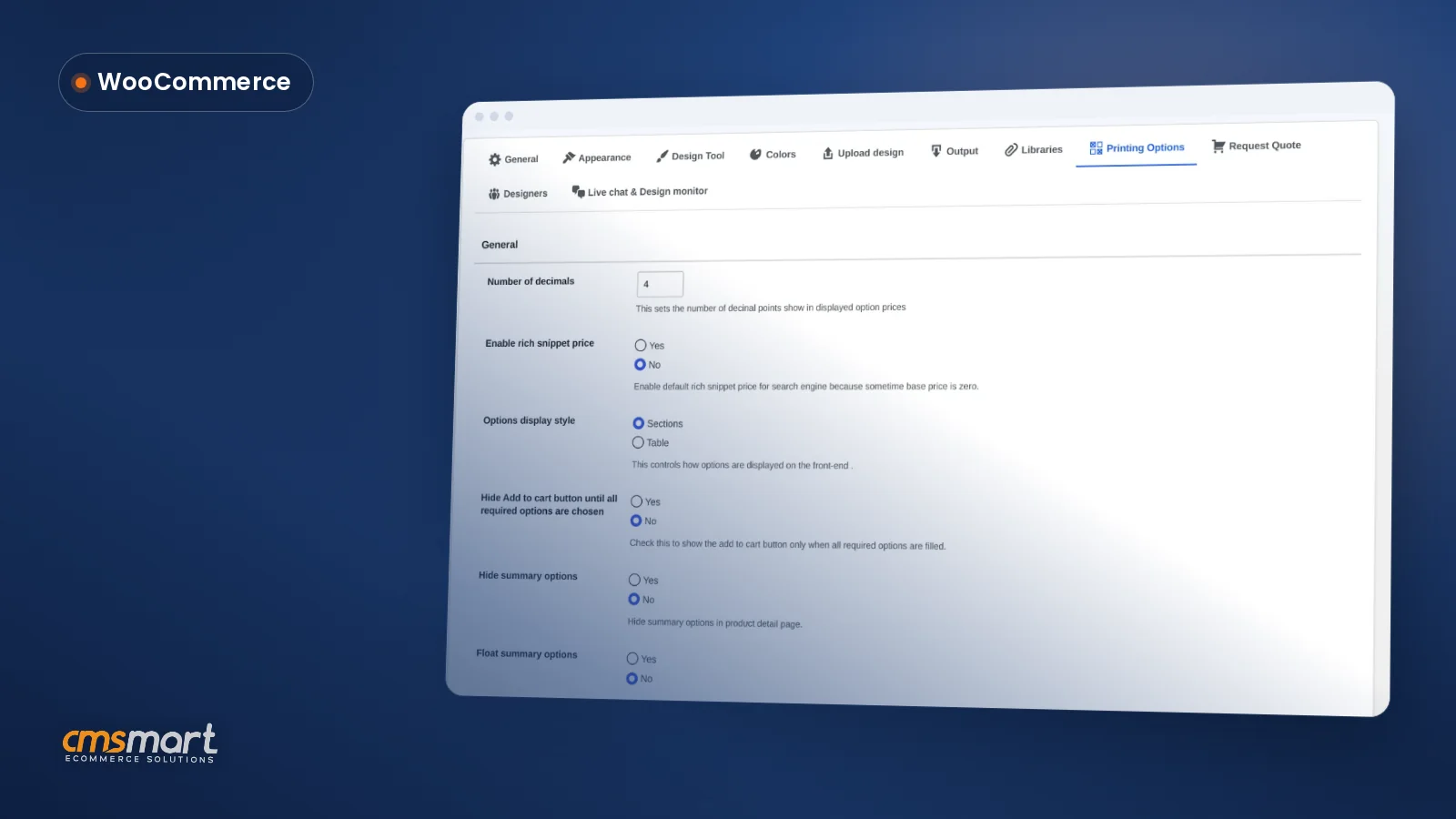
Cmsmart's Product Designer plugs a canvas editor, a component system called Product Builder, a printing-options price matrix and Cmsmart Cloud's AI and rendering tools straight into a WooCommerce product, so a shoe listing becomes configurable without a separate app or checkout.
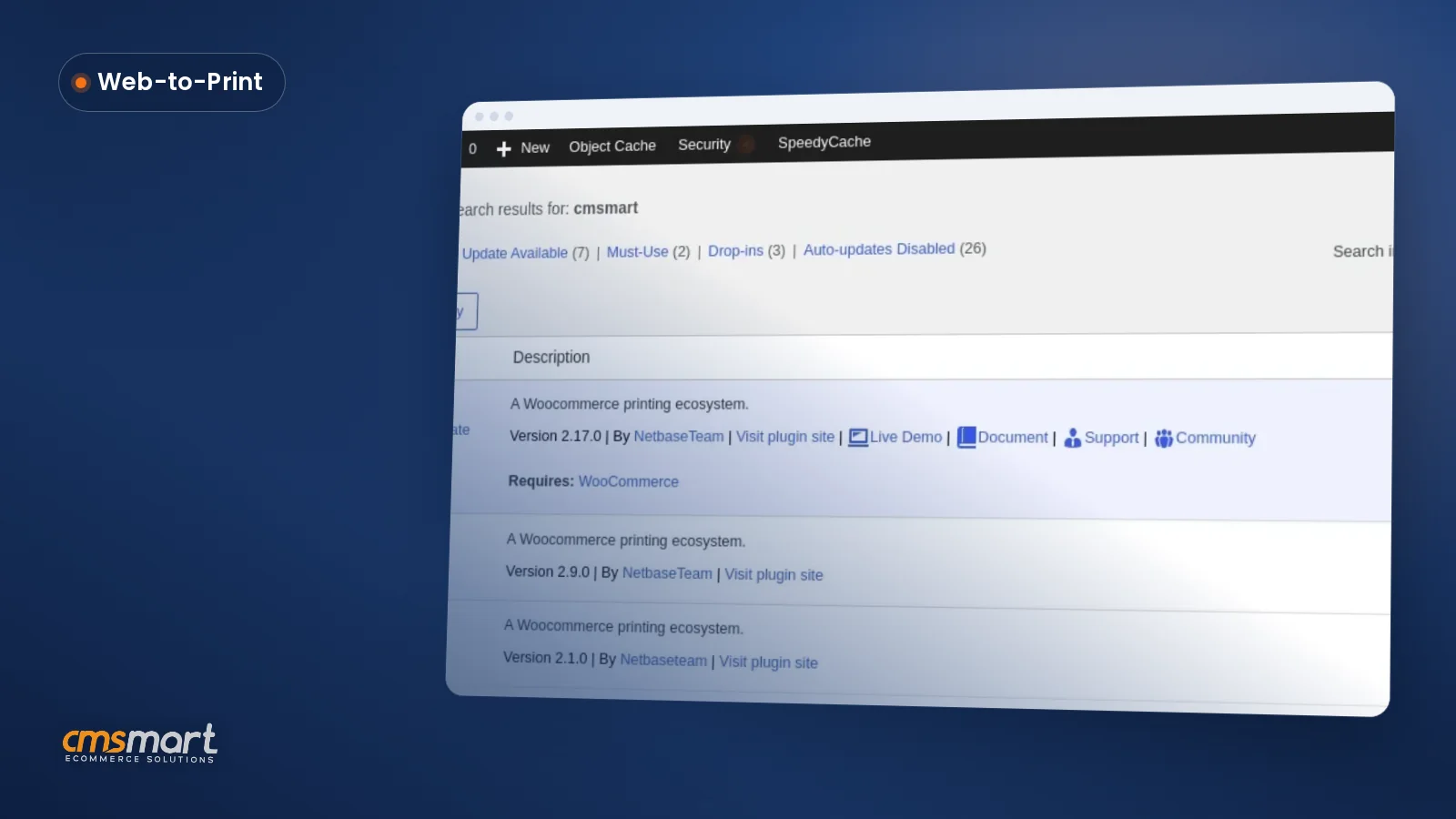
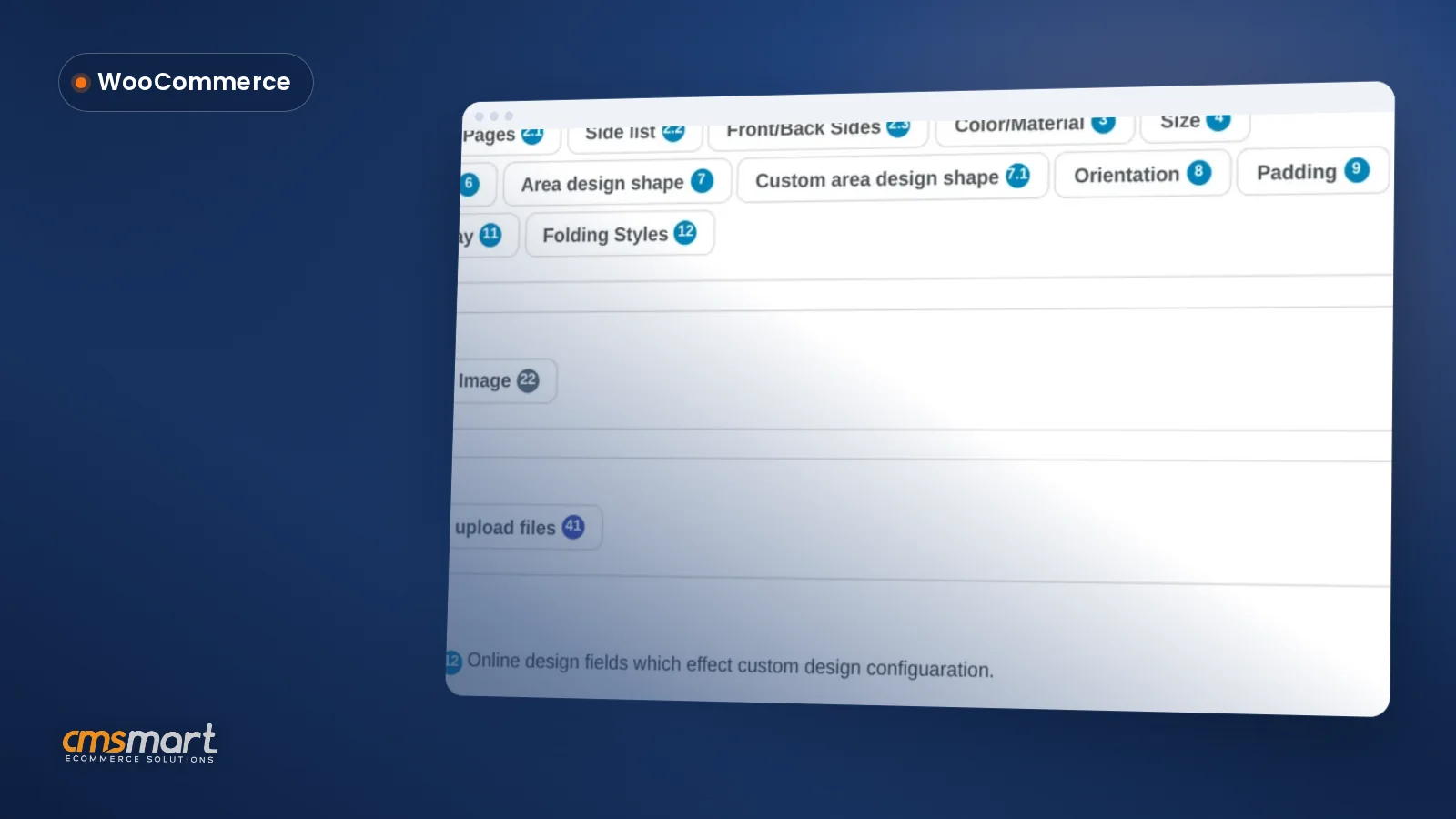
Six building blocks make up the system, all visible on the current 2.17.0 admin screens:
Component,Text,Image— breaks a shoe into swappable parts (sole, upper, laces) instead of one flat design area.Cmsmart insight: treat "sole," "upper," and "laces" as separate Product Builder components rather than one big design area. It keeps each part's print file simple (one material, one color space) and makes the price matrix easier to reason about than a single catalog of combinations.
For the parts of the shoe you photograph rather than print — say, a stock sole in a few fixed colors — our walkthrough of building Product Builder components covers the component setup in more depth than fits here.
What's the ROI of adding shoe customization to your store?
Cmsmart's Product Designer turns manual proofing and quoting into on-page steps your KPIs can already track — fewer abandoned design sessions, fewer reprints, and less staff time per custom order.
ROI worksheet — fill in your own numbers:
Plug in your own reprint rate and order volume before deciding whether the setup below pays for itself in one month or six.
Mass customization is not a niche bet: Grand View Research estimates the U.S. customized-sneakers market at USD 809.5 million in 2025, growing to USD 1,315.6 million by 2033 (a 6.3% CAGR) — a demand curve that rewards brands who cut friction from the design step rather than still quoting custom orders by hand.
How do you set up shoe customization software on WooCommerce?
Setting up Cmsmart's Product Designer on a shoe product means configuring production specs and components once, then letting every order flow through the same designer, price matrix and approval screens without further manual work.
Componententry per swappable part of the shoe (sole, upper, laces), plusTextandImagefields for anything the buyer personalizes directly.This matters because the Library of Congress describes PDF/X as a constrained subset of PDF built for reliable prepress data exchange — the same reason Cmsmart locks bleed, color profile and page geometry to what you set in step 1, instead of leaving it to the buyer's browser.
What can Cmsmart build beyond the standard shoe customizer?
Where a footwear brand wants more than the core designer — a full 3D/AR configurator, brand-guideline validation, or a direct manufacturer hand-off — Cmsmart builds it as custom development on top of the same WooCommerce store, rather than bolting on a separate app.
The core plugin covers the design, pricing, approval and print-ready steps above — see Cmsmart's product designer customization service for the full scope. Brands that want to go further usually ask for one of these:
These follow the same delivery path regardless of scope: discovery, solution design, build sprints, QA, launch and support — see Cmsmart's ecommerce project case studies.
Plan my custom shoe builder
Why work with Cmsmart on your footwear store?
Cmsmart has run WooCommerce and web-to-print projects as a Netbase JSC division since 2012, with the Product Designer plugin and the custom-development team built from the same codebase your store already runs on.
Cmsmart has delivered 6,300+ client projects since 2012, with 1,800+ stores live today across 80+ countries, and carries a Trustpilot rating of 4.2 from 404 reviews. One recent five-star review: "The designer works exceptionally well across all devices and allows us to create the exact customisations required to perfectly fit our products and our business model."
For related reading, see how other shops use the same plugin for batching multiple customized items onto one print sheet, or explore the web-to-print solutions hub and the Cmsmart Product Designer plugin page for the full feature set.
Frequently asked questions about shoe customization software
Does Cmsmart's Product Designer work for shoes specifically, or only flat products like T-shirts and cards?
It's a general-purpose WooCommerce product designer: you define design areas and Product Builder components per product, so a shoe with separate sole/upper/lace parts is configured the same way a flat product uses design areas and print options.
Can shoppers see a rotating 3D view of their shoe before they buy?
Partly: the core plugin already offers a basic 3D preview toggle per product on desktop, plus a 2D canvas preview of each component as it's built. A full rotate-and-zoom configurator, AR try-on, and mobile 3D support aren't part of the core plugin yet — Cmsmart builds those as custom development on the same component data.
What happens if a customer uploads a logo that's too low-resolution to print well?
AI Preflight scans every saved design for print-quality problems before it reaches production. When the issue is low resolution, AI Upscale can auto-fix it automatically; anything else it flags needs a manual look.
Does approving a design lock it from further changes?
Yes. Since 2.17.0, saving over a design whose order item has already been approved is refused with a clear message, whatever link or designer tab the save comes from — the approved-artwork lock.
Can the print-ready file go straight to our shoe manufacturer's system?
The core plugin gives you a downloadable print-ready PDF per order, rendered by Cmsmart Cloud to match the exact order size. A direct API hand-off into a manufacturer's ERP or MIS queue is custom development.
How long does it take to configure an existing shoe product for customization?
It depends on how many components your shoe has and how granular the price matrix needs to be. The setup steps above cover every screen involved; a Cmsmart consultant can scope your product range for an estimate.
Written by
Cmsmart Product Designer Plugin Engineer
Builds and supports the Cmsmart Product Designer (NBDesigner) for WooCommerce.
- NBDesigner
- WooCommerce
- Product customizer
- Release notes
More from this expert →