

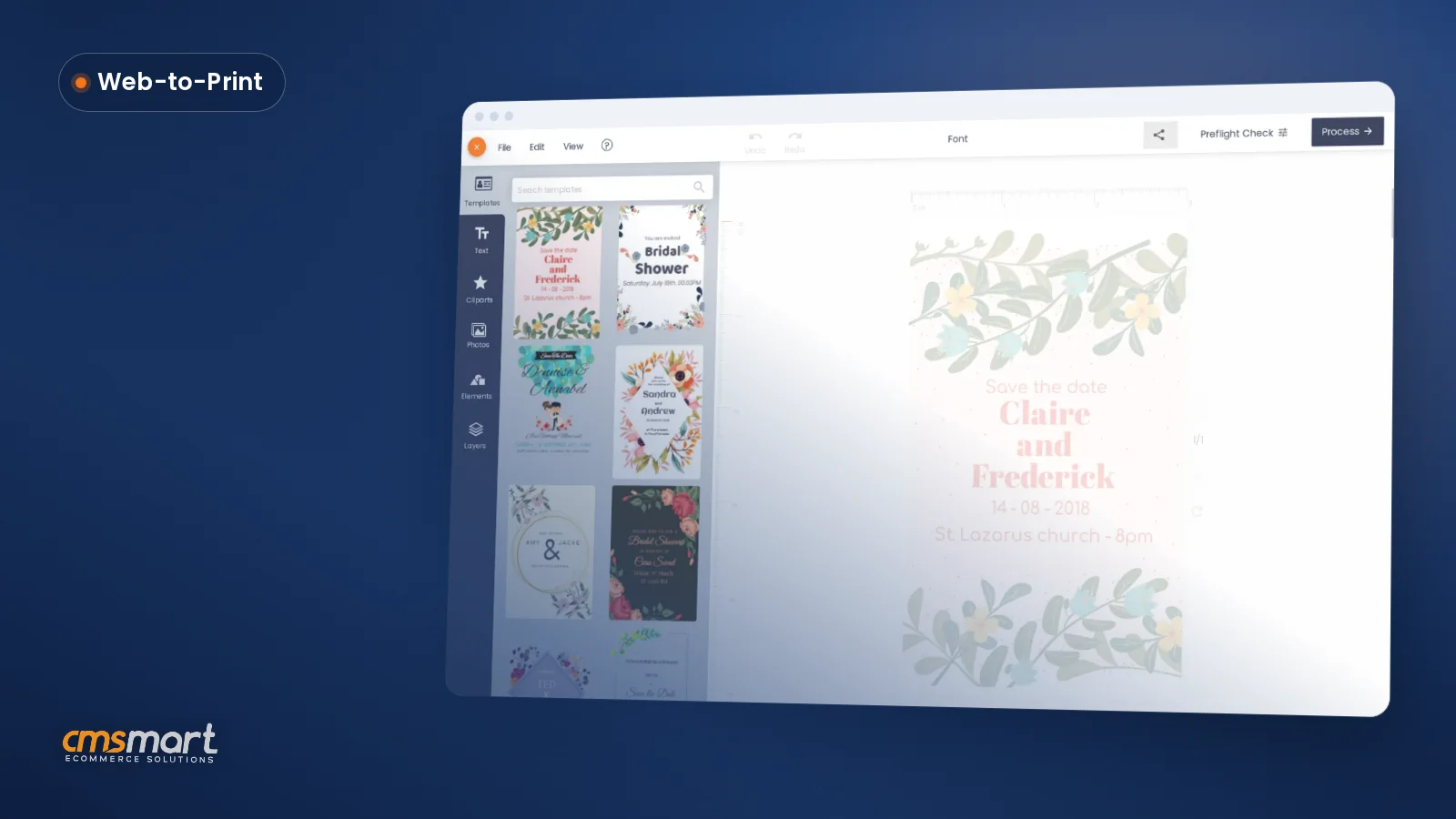
Guide · Web-to-print
WooCommerce Product Designer Plugin: Import Customer Artwork
WooCommerce product designer plugin: let customers upload artwork or design online, cut proof emails, and ship print-ready files. See how to set it up...
WooCommerce customer file upload settings decide whether your production queue gets a usable print file or a 72 DPI phone screenshot grabbed off Instagram — and the rule lives in one screen plus one product tab, not scattered across the plugin.
Was this tutorial helpful?
Written by
Cmsmart Product Designer Plugin Engineer
Builds and supports the Cmsmart Product Designer (NBDesigner) for WooCommerce.
The team behind it
 Account Manager
 Project Manager
 Business Analyst
 Developers & QA
Guide · Web-to-print
WooCommerce product designer plugin: let customers upload artwork or design online, cut proof emails, and ship print-ready files. See how to set it up...
Case study · Web-to-print
See how Cmsmart's product customization software for WooCommerce gives buyers real design control, plus pricing and print automation for your team.
Guide · Web-to-print
Set up automatic print-ready PDF export for WooCommerce, sync files to FTP, Dropbox, or Amazon S3, and manage print options the right way. See how.

Cmsmart Ecommerce provides custom ecommerce and WooCommerce development services for web-to-print, product personalization, plugin support and API integration.
Cmsmart Product Designer Plugin Engineer
Builds and supports the Cmsmart Product Designer (NBDesigner) for WooCommerce.
Meet the team →
In short
This chapter of our admin settings guide covers every field on that screen, what it controls on the storefront, and the mistakes that quietly let bad files through even when settings look right.
What's the real cost of loose WooCommerce file upload settings?
Cmsmart Product Designer's upload rules catch a wrong file type, an oversized attachment or a low-resolution photo at the moment a buyer tries to check out, instead of after your prepress team has already opened it.
Left on its defaults, Settings → Upload design costs you in familiar ways:
Cmsmart insight: on the demo environment captured for this guide, the plugin's Max upload size was 100 MB while the server's own PHP "Upload max filesize" was 2 MB. Any setting you raise here is capped by whichever is lower — check your host's PHP upload limit (Tools → Site Health → Info) before promising buyers a 100 MB allowance.
Put a number on it with your own variables: (orders per month with a rejected or re-uploaded file) × (minutes of staff time per re-upload) + (reprints caused by low-DPI art) × (cost per reprint). A single oversized PSD bouncing off a server limit, multiplied across every customer who gives up, adds up fast.
What does it look like when your upload settings are dialed in?
Cmsmart Product Designer shows buyers a plain "Upload a full design" option right in the design chooser, already enforcing the file types, size and DPI rule your team set — no extra plugin, no second checkout step.
Example scenario: a buyer opens your Invitation or Photo frame product, clicks the design button, and sees two cards: one for uploading a finished design, one for designing online with your templates. They pick upload, and whatever they attach is already checked against the file types, size limits and minimum resolution you configured — they never see a generic WordPress media uploader with no rules at all.
How does Cmsmart's upload design architecture work?
Cmsmart Product Designer splits upload rules into a global Settings → Upload design screen for defaults and a per-product Upload Design tab for overrides, so a photo-frame product can demand a higher DPI than a generic sticker without a line of code.
Four building blocks carry a file from the settings screen to a working rule on the storefront:
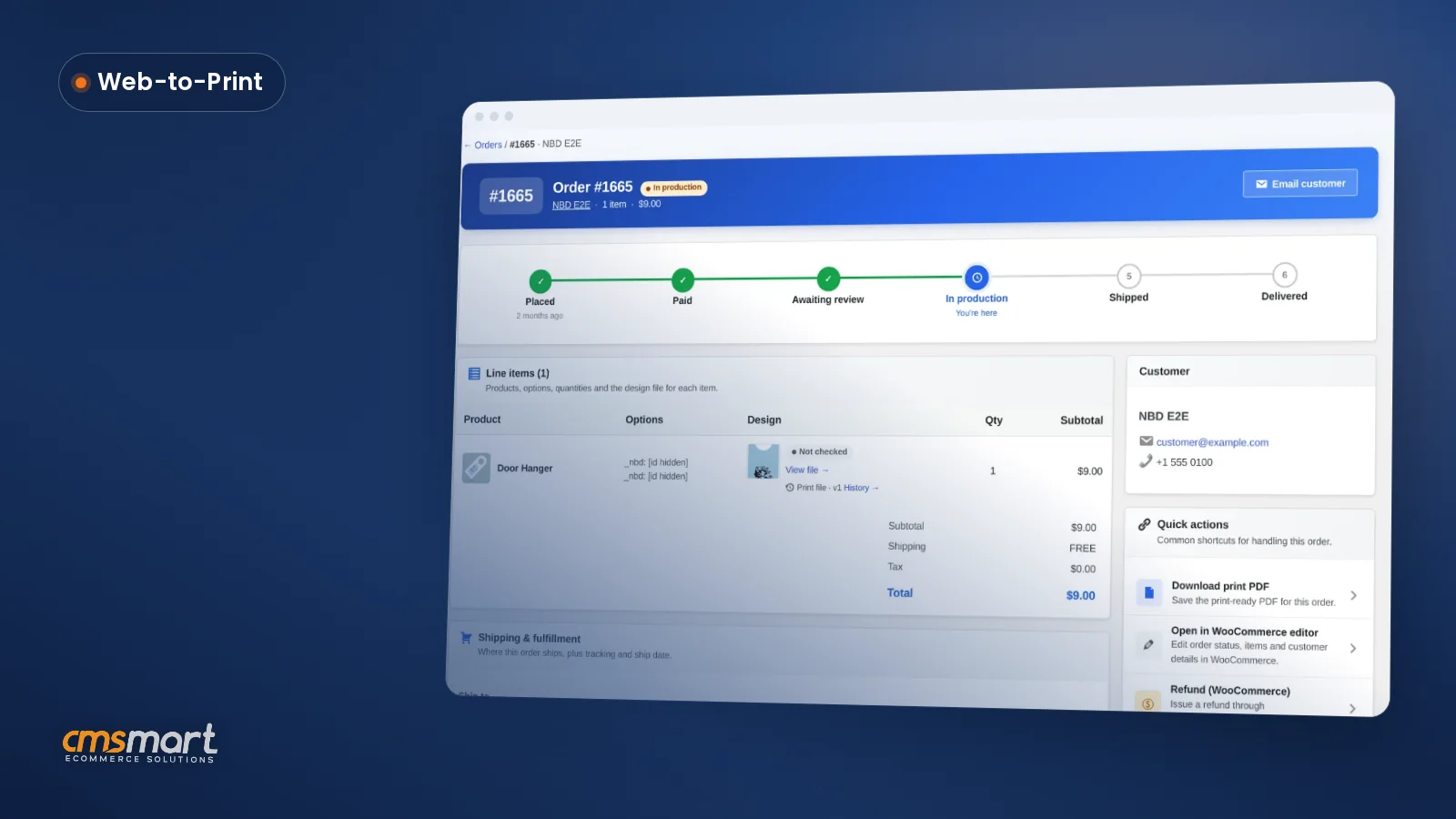
Once attached to the order, AI Preflight can flag resolution and format problems for your team to review before production — a second check behind the upload rule, not a replacement for it.
WooCommerce's own Product Add-ons extension ships a basic File Upload field — fine for a simple store, but it stops at the attachment: no DPI rule, no override tab, no approval box. That gap is what Cmsmart's customer artwork upload module closes.
What's the value and ROI of getting file upload settings right?
Cmsmart Product Designer turns a two-minute settings change into fewer reprints, less staff time spent chasing re-uploads, and a cleaner production record — on the platform running the largest share of stores whose ecommerce software is known.
WooCommerce powers 47.6% of all websites whose ecommerce platform is known, the largest single share tracked (W3Techs, accessed October 2026). Getting the upload rules right there, rather than bolting on a separate file-transfer tool, keeps the file, the order and the approval status in one place your team already checks.
Rough ROI worksheet — use your own numbers: (orders per month needing a re-upload) × (minutes per re-upload) × (hourly staff cost) = monthly hours recovered. Add (current reprint rate − expected rate after a DPI minimum) × (orders per month) × (cost per reprint) for the materials side.
How do you set up WooCommerce customer file upload settings?
Cmsmart Product Designer's upload rules are configured once in Settings → Upload design, then tightened per product in that product's own Upload Design tab — buyers never see the settings screen, only the result.
Here's how to configure it:
jpg,pdf,psd,ai,eps) to match what your print line can run — an allowlist, not a list of everything to block.png,giffor a flat-colour-only workflow.Common mistakes to avoid
For related settings, see PDF, SVG and EPS uploads and upload file formats, or go back to the admin settings guide hub for the rest of the series. This walkthrough covers a related flow on video:
Going further: what custom development adds to file intake
The upload rules, overrides and multi-format output above ship in Cmsmart Product Designer today. For what the core screen doesn't cover — automated prepress, multi-approver sign-off, MIS hand-off — Cmsmart builds the rest on the same upload and order data.
Delivery follows the same path for all four: discovery, a solution design, build sprints, QA, launch and support — the model behind the case studies on Cmsmart's ecommerce projects page.
Get a custom file-intake workflow quote
Why work with Cmsmart on your upload and artwork settings?
Cmsmart has built WooCommerce product customization since 2012 as a division of Netbase JSC, with the Product Designer (formerly NBDesigner) plugin and custom development running across thousands of live stores.
Cmsmart has delivered 6,300+ client projects since 2012, with 1,800+ stores live across 80+ countries, and holds a 4.2 rating from 404 reviews on Trustpilot:
See more on Cmsmart's project case studies, or start from the Cmsmart Product Designer plugin page. For the wider picture, see the web-to-print solutions hub, or the product designer customization service if this screen told you that you need custom work.
Frequently asked questions about WooCommerce file upload settings
Where do I find the WooCommerce customer file upload settings?
In wp-admin under WooCommerce → Settings → Cmsmart → Upload design. Per-product overrides live on the product's own Upload Design tab.
What happens if my server's PHP upload limit is lower than the plugin's Max upload size?
The lower number wins. If your host's PHP "Upload max filesize" is 2 MB and the plugin accepts 100 MB, every file over roughly 2 MB is rejected before the plugin's rule runs — check Site Health → Info → Server and raise both together.
Can I require a minimum resolution so blurry photos get caught early?
Yes. The Min. resolution DPI for JPG/JPEG image field rejects images below your chosen resolution before checkout. In the demo environment this field ships at 0, meaning no check runs until you set it.
Do the upload rules apply store-wide or per product?
Both. Settings → Upload design sets the defaults for every design-enabled product; a product's own Upload Design tab can set a different file type, count, size or DPI rule for that item, such as a stricter rule for large-format prints.
Can Cmsmart route an accepted upload straight into our MIS or ERP?
Not out of the box. Cmsmart builds that hand-off as custom development, reading the same order and uploaded-file data the Upload design settings already store.