Community
Build a Website Like Canva on WooCommerce

To build a website like Canva, you need to solve two problems: a canvas editor simple enough for non-designers, and a business model around templates, tiers and exports. Cmsmart Product Designer (NBDesigner) already solves the first on WooCommerce. Cmsmart's custom development team builds the second around it, so you launch a working platform, not a prototype.

Cmsmart Ecommerce provides custom ecommerce and WooCommerce development services for web-to-print, product personalization, plugin support and API integration.

Cmsmart Product Designer Plugin Engineer
Builds and supports the Cmsmart Product Designer (NBDesigner) for WooCommerce.
Meet the team →
Top
In short
Why does it cost so much to build a website like Canva from scratch?
Cmsmart has scoped enough of these builds to know the real cost driver isn't the editor UI — it's everything behind it: license handling, print-file generation, font and clipart libraries, and the support load once real uploads start arriving. Cmsmart Product Designer already carries that weight, so your budget goes to what makes your platform different, not the canvas itself.
More than 265 million people a month now use Canva for exactly this kind of self-serve design (Wikipedia, 2025), which is why so many WooCommerce merchants ask Cmsmart for "something like Canva, but ours." The appetite is real. The cost of building the editor from zero is usually what derails the project:
Roughly: (developer-weeks to build a working canvas editor × loaded hourly rate) + ongoing print-pipeline maintenance is the number most teams never put in the original budget — manual proofing and reprint cleanup both land on your team's calendar every week until the pipeline is solid.
Cmsmart insight: the parts of a Canva-style build that fail in production are rarely the parts founders worry about first. Font licensing, upload validation and print-file geometry generate more support tickets in year one than the editor's feature list ever does.
What would your own Canva alternative look like for your customers?
Picture a storefront where a customer opens a template, personalizes it with their own photo and text, and downloads or orders a printed version in minutes — all under your brand, never Canva's. Cmsmart builds that buyer journey on top of NBDesigner's canvas, so the experience reads as your product from the first click to the final file.
Example scenario: A regional print shop wants a self-serve design tool for small businesses that can't afford a designer. A visitor picks a flyer template, swaps in their own logo and hours, and either downloads a high-resolution file for free or pays a small fee to have it printed and shipped. The shop never opens Photoshop; the design-to-print pipeline runs itself.
If that buyer journey sounds like what your business needs, talk to an ecommerce expert about scoping it before you commit to a build.
How does Cmsmart's solution architecture power a Canva-style platform?
Cmsmart layers a WooCommerce storefront, the NBDesigner canvas, a template library, AI tools and print-ready output into one pipeline, then adds the pieces your version of Canva needs that the core plugin deliberately leaves out — access tiers, localization, your own billing. The storefront, canvas and print path are real today; Cmsmart builds the rest around them.
Six building blocks make up the architecture. The first five are in Cmsmart Product Designer today; the sixth is where custom development starts.
That AI Background Remover is a genuine point worth correcting if you've read about Canva-style builds elsewhere: one-click background removal is a built-in Cmsmart Cloud tool today, enabled per store from AI Tools, not something that has to be custom-developed from scratch.
What's the business value and ROI of a custom design platform?
A branded design platform turns a one-time print order into a recurring relationship: customers come back to reuse templates, upgrade for premium ones, or reorder without a design fee each time. Cmsmart ties that behavior to KPIs you can track from day one — template usage, upgrade rate and reorder rate — instead of vague growth promises.
ROI worksheet — fill in your own numbers:
That "Members" audience setting is a real, built-in lever for the business model, not a custom add-on: switching from Everyone to Members means a visitor creates a free account before using an AI tool, which is how a template-driven platform collects leads without extra development.
How do you set up NBDesigner as the engine behind your platform?
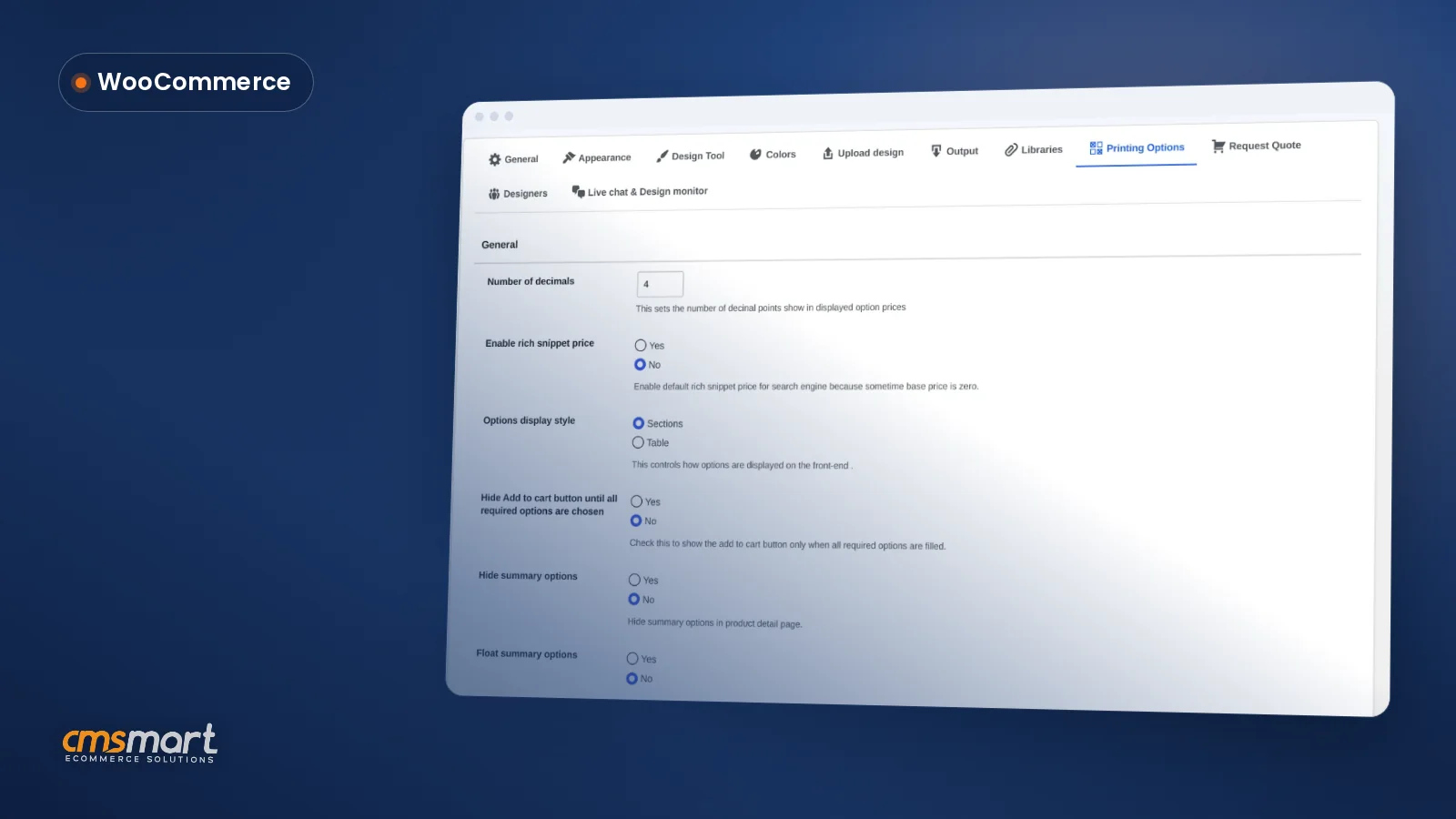
Before any custom work starts, Cmsmart configures the core plugin so it behaves like the backbone of your platform: products enabled for design, templates organized by category, AI tools scoped to the right audience, and print output matched to your press. Here is the sequence Cmsmart follows on every build.
How can Cmsmart build on top of the plugin to match Canva's playbook?
Everything Canva does beyond a canvas editor — free and pro tiers, localized template packs, its own billing, multi-user accounts — is deliberately not in the core plugin, because every merchant's version of that business is different. Cmsmart builds these as custom development on top of NBDesigner, scoped to how you plan to monetize.
Cmsmart scopes every one of these as its own engagement — discovery, solution design, build sprints, QA against your real catalog, launch, and ongoing support — the process behind the Cmsmart ecommerce project delivery model.
Plan my Canva-style platform
Why work with Cmsmart to build your Canva alternative?
Cmsmart has been building WooCommerce and web-to-print projects since 2012 as a Netbase JSC division, with more than 500 custom development projects behind NBDesigner and the platforms built on it. That track record is what a Canva-style build needs most: a team that has already hit — and fixed — the edge cases a first-time build runs into.
The numbers behind that track record: 6,300+ client projects and 500+ custom development projects since 2012, a 4.2 rating on Trustpilot (404 reviews), and ongoing engagements, some running five years or more. See related work in Cmsmart's project case studies, and the plugin this is all built on at the Cmsmart Product Designer (NBDesigner) page. For the wider web-to-print picture, start at the web-to-print solutions hub, and for the service that scopes projects like this one, see product designer customization.
Related reading: how to create a component in NBDesigner's Product Builder and batch design with the gang sheet builder — both useful once your template catalog grows past a handful of products.
Frequently asked questions about building a website like Canva
Can Cmsmart Product Designer become a fully white-labeled design tool like Canva?
Not on its own — the plugin is a WooCommerce product customizer, not a standalone SaaS. Cmsmart builds the white-label layer (your branding, your domain, your access tiers) as custom development on top of it.
Does the plugin include free and pro template tiers out of the box?
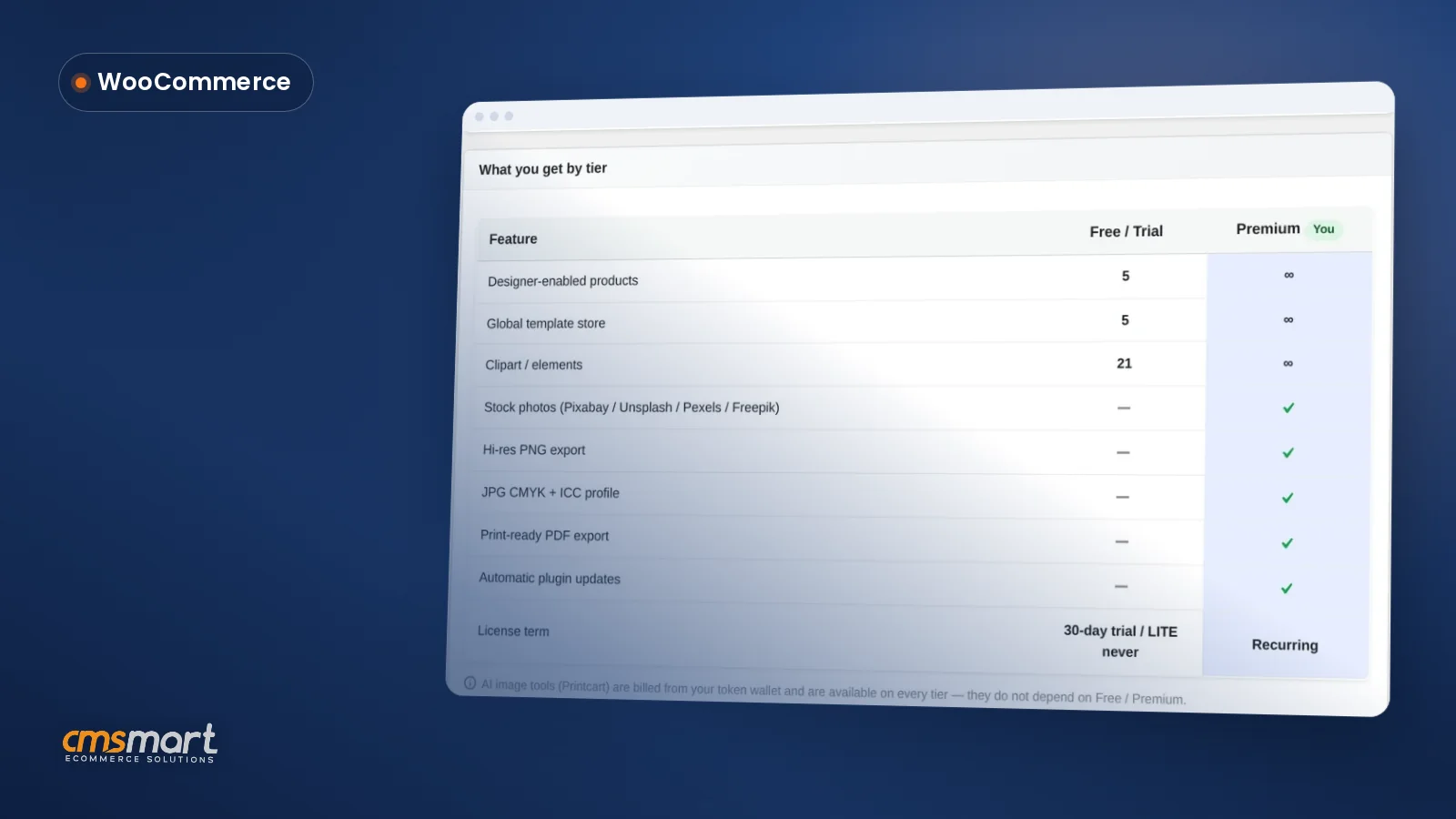
Not today. Templates in the core plugin are simply available or not; splitting them into free and paid tiers, with a gate that blocks non-paying visitors from a Pro template, is something Cmsmart builds as custom development.
How long does a project like this take?
It depends on how much of the custom layer you need. A store that only needs template organization, AI tools and print setup can be configured in days. A tiered, localized platform with its own billing is a multi-sprint engagement that Cmsmart scopes after a discovery call.
Can the design tool connect to our own production system or ERP?
Yes, as an integration. Cmsmart can push the certified print-ready PDF and order data to a press management system, MIS or ERP once an order is placed.
Do we need WooCommerce to run this?
NBDesigner is built for WooCommerce, and that is usually the fastest path to launch: WooCommerce powers 4M+ online stores and roughly 31% of the top 1 million ecommerce sites (WooCommerce, 2026). If a different platform is non-negotiable, Cmsmart can scope a decoupled build instead.
Canva is a trademark of Canva Pty Ltd. Cmsmart is an independent development partner and is not affiliated with Canva.
What does a Canva-style design tool do?
A Canva-style design tool is a browser editor where people who are not designers start from a template, change text, photos and graphics by drag and drop, and export or print the result. On WooCommerce, Cmsmart Product Designer provides this editor with templates, text, photos, cliparts and QR codes, and sends each design to your team as a print-ready file.
Which file formats can designs from the editor be exported in?
Cmsmart Product Designer produces a print-ready PDF for each design, and PNG, SVG and JPG CMYK downloads can be enabled as well. The CMYK output is the JPG with an ICC profile, which needs ImageMagick with lcms2 on the server. Files uploaded by the customer stay on the order for your team to download.
Written by
Cmsmart Product Designer Plugin Engineer
Builds and supports the Cmsmart Product Designer (NBDesigner) for WooCommerce.
- NBDesigner
- WooCommerce
- Product customizer
- Release notes
More from this expert →