
Guide · Web-to-print
Cmsmart Stores Setup Wizard: What's New, October 2026
The Cmsmart Stores Setup wizard installs niche, B2B and Marketplace stores with sample data live in minutes. See what changed and try it free.
Web-to-print software lets a printer sell configurable print products online through a storefront, product options, a designer or file upload, pricing rules and order handling linked to production. To evaluate options, list your products, file checks and approval steps, then test each tool with real orders and check how it connects to your MIS, ERP and shipping systems.
Was this tutorial helpful?
Written by
Cmsmart Web-to-Print Solutions Consultant
Plans online print storefronts: product setup, pricing rules, proofing and print-ready files.
The team behind it
 Account Manager
 Project Manager
 Business Analyst
 Developers & QA
Guide · Web-to-print
The Cmsmart Stores Setup wizard installs niche, B2B and Marketplace stores with sample data live in minutes. See what changed and try it free.
Guide · Web-to-print
The NBDesigner plugin now gives stationery shoppers a curated background library so print-ready PDFs always match the preview. See how to set it up.
Guide · Web-to-print
See how t-shirt artwork approval and print-ready PDFs cut POD reprints on WooCommerce; get a free workflow review from Cmsmart today.

Cmsmart Ecommerce provides custom ecommerce and WooCommerce development services for web-to-print, product personalization, plugin support and API integration.
Cmsmart Web-to-Print Solutions Consultant
Plans online print storefronts: product setup, pricing rules, proofing and print-ready files.
Meet the team →
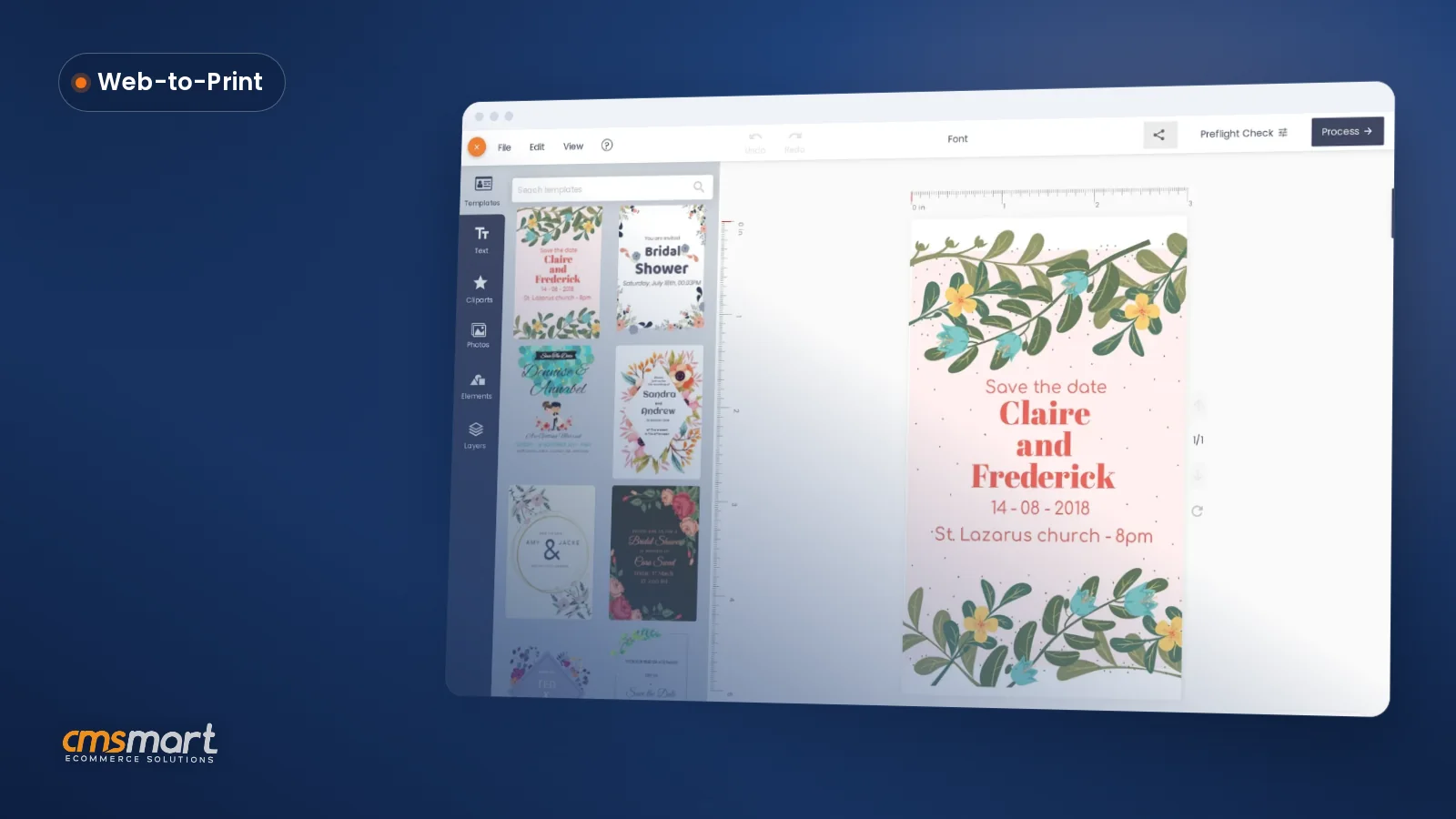

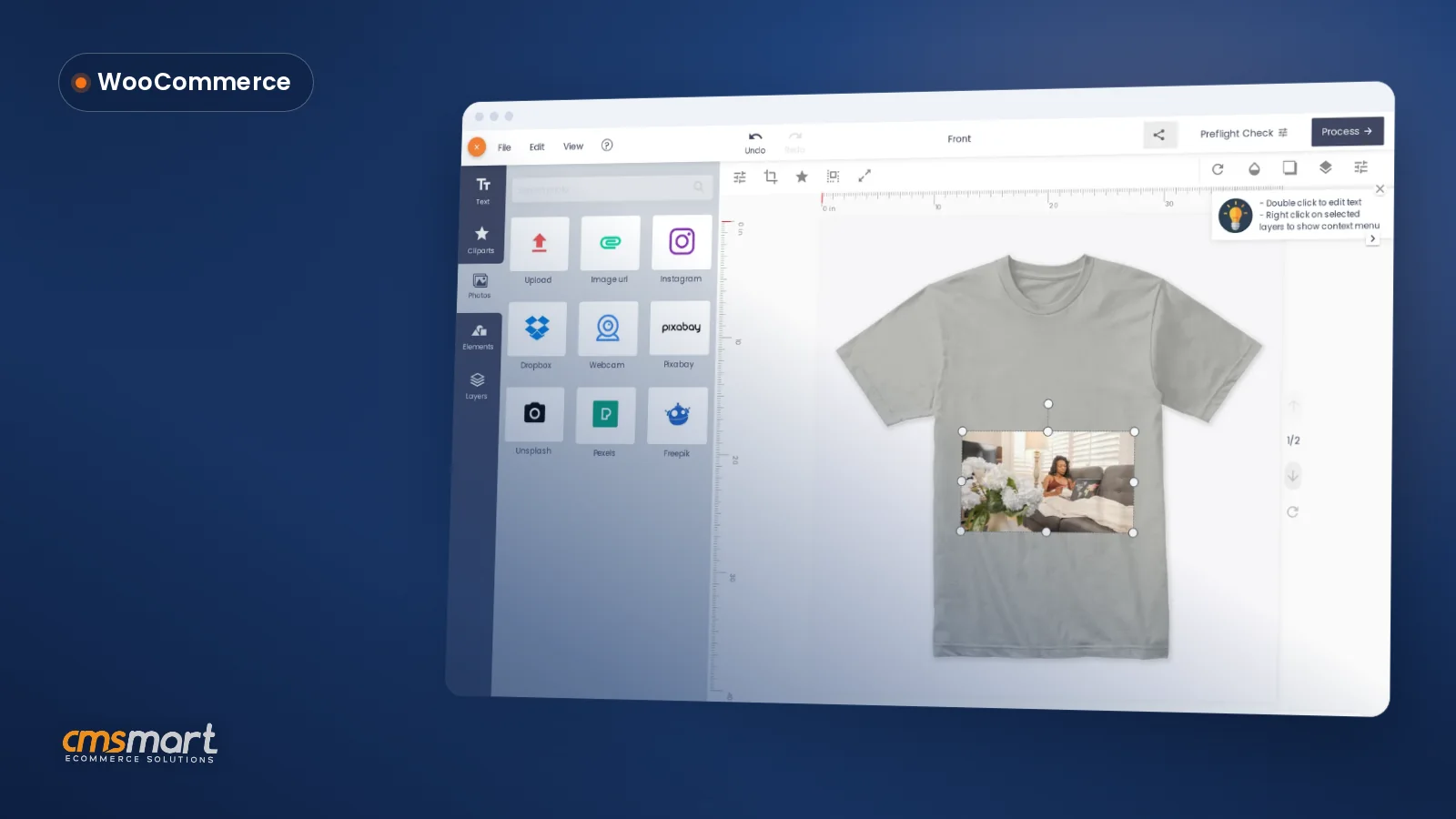

Web-to-print software connects an online storefront, product configuration, orders and production workflows. Before choosing, check the features you need, supported file formats, integrations, pricing and who runs what. This Cmsmart guide lists the key features and how to measure results; see our web-to-print solution.
Understanding the Web to Print Software Landscape
Web-to-print software can connect an online storefront, product configuration, orders and production workflows. Evaluate the required features, integrations and operating responsibilities for the individual business.
Key Features of Web to Print Software
Online Storefronts: Can be configured for browsing, customization and ordering; verify the implemented workflow.
Customizable Templates: Integrated tools like the Cmsmart Product Designer Plugin allow customers to create personalized products easily.
Design Software Integration: Confirm supported Adobe Creative Cloud file formats, versions and upload handling.
Automated File Preparation: Can support file checks and preparation; measure error and production effects for the configured workflow.
Real-Time Shipping Rates and Payments: Confirm current carrier, gateway, rate and checkout support.
Mobile Optimization: Test design and ordering on the required devices and browsers.
For a deeper dive into how web to print software integrates with your online store, explore our Cmsmart Web to Print Solution.
Why It’s Essential for Modern Print Businesses
A web-to-print workflow can connect storefront, design, order and production steps. Measure cost, error, productivity and satisfaction effects for the individual implementation.
The linked industry resources provide additional context; verify each publication date, scope and methodology before relying on it.
Printing Impressions: Web-to-Print Adoption Trends
WhatTheyThink: Web-to-Print resource (check current publication date)
Real-World Application
Historical example: the original article attributed a 25% sales increase and 30% fewer order errors to an unnamed print shop using Cmsmart’s solution. No customer identity, baseline evidence or measurement method is provided, so do not use these figures as a verified result.
Use Cmsmart Community Case Studies as a list of candidate examples, then verify the named customer, scope and evidence for each claim.
Ready to see the software in action? Explore a live demo here: Photo Frame Advanced Upload Demo.
Web-to-Print Requirements and Measurements
Web to print software brings tangible advantages to both print businesses and their customers. Here’s why adopting a web to print solution can transform your business outcomes:
Cost and Efficiency Measurement
Overhead and Error Measurement: Record labour inputs and errors before and after the configured workflow.
Print On-Demand: Compare ordered quantities, setup waste and rework for the configured production process.
Batch Processing: Confirm grouping, release and exception handling for large orders.
Customer Experience Requirements
Personalization at Scale: Allow customers to design their own products using easy-to-use online tools. See how at Cmsmart Personalization Solutions.
Real-Time Previews: Let customers review a design before submitting an order; measure any conversion effect for the individual store.
Multi-Device Access: Test customization and ordering on the required devices and browsers.
Capacity and Delivery-Location Requirements
Expand Your Market: Web to print solutions enable you to serve customers globally, regardless of time zones.
Infrastructure Capacity: Require B2C, B2B and multi-store capacity evidence from Cmsmart Web to Print against the written requirements.
Reporting and Measurement
Advanced Reporting: Confirm available sales, customer and inventory data, refresh timing and access controls.
Decision Support: Define required data, quality, refresh timing and the decisions it should inform.
Evaluation Criteria
Stay Ahead of Trends: Offering web to print capabilities positions your business as innovative and customer-focused.
Sustainability: Measure material, energy, rework and disposal effects for the configured production workflow.
External resources provide additional perspectives on the value of web to print adoption:
Printing News: Benefits of Web to Print Solutions
XMPie: Personalization and Automation in Web to Print
For related web-to-print materials, visit Cmsmart’s dedicated resources and verify current applicability.
How Web-to-Print Software Connects Workflow Steps
Web to print software simplifies and automates the printing process by providing a centralized online platform for managing orders, customizations, and production workflows.
Online Storefront and Customer Interaction
User-Friendly Interfaces: Customers browse, customize, and order products with ease through a branded online storefront.
Customization Options: Templates, text, images, and layout tools allow customers to design personalized products.
Live Preview: Customers can review a design before submitting an order; measure any error effect for the configured workflow.
Automation from Order to Production
Automated File Preparation: Confirm the checks, supported formats, operator review and production output in the selected system.
Integrated Fulfillment: Confirm how print files and job specifications reach production, including validation and failure handling.
Real-Time Shipping Integration: Verify which carriers, rates and label workflows Cmsmart Web to Print currently supports.
Payment Gateways: Confirm supported gateways, PCI responsibilities, authentication and checkout testing.
Backend Operations
Batch Processing: Define expected order volume, grouping rules, exceptions and operator controls.
Inventory Management: Confirm stock-update timing and measure delays or overselling for the implemented integration.
Analytics and Reporting: Access insights on customer orders, product preferences, and fulfillment metrics.
External references for understanding how web to print works include:
PrintWeek: Understanding Web-to-Print Workflows
WhatTheyThink: Web-to-Print: Workflow Automation
For a detailed guide on setting up an online design tool and configuring product workflows, explore the Cmsmart Product Designer Plugin and our web to print resources.
Key Features to Look for When Choosing a Web to Print Solution
When selecting web-to-print software, compare current features with written workflow, integration, support and measurement requirements.
Essential Features
Online Design Tools: Empower customers to create designs using intuitive drag-and-drop tools. Explore Cmsmart's Online Product Designer for a feature-rich solution.
Customizable Templates: Confirm the available template library, permissions and editing controls for the selected plan.
Variable Data Printing (VDP): Support personalized content, such as names or addresses, for each print job.
Real-Time Preview: Let customers review a design before submission; measure errors and revisions for the configured workflow.
Mobile-Responsive Design: Test required tasks on representative devices and browsers.
Backend and Integration Features
Automated File Preparation: Confirm supported checks and operator review, then measure manual errors and output accuracy.
Multi-Store and Franchise Support: Verify current tenancy, permissions, catalogue and reporting support for the required operating model.
Payment Gateway Integration: Verify current PayPal and Stripe support, authentication, PCI responsibilities and checkout behaviour.
Shipping Carrier Integration: Verify current FedEx, UPS, rate and label support for the selected version.
CRM and Marketing Integration: Verify current Salesforce, Mailchimp and HubSpot data flows, permissions and supported actions.
Capacity and Architecture
Modular Architecture: Choose solutions that allow you to add or remove features based on your business needs.
Cloud-Based Infrastructure: Document capacity, availability, access controls and supported administration locations.
External resources for further reading include:
Software Advice: Web-to-print resource (check current publication date)
Printing News: Web-to-Print Must-Have Features
For a comprehensive list of features tailored to your business needs, check out the Cmsmart Web to Print Solution.
Customization Options Available (Templates, VDP, Product Options)
Customization is the cornerstone of web to print software, enabling businesses to offer unique and tailored products that stand out in a crowded marketplace.
Design Customization Features
Template Libraries: Confirm available templates, brand controls, permissions and editing workflow.
Drag-and-Drop Editors: Allow users to adjust layouts, add images, and personalize text.
Variable Data Printing (VDP): Personalize each print piece with customer-specific data like names, addresses, and messages.
Dynamic Color and Font Selection: Let customers select from a palette of colors and fonts to suit their style.
Custom Image Uploads: Customers can upload their own graphics and photos to incorporate into designs.
Product Customization Options
Product Type Variability: Customize a wide array of products including apparel, banners, business cards, and more.
Size and Material Choices: Offer multiple sizes, finishes, and material options to cater to various needs.
3D Product Visualization: Confirm model assets, device support and preview accuracy; measure confidence separately.
Mobile and Cross-Platform Compatibility
Mobile-Optimized Customization Tools: Test the required design tasks on representative devices and browsers.
Cross-Browser Functionality: Define supported browsers and test required tasks, accessibility and failures on representative versions.
External resources for further reading include:
XMPie: Personalization and Automation in Web to Print
Printing Impressions: Enhancing Customization in Web to Print
For a hands-on experience of customization features, explore our Cmsmart Web to Print Solution and the Online Product Designer Demo.
Integration with Ecommerce, Design Tools, and Workflow Systems
Document each required integration, data owner, failure path and maintenance responsibility. Measure operational effects after implementation.
Ecommerce Platform Integration
WooCommerce and Magento Support: Sync web to print functionalities with your existing ecommerce platform.
Checkout: Confirm cart, gateway and tracking integrations, then test the required customer journeys.
Multi-Store Management: Verify current store, channel, permission and reporting support for the required operating model.
Design Software Integration
Adobe Creative Cloud and CorelDRAW Compatibility: Designers can work in their preferred software and directly upload print-ready files.
Pre-Flight Checks: Confirm the file rules, supported formats and operator review; measure error and production effects.
Workflow and Operations Integration
Shipping Carrier APIs: Verify current FedEx, UPS, USPS, rate and label support for the selected version.
CRM and Marketing Tools: Verify current Salesforce, Mailchimp and HubSpot integrations, data flows and supported actions.
Accounting and Inventory Systems: Verify current QuickBooks, Xero and inventory data flows, ownership and conflict handling.
Scalability and Cloud Support
Cloud-Based Capacity: Ask for capacity, availability and access evidence for Cmsmart Web to Print against the written requirements.
Automated Order Processing: Document the automated steps, required operator review and accuracy measurement from upload to shipment.
External resources for best practices include:
PrintWeek: Web-to-Print Integration Strategies
WhatTheyThink: Streamlining Production with Web-to-Print
Explore a comprehensive integration guide with the Cmsmart Product Designer Plugin and visit our community tutorials for practical insights.
Setting Up Your Ecommerce Foundation
Define infrastructure requirements for availability, performance, security, recovery and customer journeys, then test the implemented platform against them.
Choosing the Right Hosting and Infrastructure
Hosting: Define load, capacity and availability requirements, then test the proposed hosting configuration against them.
TLS Certificates: Configure valid certificates and current transport security; measure customer trust separately.
Installing Essential Ecommerce Components
WooCommerce Setup: Install WooCommerce as your primary ecommerce platform, ensuring compatibility with web to print functionalities.
Cmsmart Product Designer Plugin: Integrate the Cmsmart Product Designer Plugin for advanced online customization capabilities.
Payment Gateways: Confirm current PayPal, Stripe and Authorize.Net support, PCI responsibilities and authentication requirements.
Shipping Integration: Connect with carriers such as FedEx and UPS for automated rate calculations and label generation.
Configuring Storefront and Backend
User-Friendly Storefront: Customize the design and layout of your storefront to reflect your brand identity and make navigation intuitive.
Inventory Management: Confirm stock-update timing and measure stockouts or delays after implementation.
Order Processing: Document automated and manual steps, then measure intervention and error rates.
Recommended Plugins and Tools
Security and Performance: Install plugins for firewall protection, caching, and malware scanning.
SEO Tools: Use Yoast SEO or Rank Math as implementation aids where relevant, then measure search visibility separately.
Marketing Automation: Integrate with Mailchimp, HubSpot, or other CRM tools for marketing campaigns and customer segmentation.
Useful Resources
Cmsmart Web to Print Solutions
WooCommerce Documentation
Smashing Magazine: Ecommerce Setup Best Practices
For additional setup tips and troubleshooting guides, explore Cmsmart Community Resources.
Configuring Product Options and Dynamic Pricing
Define required product options and pricing rules, then test their usability and commercial effect for the individual store.
Creating Product Variations and Attributes
Detailed Attributes: Define size, color, material, and other attributes that are essential for each product category.
Swatch Options: Allow customers to preview color and material variations directly on product pages.
Conditional Logic: Set conditions that show or hide certain product options based on user selections.
Implementing Price Matrices
Price Matrix Tables: Set up pricing tiers based on quantity, size, material, or complexity. Learn more with the Cmsmart Pricing Matrix Module.
Custom Pricing Rules: Apply discounts or surcharges based on design complexity, customer groups, or order history.
Pricing Updates: Define the source of truth and test displayed prices throughout customization and checkout.
Integration with Online Product Designer
Cmsmart Online Designer Plugin: Verify the current Product Designer Plugin connection, supported configurations and implementation requirements.
DPI, Bleed, and Safe Zone Configuration: Define print specifications and verify output against them.
Best Practices
Simplicity and Clarity: Avoid overwhelming customers with too many options; keep the interface clean and intuitive.
Mobile-Friendly Design: Test required configuration tasks on representative devices and browsers.
Testing and Quality Assurance: Test configuration and pricing logic against documented expected results.
External Resources
XMPie: Variable Data and Dynamic Pricing
PrintWeek: Managing Product Variations in Web to Print
For additional tools and configuration tips, explore Cmsmart’s Web to Print Community and the Photo Frame Advanced Upload Demo.
Backend and Batch Processing
Document expected order volume, production steps, exceptions and operator responsibilities before choosing backend controls.
Order Management Requirements
Batch Processing: Define grouping rules, then measure setup time and production effects for the configured workflow.
Automated File Handling: Automate the preparation, checking, and sending of print files directly to production.
Tracking: Confirm update timing for orders, stock and production schedules, then measure delays and errors.
Integrating with Fulfillment Services
Third-Party Fulfillment: Verify provider interfaces, ownership, failure handling and delivery measurements.
Inventory Synchronization: Confirm update timing, conflict handling and the source of truth for stock data.
Automated Notifications: Send automatic alerts for order status updates, shipping confirmations, and customer communications.
Bulk Uploads and Asset Management
File Management: Use bulk upload capabilities to handle large volumes of designs and print files.
Auto-Resize and Quality Checks: Define DPI, bleed and colour requirements, then verify files and operator review before production.
Template Management: Confirm storage, permissions, versioning, retrieval and reuse requirements.
Performance and Scalability
Cloud-Based Systems: Require capacity and processing evidence from Cmsmart Web to Print against expected order volumes.
Data Analytics: Define required order, customer and production data, access controls, refresh timing and measurement use.
External Resources
PrintWeek: Streamlining Print Production
WhatTheyThink: Optimizing Web-to-Print Production
For related backend materials, explore Cmsmart’s Web to Print Community and the Product Designer Plugin, then verify current applicability.
Frontend UX Requirements and Testing
Define the required user journeys and test usability, accessibility and task completion with representative customers.
Live Preview and 3D Visualization
Interactive Previews: Let customers review design changes; measure confidence and order errors for the configured workflow.
3D Product Visualization: Verify model assets, device support and preview accuracy. Explore the Photo Frame Advanced Upload Demo, then assess the configured experience with users.
Mobile Optimization
Responsive Design: Test storefront and customization tasks on representative mobile devices and browsers.
Touch Interfaces: Test required design tasks, target sizes and gestures on representative mobile and tablet devices.
Real-Time Feedback and Edit Options
Error Checking: Confirm the design rules, notification timing and correction workflow in the selected system.
User Control: Allow easy edits and revisions without restarting the entire customization process.
Personalization and Recommendations
Suggested Products: If recommendations are in scope, document the data source, consent, logic and measurement plan. Do not assume an average-order-value effect.
Personalized Templates: Offer ready-made templates that align with user preferences and past designs.
Additional Cmsmart Resources
Cmsmart Knowledge Base: Web to Print Tutorials
Cmsmart Product Designer Video Demo
Cmsmart Landing Page for Customizable Photobooks
Cmsmart Marketplace and Multi-Vendor Features
Cmsmart Case Study: Sticker Ecommerce Guide
Cmsmart Tutorials: Printcart Integration
Cmsmart Demo: Product Customization Flow
External Resources
Smashing Magazine: UX Best Practices for Ecommerce
Baymard Institute: Ecommerce UX Guidelines
For more tips on creating exceptional frontend experiences, check out Cmsmart’s Web to Print Resources and our Community Tutorials.
SEO and Marketing Strategies
Define search and marketing work against measurable discovery, traffic and conversion goals for the individual site.
SEO Best Practices
Keyword Optimization: Target relevant keywords like “web to print software,” “custom product design,” and long-tail variations. Use them in page titles, meta descriptions, and throughout content.
Internal Linking: Connect relevant product pages and resources such as Cmsmart Product Designer Plugin and Cmsmart Web to Print with descriptive link text.
Content-Rich Pages: Create educational content including blogs, tutorials, and FAQs. Leverage Cmsmart Community Tutorials for inspiration.
Metadata: Give each indexable page a descriptive title and meta description, then measure search visibility separately.
Content Marketing Strategies
Tutorial Videos: Share detailed demos and how-to guides via channels like Cmsmart’s YouTube Channel.
Case Studies: Use the Cmsmart Community as a list of candidate examples, then verify customer identity, permission, scope and evidence.
Email Marketing: Use platforms like Mailchimp to nurture leads and promote special offers. Integrate with your CRM for targeted campaigns.
Social Media and Retargeting
Platform Presence: Engage customers on Facebook, Instagram, LinkedIn, and Twitter with personalized content.
Retargeting Ads: Use platforms like Google Ads and Facebook Ads to re-engage website visitors.
Influencer Partnerships: Collaborate with industry influencers to expand reach.
Landing Pages and Lead Generation
Dedicated Landing Pages: Create specific landing pages for product demos, like Customizable Photobooks and Printcart Integration.
CTAs and Forms: Place clear call-to-action buttons and lead capture forms strategically throughout the site.
External Resources
Moz: SEO Basics
HubSpot: Marketing Strategies for Ecommerce
For practical examples and inspiration, check out Cmsmart’s Web to Print Resources, Community Tutorials, and our Marketplace Features.
Historical Examples and Evidence Checklist
The following examples appeared in the original article without named, verifiable evidence. They are retained as historical claims with an evidence checklist, not as validated customer results.
Historical example: Unnamed custom mug store
Historical context: the original article described an unnamed mug store using Cmsmart Web to Print; no customer identity or source is provided.
Historical claim: the original article reported a 42% sales increase without a named customer, baseline, period evidence or measurement method.
Historical claim: the original article reported 30% less rework without a named customer, baseline, period evidence or measurement method.
Historical claim: the original article attributed satisfaction and repeat purchases to previews and mobile design without a defined measurement method.
Historical example: Unnamed sticker ecommerce site
Historical context: the original article described an unnamed sticker site using Cmsmart’s Product Designer Plugin; no customer identity or source is provided.
Historical claim: the original article said launch time was cut in half without a named customer, baseline or period evidence.
Historical claim: the original article reported a 35% conversion increase without a named customer, baseline, period evidence or measurement method.
Historical claim: the original article reported lower support demand without a named customer, baseline or measurement method.
Historical example: Unnamed enterprise printing company
Historical context: the original article described an unnamed enterprise integration; no customer identity or source is provided.
Historical claim: the original example described multiple storefronts managed from one backend; verify the required multi-store scope and current capability.
Historical claim: the original example described pricing by customer type and order volume; verify current rule support and the implemented scope.
Historical claim: the original article attributed international growth to platform scalability without a named customer or measurement evidence.
Additional Cmsmart Resources
Cmsmart Web to Print Community Case Studies
Cmsmart’s YouTube Channel
Cmsmart Printcart Integration Guide
Cmsmart custom sticker ecommerce resource (verify case evidence)
Video Tutorials and Resource Links
Use the linked learning materials and demos to review workflows, then verify current product capabilities and implementation requirements.
Video Tutorials and Demonstrations
Cmsmart Product Designer Video Demo: Watch Here
Web to Print Integration Walkthrough: Watch Now
Printcart Product Customization Demo: Explore Demo
Cmsmart Custom Sticker Ecommerce Tutorial: Learn More
Resource Hubs and Community
Cmsmart Community: Join Here for case studies, tutorials, and support.
Cmsmart Web to Print Knowledge Base: Explore Here
Cmsmart Marketplace and Multi-Vendor Solutions: Learn More
Customizable Photobook Solutions: Visit Page
Cmsmart’s YouTube Channel: Subscribe Here
External Learning Resources
HubSpot: Video Marketing Strategies
Moz: Video SEO Guide
Future Trends in Web to Print Technology
Web to print technology is constantly evolving to meet the changing demands of businesses and customers. Here are some key trends shaping the future of this industry.
Artificial Intelligence and Automation
AI-Assisted Workflows: Evaluate each design, file-checking or scheduling feature against current product documentation, data controls and a defined measurement plan.
Dynamic Pricing Automation: Automated adjustments based on customer profiles, order volume, and market conditions.
Augmented and Virtual Reality (AR/VR)
Interactive Product Previews: Verify current AR or VR asset, device and workflow support before including it in scope.
User Evaluation: Test understanding and confidence for the implemented experience, and measure conversion separately.
Cloud Architecture and Capacity
Global Accessibility: Cloud-based platforms like Cmsmart Web to Print enable businesses to manage operations and customer interactions from anywhere.
Third-Party Integration: Verify current inventory, CRM and marketing connectors, supported actions and data flows.
Sustainability and Eco-Friendly Practices
Green Printing Options: Adoption of sustainable materials, eco-friendly inks, and energy-efficient production.
Waste Measurement: Record errors, rework and material use before and after the configured automation.
Hyper-Personalization
Variable Data Printing (VDP): Advanced data-driven customization for targeted marketing campaigns.
User Personalization: Document the data source, consent, logic, retention and user controls before implementation.
External Resources
WhatTheyThink: Web-to-print trends resource (check current publication date)
Printing Impressions: Web-to-Print Evolution
Explore more on these trends and their implementation through Cmsmart’s Web to Print Solutions and our Community Resources.
Your Next Steps
A web-to-print implementation plan should define software selection, product options, backend workflows, frontend testing and operational ownership.
Key Takeaways
Personalization Measurement: Define the options and measure acquisition and retention for the individual store.
Automation Measurement: Record errors, time and commercial results before and after the configured workflow.
Integration Requirements: Document ecommerce, design and workflow connections, data ownership, failure handling and maintenance.
Technology Review: Evaluate AI, AR or VR and sustainability requirements against current evidence and operating needs.
Your Action
Explore Cmsmart Web to Print Solutions: Visit Cmsmart Web to Print
Demo Online Product Designer Plugin: Explore Demo
Discover More Resources: Cmsmart Tutorials and Community, Cmsmart YouTube Channel
Request a Consultation: Contact our expert team at project@cmsmart.net or via WhatsApp: +84 937 869 689
Next Steps
Assess your current printing workflows and ecommerce setup.
Identify areas for improvement with web to print solutions.
Implement personalization tools and backend automation.
Explore Cmsmart's resources, tutorials, and expert consultation.
FAQ
How does Cmsmart Web to Print compare with other leading competitors?
Cmsmart vs. OnPrintShop:
Historical comparison claim: verify current Cmsmart and OnPrintShop customization, pricing and 3D-preview capabilities directly with each provider.
Historical comparison claim: verify current Cmsmart and OnPrintShop support for WooCommerce, Magento and implementation requirements directly with each provider.
Historical comparison claim: verify current Cmsmart and OnPrintShop pricing rules, conditional logic and plan limits directly with each provider.
Cmsmart vs. Pressero:
Historical comparison claim: verify current Cmsmart and Pressero audiences, preview workflows and customization features directly with each provider.
Automation and Workflow: Cmsmart emphasizes full automation from design to production, while Pressero often requires manual intervention.
Historical comparison claim: verify current Cmsmart and Pressero multi-store, franchise, capacity and plan limits directly with each provider.
Cmsmart vs. WP2Print:
Product Range: Cmsmart supports a wide array of products, from apparel to signage, while WP2Print is more focused on document printing and brochures.
Ease of Use: Cmsmart’s product designer offers drag-and-drop features and a more intuitive interface, while WP2Print’s setup is often reported as complex.
Training and Support: Cmsmart provides a comprehensive knowledge base, video tutorials, and a dedicated community, while WP2Print’s training options are more limited.
For detailed feature comparisons and case studies, explore:
Cmsmart Web to Print Solutions
Cmsmart Community Tutorials and Case Studies
Cmsmart YouTube Channel
How do web to print ERP integrations work?
An integration passes each web order, with its product options, quantities, files and customer details, from the storefront to your ERP or print MIS, and sends job status, stock and invoices back. Plan which system owns prices and customer records first. Specialist web to print ERP integrations are usually built per project around your existing systems.
Is there web-to-print software for screen printing and embroidery?
Yes, but check how each tool handles these methods. Screen printing needs ink colour counts, print locations and quantity breaks in the price; embroidery needs stitch-friendly artwork, thread colours and placement. Test whether the software can capture those details on the product page and pass them into production with the order.
What file formats should web-to-print software accept?
Web-to-print software should accept the formats your customers and production team already use, usually print-ready PDF plus common images such as PNG, JPG and SVG. It should also check resolution, bleed and colour mode at upload, and export production files your presses or RIP can read without manual rework.
Is there a web-to-print plugin for Shopware?
Look in the Shopware extension store for product designer or print option extensions, then test each one with your real print products, file checks and approval steps. Cmsmart does not cover Shopware: Cmsmart Product Designer runs on WooCommerce, so using it means running the print store on WooCommerce.
What does custom web-to-print software development involve?
Custom development covers what a ready-made plugin does not: a product-specific editor or 3D configurator, variable data printing from a CSV, pricing rules from an ERP or MIS, and a connection to a print MIS or RIP. At Cmsmart this work is scoped and quoted per project, on top of the plugin's standard printing options and designer.