

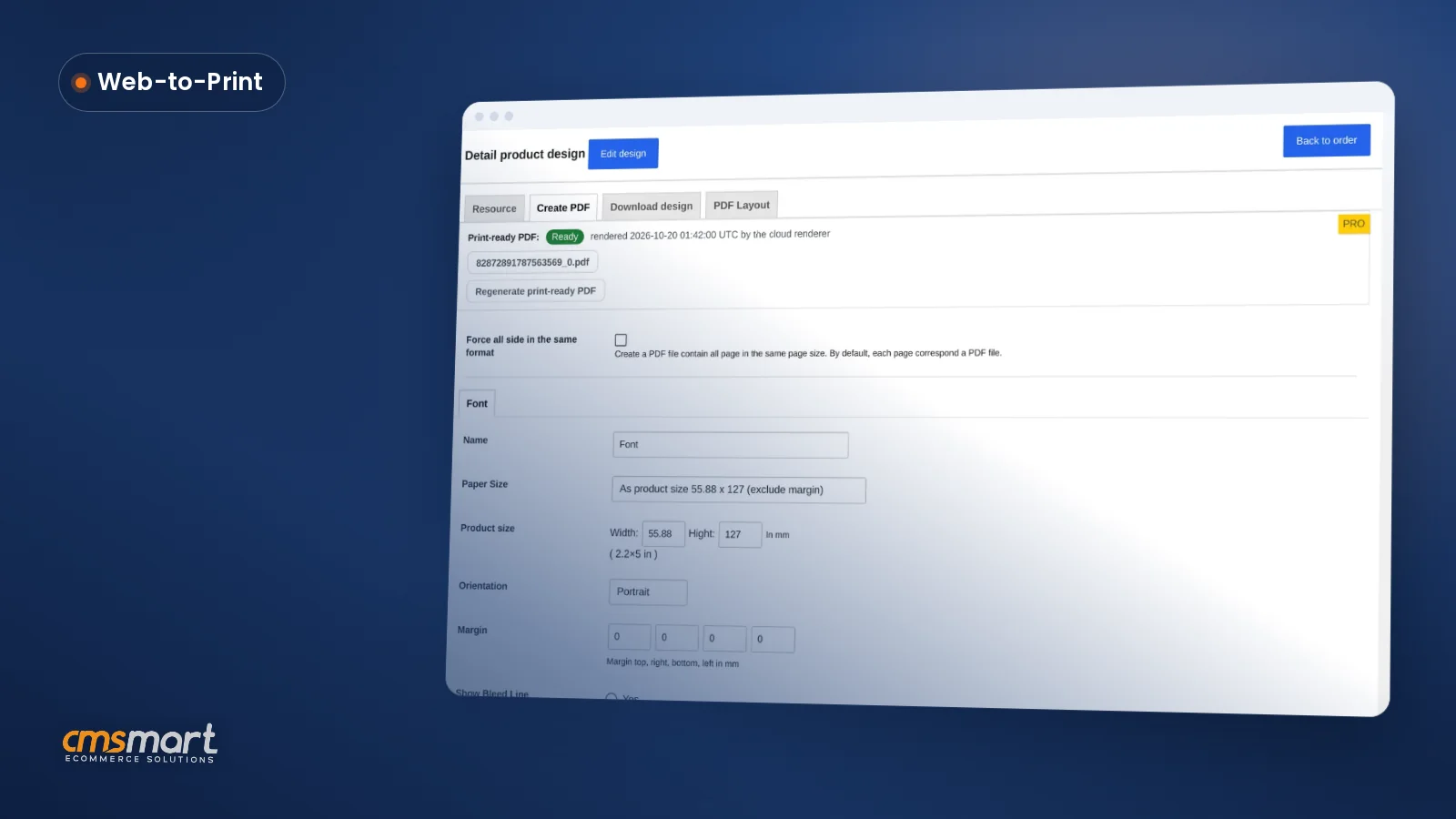
Case study · Web-to-print
Product Personalization Software for WooCommerce
Product personalization software for WooCommerce lets shoppers customize templates on the product page, then get a custom design quote from Cmsmart.
How to choose an ecommerce design company starts with evidence, not promises: compare firms on wireframes, page designs, the checkout flow, handed-over source files and a written scope before you sign. Cmsmart designs branded, mobile-friendly WooCommerce storefronts for SMEs, B2B sellers and print shops, delivered remotely and quoted per project after a free scoping call.
Was this tutorial helpful?
Written by
Cmsmart WooCommerce Development Lead
Leads custom WooCommerce builds: architecture, checkout, performance and integrations.
The team behind it
 Account Manager
 Project Manager
 Business Analyst
 Developers & QA
Case study · Web-to-print
Product personalization software for WooCommerce lets shoppers customize templates on the product page, then get a custom design quote from Cmsmart.
Case study · Web-to-print
Set up an artwork approval workflow for WooCommerce: buyers confirm designs, Cmsmart locks the file, and print-ready PDFs generate automatically.
Guide · Web-to-print
Accept customer file uploads for print on demand orders: Cmsmart checks formats, size and DPI, then hands over a print-ready PDF. Get a custom quote t...

Cmsmart Ecommerce provides custom ecommerce and WooCommerce development services for web-to-print, product personalization, plugin support and API integration.
Cmsmart WooCommerce Development Lead
Leads custom WooCommerce builds: architecture, checkout, performance and integrations.
Meet the team →

In short
What's the real cost of choosing the wrong ecommerce design company?
Picking the wrong ecommerce design company usually shows up later as a slow checkout, a theme you cannot edit, or a second redesign bill. Cmsmart avoids this by putting the scope, the platform and the acceptance criteria in writing before any design work starts, so you can check progress against something concrete.
Search "ecommerce web design agency" and you get a long list of firms with similar-looking portfolios and no easy way to tell them apart. The pains below tend to show up after the contract is signed, not before:
Cost of a wrong pick = months of delay × your monthly revenue at risk + rework hours × your team's hourly rate + the lock-in cost of a store you cannot move to another developer. Put your own numbers in before you compare quotes.
What does a well-designed, scalable ecommerce store look like?
A well-designed ecommerce store uses reusable page components and a catalogue structure that still works at ten times the size, not a set of one-off pages. Cmsmart builds stores on WooCommerce with that kind of component-based layout, so the design holds up as your catalogue and order volume grow.
"Scalable" is one of the most-searched ecommerce design phrases, and it has a specific meaning: can the homepage, category, product and checkout templates handle more products, more variants and more traffic without a rebuild? A single hero-banner redesign is not scalable; a component library — header, filters, product card, cart, checkout steps — that every new page reuses, is.
Example scenario: A homeware retailer with 60 products adds a personalised gift range and a wholesale price list eighteen months after launch. On a component-based store, the new range reuses the existing product template and filters; on a set of custom one-off pages, each new range needs its own build.
You own the code on WooCommerce, so a scalable design choice today does not lock you into one agency later.
What should an ecommerce design company deliver, and how does Cmsmart build it?
An ecommerce design company should deliver wireframes, branded page designs, a working checkout flow, the handed-over source files and a written scope with acceptance criteria. Cmsmart runs every project through the same stages — scope, wireframe, page designs, build, QA, launch and support — so you always know what stage you are paying for.
Ask to see these five things before you sign, whichever firm you are talking to:
Cmsmart's own delivery model for ecommerce projects runs discovery, solution design, build sprints, QA, launch and support in that order, so every milestone has a concrete deliverable attached to it:
If this matches your brief, review Cmsmart's ecommerce website design services and the wider ecommerce development services, then ask any other firm you compare it to for the same five deliverables.
What's the ROI of hiring the right ecommerce design company?
The ROI of hiring the right ecommerce design company shows up as fewer abandoned carts, fewer revision rounds and less staff time chasing an agency after launch. Track it with KPIs you measure before and after the project, not with a promised sales percentage.
Baymard Institute's long-running benchmark puts the average documented online cart abandonment rate at about 70%, averaged across 50 studies, and separately finds that 65% of sites still have "mediocre or worse" checkout usability, with the average site carrying 32 separate checkout issues to fix (Baymard Institute, updated 2025; Baymard Institute, 2026). A design company that treats checkout as a first-class page, not an afterthought, is working against those numbers directly.
When is a redesign better than a new build, and do you need a local ecommerce web designer?
A redesign is usually enough when your platform is still supported and your catalogue is clean; a new build or migration makes more sense once the platform is end of life. Either way, Cmsmart delivers the work remotely for clients in any country, so "local" is rarely a requirement worth paying extra for.
Cmsmart insight: a request that starts as "just refresh the theme" often turns into a catalogue clean-up once broken categories and duplicate variants surface during the scoping call — ask about data clean-up scope before you compare prices.
On "local": a store's design, build and support can all happen over video calls and a shared project board. Cmsmart's team works this way for clients in 80+ countries, with a written scope standing in for a site visit.
What does a custom ecommerce build for a startup need, and when does it call for custom development?
A startup's first ecommerce store needs a clean catalogue, a working checkout with real payment methods, consistent branding and a mobile-friendly layout — nothing more. Cmsmart builds that minimum viable store on WooCommerce, then adds custom development such as product personalisation or B2B ordering only once the business case for it is clear.
Keep the first build small: catalogue, checkout, payments, brand, mobile. Resist a long feature list before the store has taken its first orders.
Some stores need more from day one, most often print shops, personalised-gift brands and B2B sellers who sell a configurable or printed product. For those, Cmsmart builds a product designer into the WooCommerce storefront as custom development: shoppers add text and photos to a product in the browser, see a live preview, and the order carries a print-ready file.
Behind that tool sits an AI preflight check that flags a low-resolution upload before it reaches production, and the order gets a print-ready PDF that matches the order rather than a generic preview. See the Cmsmart Product Designer plugin page for what ships today versus what is built as a custom extension for a specific catalogue, or Cmsmart's custom storefront design service for a bespoke build.
How to choose an ecommerce design company: 8 questions to ask before you sign
To choose an ecommerce design company, run the same eight questions past every firm you shortlist, then compare the written answers side by side. Cmsmart answers all eight below, so you can hold any quote against the same bar.
On Cmsmart specifically: every quote follows a written scope, design work is shown before any code is built, the store runs on WooCommerce so you keep the code, delivery is remote for clients in any country, and every project is quoted after a free scoping call rather than priced up front.
Get a free scoping call for my store design
Where can you see an ecommerce design company's real project work, and what support comes after launch?
Ask to see a firm's real project work on the same platform and business model you need, with a named period and the firm's own role, not just a gallery of homepages. Cmsmart publishes its own project examples and answers support questions in writing before you sign.
A case study worth trusting names the problem, the delivered scope, the platform and a verifiable result, with the agency's role made explicit — not just a screenshot. See Cmsmart's published project examples and ask any firm you compare it to for the same four details.
After launch, find out what support actually covers. On Cmsmart's own plans, support tickets get a first reply within 24 hours, and 48 hours over a weekend; design changes and new features are quoted separately. Ask every firm you compare for the same split in writing: what is included, what is billed, and how fast a ticket gets a first reply.
Why work with Cmsmart for your ecommerce design?
Cmsmart has designed and built ecommerce stores since 2012 as part of Netbase JSC, with more than 6,300 client projects and 1,800+ stores live today. Its team works remotely with SMEs, B2B sellers and print shops on WooCommerce, and quotes every project after a written scope.
Built on WooCommerce, which now says it powers more than 4 million online stores (WooCommerce, accessed 2026), so the skills and plugins a Cmsmart-built store needs are widely supported, not specific to one small agency.
For more on finding the right partner, see Cmsmart's related guides on choosing a top ecommerce agency and on comparing ecommerce web development services. Review real project examples or the ecommerce website design services page, then compare the quote against the eight questions above.
Frequently asked questions
How much does an ecommerce website design cost?
Cmsmart's services are quote-only: price depends on scope — pages, catalogue size and integrations. A free scoping call produces a written scope and a quote; no fixed figure is published.
Do I need a local ecommerce web designer?
No. Every Cmsmart service is delivered remotely for clients in any country; the scoping call and design reviews happen online.
Who owns the design files and the store?
On Cmsmart, the store runs on WooCommerce on hosting you choose, so the store, its data and your customer list are yours. Ask any firm you compare to put file handover in the written scope.
Is a redesign better than a new build?
If the platform is still supported and the catalogue is clean, a redesign of templates and checkout is usually enough. If the platform is end of life, plan a migration instead.
What happens after launch?
Plan customers get ticket support with a first reply inside 24 hours (48 hours at weekends); design changes and new features are quoted separately. Ask every firm for the same split in writing.
What makes a good ecommerce website design?
A good ecommerce design gets a shopper from product to paid order in few steps. It needs clear categories and search, product pages with the price, options and delivery terms in view, a layout that works on a phone and a short checkout. Test those journeys with real buyers instead of judging the design by its homepage alone.
Should one company handle both ecommerce design and development?
Often yes, because decisions about the catalogue, product options and checkout have to be designed, built and tested together. If you split the work, agree in writing who owns the design files, the front-end build and acceptance testing. Cmsmart delivers full store builds and custom development on WooCommerce remotely, each scoped and quoted per project.