
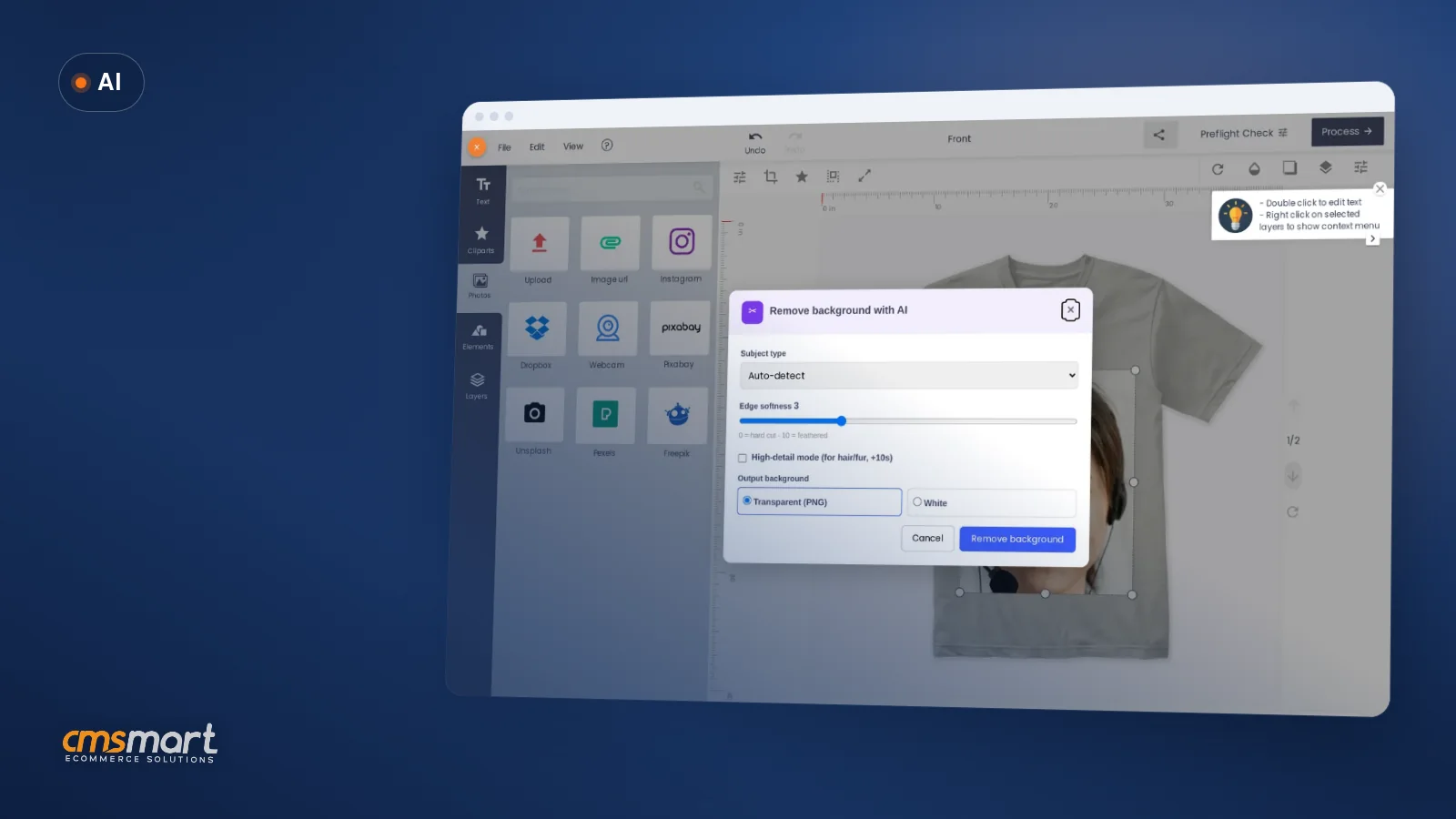
Case study · AI
AI Background Remover for WooCommerce Product Designer
Add an AI background remover for WooCommerce to your product designer so buyers get a clean cutout instantly, and see how Cmsmart builds the rest for...
Unlock new income with effective Commerce Re-Platform solutions tailored for your e-commerce needs. Start transforming your business today!
Table of contents
Was this tutorial helpful?
Written by
Cmsmart Ecommerce Growth & Trends Analyst
Tracks ecommerce trends and turns them into practical moves for growing stores.
The team behind it
 Account Manager
 Project Manager
 Business Analyst
 Developers & QA
Case study · AI
Add an AI background remover for WooCommerce to your product designer so buyers get a clean cutout instantly, and see how Cmsmart builds the rest for...
Case study · Web-to-print
Save design and reorder WooCommerce orders in one click, with a fresh print-ready PDF every time. See how Cmsmart builds it.
Guide · Web-to-print
Custom size printing WooCommerce shoppers configure themselves: Cmsmart prices it live and matches the print-ready PDF to the order. Get a quote.
Browse more guides, tutorials and case studies from the Cmsmart community.
Unlock the Power of Mobile Commerce: Propel Your Business Forward
Read MoreDiscover how to harness mobile commerce to enhance your business growth. Learn strategies for optimizing the mobile shopping experience and increasing consumer engagement.
Read MoreDiscover the benefits of mobile commerce and how it can transform your business. Learn effective strategies for maximizing sales and customer engagement through mobile-optimized shopping experiences.
Read More
Cmsmart Ecommerce provides custom ecommerce and WooCommerce development services for web-to-print, product personalization, plugin support and API integration.
Cmsmart Ecommerce Growth & Trends Analyst
Tracks ecommerce trends and turns them into practical moves for growing stores.
Meet the team →




Is your eCommerce platform stifling your business growth? You're not alone. As highlighted in a recent report by eMarketer, global eCommerce sales are projected to soar past $6.4 trillion by 2024. Yet, many businesses find themselves grappling with outdated technology that hampers their scalability and ambition. Take, for instance, an inspiring case of ABC Fashion, a burgeoning clothing brand based in Japan. Despite its unique product offerings, ABC Fashion struggled with its existing platform, which could not accommodate the waves of traffic during promotional events. With the help of Cmsmart’s effective eCommerce re-platforming solutions, they transitioned to a more adaptive system that not only optimized their operational costs but also enhanced customer experiences, driving their sales growth by a staggering 35% in just six months.
In the competitive landscape of eCommerce, the right platform can be the difference between stagnation and flourishing success. Understanding the significance of eCommerce re-platforming can empower your business to respond swiftly to market trends and optimize costs across all channels. To support businesses like ABC Fashion, Cmsmart provides tailor-made solutions designed to streamline operations and boost business agility. If you’re curious about how to transform your eCommerce landscape, explore our resource on Commerce Re-Platform Solutions and start your journey towards optimized growth. In this tutorial, we'll delve into the practical steps and strategies necessary to effectively re-platform your eCommerce business and unleash its full potential.
Challenge Accepted: Making the Switch
Is your current eCommerce platform holding back your business growth? Youre not alone.Many businesses grapple with the scalability and effectiveness of their existing eCommerce solutions, feeling stifled by outdated technology and a lack of measurable goals.
Understanding eCommerce Re-Platforming
What if eCommerce could become more streamlined, responsive, and profitable with just one strategic move? Enter the realm of eCommerce Re-Platforming—where you transition to a more adaptable platform designed to conquer today’s challenges.The Challenges of Current Platforms
Many eCommerce executives face significant hurdles, including:Actionable Tips for a Successful Transition
Successfully making the switch involves several critical steps:- Assess your current platforms weaknesses to pinpoint areas for improvement.
- Define your business goals to guide your re-platforming strategy.
- Engage stakeholders early to align everyone on expectations.
- Invest in a platform that supports multichannel sales strategies.
For comprehensive strategies on charting measurable business goals, see our detailed guide on defining Key Performance Indicators and challenges of current eCommerce platforms.In summary: Transitioning to a new eCommerce platform is not merely about adopting new technology; its a strategic move to enhance operational efficiency, improve customer experiences, and ultimately drive profits. In the next section, well explore how to improve business agility with a new platform to keep pace with market demands.
Defining Commerce Re-Platforming
Struggling with your current eCommerce platforms scalability and flexibility? Youre not alone.Many eCommerce executives find themselves grappling with the necessity of establishing measurable business goals, adapting to the explosive shift towards mobile commerce, and navigating platform challenges that hinder future growth.
Understanding Commerce Re-Platforming
Commerce re-platforming refers to the process of transitioning your online business from one eCommerce platform to another. This transition is often essential for businesses seeking to enhance their digital presence, support multichannel initiatives, and achieve greater business agility.Why eCommerce Platform Transition is Crucial
Faced with rapidly evolving consumer expectations and technological advancements, companies must adapt to maintain competitiveness. Here are actionable reasons why re-platforming is vital:Basic Terminologies: Commerce Re-Platforming Vs eCommerce Platform Transition
Understanding the terminology is crucial as it lays the foundation for successful navigation of the transitioning process.- Commerce Re-Platforming: The complete overhaul of your existing platform to a new solution that meets current business needs.
- eCommerce Platform Transition: A broader term encompassing any shift or update to your existing platform without necessarily changing it entirely.
Pro Tips:- Before initiating a re-platforming project, chart measurable business goals.
- Identify and define your target customer demographics to tailor the platform properly.
- Establish clear Key Performance Indicators (KPIs) to evaluate success post-transition.
In summary: Commerce re-platforming is a strategic move that enables businesses to remain competitive in a fast-evolving market. As you navigate the complexities of this transition, stay focused on your goals, customer needs, and operational efficiencies. In the next section, well delve deeper into the challenges posed by current eCommerce platforms and how to overcome them effectively.Reasons To Prioritize Commerce Re-Platforming
Struggling to keep pace with the growth of e-commerce? Youre not alone.Many businesses face challenges with the scalability of their current platforms, hampered by the need for clearly defined business goals and the rising prevalence of mobile commerce.
Re-Platforming for a Next-Generation Platform
Re-platforming isnt just about switching software; its about transforming your e-commerce strategy. Here are key reasons to consider a platform transition:Scalability and Re-Platforming
A robust e-commerce platform should scale effortlessly with your business. Here’s how re-platforming supports this:How Re-Platforming Aligns with Business Goals and Objectives
Aligning your e-commerce platform with strategic business goals is crucial for success. Consider these actions:- Define clear Key Performance Indicators (KPIs) that measure success.
- Regularly assess customer demographics to fine-tune marketing strategies.
- Implement tools that enhance business agility and reduce operational costs.
For more insights, explore our resources on how eCommerce executives prioritize re-platforming and the challenges of current eCommerce platforms. In summary: Re-platforming is essential to stay competitive in the rapidly evolving e-commerce landscape. As you transition to a new platform, keep an eye on your business goals and scalability to maximize success—next, we’ll delve into how to improve business agility with a new e-commerce platform.The Shift to Mobile Commerce and Re-Platforming
Is your current eCommerce platform struggling to keep up with the rise of mobile commerce?As the landscape of online shopping evolves, many businesses grapple with the need for re-platforming to stay competitive and deliver seamless customer experiences.
Mobile Commerce: Ultra-Modern Spin-off of eCommerce
The shift towards mobile commerce has transformed how consumers shop. With over 54% of all eCommerce sales expected to come from mobile devices by 2024, its crucial for eCommerce executives to adapt their strategies to harness this trend effectively.As customer preferences shift towards smartphones and tablets, businesses must focus on:
Importance of Customer Demographics in Mobile Commerce
Understanding your customers demographics is critical in tailoring mobile commerce strategies. Here are key factors to consider:Role of Smartphones and Tablets in Mobile Commerce
Smartphones and tablets are not just devices but gateways to the digital shopping experience. To leverage these platforms effectively, focus on:- Creating mobile-first marketing campaigns
- Utilizing push notifications to engage users
- Integrating social media platforms for seamless shopping experiences
In summary: The shift to mobile commerce cannot be ignored, and the importance of understanding customer demographics plays a crucial role in optimizing business strategies. By confronting the challenges of current eCommerce platforms, companies can define clear success metrics and achieve greater business agility.To explore how to enhance operational costs through re-platforming and support multichannel initiatives, let’s dive into the next section focused on eCommerce executives priorities and measurable business goals.
Insightful Metrics: Navigating Success in Commerce Re-Platforming
Is your current eCommerce platform holding back your business growth?Many eCommerce executives grapple with the challenges of scalability and the pressing need for measurable business goals as they transition to a more agile, multichannel approach.
Metrics that Matter: Defining Key Performance Indicators (KPIs)
Establishing clear KPIs is essential for tracking success during your eCommerce re-platforming journey. Here are the key metrics to focus on:How Success Metrics Influence Commerce Re-Platforming
A successful transition to a new eCommerce platform hinges on understanding how these metrics influence your business decisions. By tracking these KPIs, you can:Looking into Future Growth with Re-Platforming
Transitioning to a new eCommerce system is not just about immediate gains; it’s about positioning yourself for future growth. Consider these strategies:- Invest in mobile-friendly designs, as over 73% of eCommerce sales are expected to be mobile by 2025.
- Implement multichannel marketing to reach customers on various platforms.
- Utilize analytics to predict trends and adapt quickly to market changes.
For deeper insights into enhancing customer engagement, explore how understanding customer demographics directly impacts your business strategies. In summary: Embracing the right metrics during your eCommerce re-platforming journey not only guides your current decisions but also lays a robust foundation for sustainable future growth. Next, we will delve into how to improve business agility with a new platform.Commerce Re-Platforming for Business Agility and Cost-Effective Operations
Is your current eCommerce platform holding your business back from adapting to market demands? You’re not alone.Many eCommerce executives struggle with platform scalability, defining clear success metrics, and achieving the agility needed to cope with rapid changes in consumer behavior and technology.
Boosting Business Agility with Commerce Re-Platforming
Re-platforming provides an essential solution to these challenges, helping businesses streamline operations and enhance overall agility.How Re-Platforming Reduces Operational Costs
Re-platforming isn’t just about agility; it’s also a powerful strategy for cutting operational expenses. Transitioning to a more optimized platform can lead to significant cost savings through:Case Studies: Success Stories of eCommerce Re-Platforming
The stories of successful re-platforming play a pivotal role in motivating businesses to take the leap. Companies that embraced eCommerce re-platforming have seen remarkable transformations:- "After switching platforms, our order processing time decreased by 50%. Our agility in responding to market changes vastly improved!" – E-commerce Executive
- "The ability to integrate mobile commerce features has significantly boosted our sales last year." – Business Owner
In summary: Embracing commerce re-platforming enables businesses to navigate current challenges effectively while positioning themselves for future growth. This sets the stage for defining key performance indicators (KPIs) that ensure success. Next, let’s explore how to chart measurable business goals for a thriving eCommerce future.Navigating Multi-Channel Initiatives in Commerce Re-Platforming
Is your current eCommerce platform holding back your growth? You’re not alone.Many businesses encounter challenges with scalability, operational costs, and the need for measurable business goals, especially in todays rapidly advancing mobile commerce landscape.
Multi-Channel Initiatives: Need of the Hour
In a digital world driven by diverse consumer preferences, embracing multi-channel strategies is crucial. Customers today expect a seamless shopping experience whether theyre on smartphones, tablets, or desktops.How Commerce Re-Platforming Supports Multi-Channel Initiatives
Re-platforming your eCommerce site can effectively resolve issues associated with legacy systems. Transitioning to a modern platform enables businesses to deliver a cohesive multi-channel experience.Multi-Channel Support as a Core eCommerce Re-Platforming Strategy
Having multi-channel support as part of your re-platforming strategy ensures that you meet customer expectations without incurring unnecessary operational costs.- Define clear success metrics for each channel to track performance.
- Foster business agility by selecting platforms that offer easy updates and integrations.
- Optimize your website for mobile experiences to capture the growing mobile commerce audience.
In summary: Multi-channel initiatives are essential in today’s eCommerce landscape. Re-platforming your system not only addresses scalability issues but also positions your business for sustainable growth. Next, we’ll explore how to overcome challenges that current eCommerce platforms present, including setting measurable business goals and understanding customer demographics. For more insights, navigate to our section on eCommerce executives prioritize re-platforming or discover how to improve business agility with a new platform.Frequently Asked Questions
Are you struggling with your current eCommerce platform’s scalability and operational costs?Many eCommerce executives find themselves revisiting the crucial need to re-platform as they face challenges related to scalability, the necessity of measurable business goals, and the increasing importance of supporting multichannel initiatives.
Common Questions Surrounding eCommerce Re-Platforming
Transitioning to a new eCommerce platform can bring clarity, efficiency, and growth opportunities. Here are some common questions that often arise:
Leverage Internal and External Resources
For in-depth insights, check our guide on starting an eCommerce business or explore how to create a multi-vendor store. In summary: Re-platforming opens avenues for growth, efficiency, and customer satisfaction. By understanding the common questions and challenges associated with this transition, you position your business for future success. Next, we will dive into how to effectively define your measurable business goals to fuel your eCommerce strategy.Further Reading
As you've seen, transitioning to a robust eCommerce platform through effective re-platforming can profoundly enhance your business capabilities. By streamlining operations and ensuring responsive adaptability, you'll reap the benefits of improved customer experiences and increased revenue potential. Let's take this journey together; do not hesitate to reach out. Connect with David, our CEO, via WhatsApp at this link or email our Ecommerce Project Consultant at [email protected] for tailored consultation on your implementation needs. For personalized quotations, visit our contact page. Join me in transforming your store today and seize the opportunity to unlock your e-commerce potential!