

Guide · Web-to-print
Cmsmart Stores Setup Wizard: What's New, October 2026
The Cmsmart Stores Setup wizard installs niche, B2B and Marketplace stores with sample data live in minutes. See what changed and try it free.
Clipart library settings for WooCommerce product designer tools keep a multi-category store on-brand: a wedding client sees romantic scripts and florals, a corporate client sees clean icons and nothing else, and nobody wades through the shop's whole asset library to find the one thing that belongs on their product. Cmsmart Product Designer (NBDesigner) lets you restrict each product to exactly what fits.
Was this tutorial helpful?
Written by
Cmsmart Product Designer Plugin Engineer
Builds and supports the Cmsmart Product Designer (NBDesigner) for WooCommerce.
The team behind it
 Account Manager
 Project Manager
 Business Analyst
 Developers & QA
Guide · Web-to-print
The Cmsmart Stores Setup wizard installs niche, B2B and Marketplace stores with sample data live in minutes. See what changed and try it free.
Guide · Web-to-print
The NBDesigner plugin now gives stationery shoppers a curated background library so print-ready PDFs always match the preview. See how to set it up.
Guide · Web-to-print
See how t-shirt artwork approval and print-ready PDFs cut POD reprints on WooCommerce; get a free workflow review from Cmsmart today.
Browse more guides, tutorials and case studies from the Cmsmart community.
Run a custom tote bag printing business with Cmsmart Product Designer: live pricing, real print specs and a print-ready PDF. See how to set it up.
Read MoreBuild a car wrap ecommerce store on WooCommerce: panel pricing, approval and print-ready PDFs before you print. Plan your wrap store today.
Read MoreDiscover how the home décor industry is transforming with the rise of personalized products and the challenges retailers face. Learn how CMSmart's Product Builder offers a solution, improving customer engagement, reducing return rates, and increasing sales through real-time 3D previews and automated processes.
Read More
Cmsmart Ecommerce provides custom ecommerce and WooCommerce development services for web-to-print, product personalization, plugin support and API integration.
Cmsmart Product Designer Plugin Engineer
Builds and supports the Cmsmart Product Designer (NBDesigner) for WooCommerce.
Meet the team →




In short
Most stores that have grown past a single product line hit the same moment: the designer that felt generous on day one now feels cluttered, and nobody remembers which setting controls what. This is the business case for taking twenty minutes to curate it properly, and the tutorial that gets you there.
What does an unmanaged clipart library cost a multi-category store?
An unmanaged library costs a WooCommerce store buyer attention and staff time: Cmsmart Product Designer ships with a large shared clipart and template library, and if every product shows all of it, buyers hunt longer, staff review more designs by hand, and off-brand artwork occasionally slips through to production.
What would it look like if every product only offered on-brand design assets?
It looks like a design panel that already knows the product: Cmsmart Product Designer shows each buyer only the templates, cliparts and icons the store owner assigned to that product, so the browsing and searching disappears and every finished design already matches the brand.
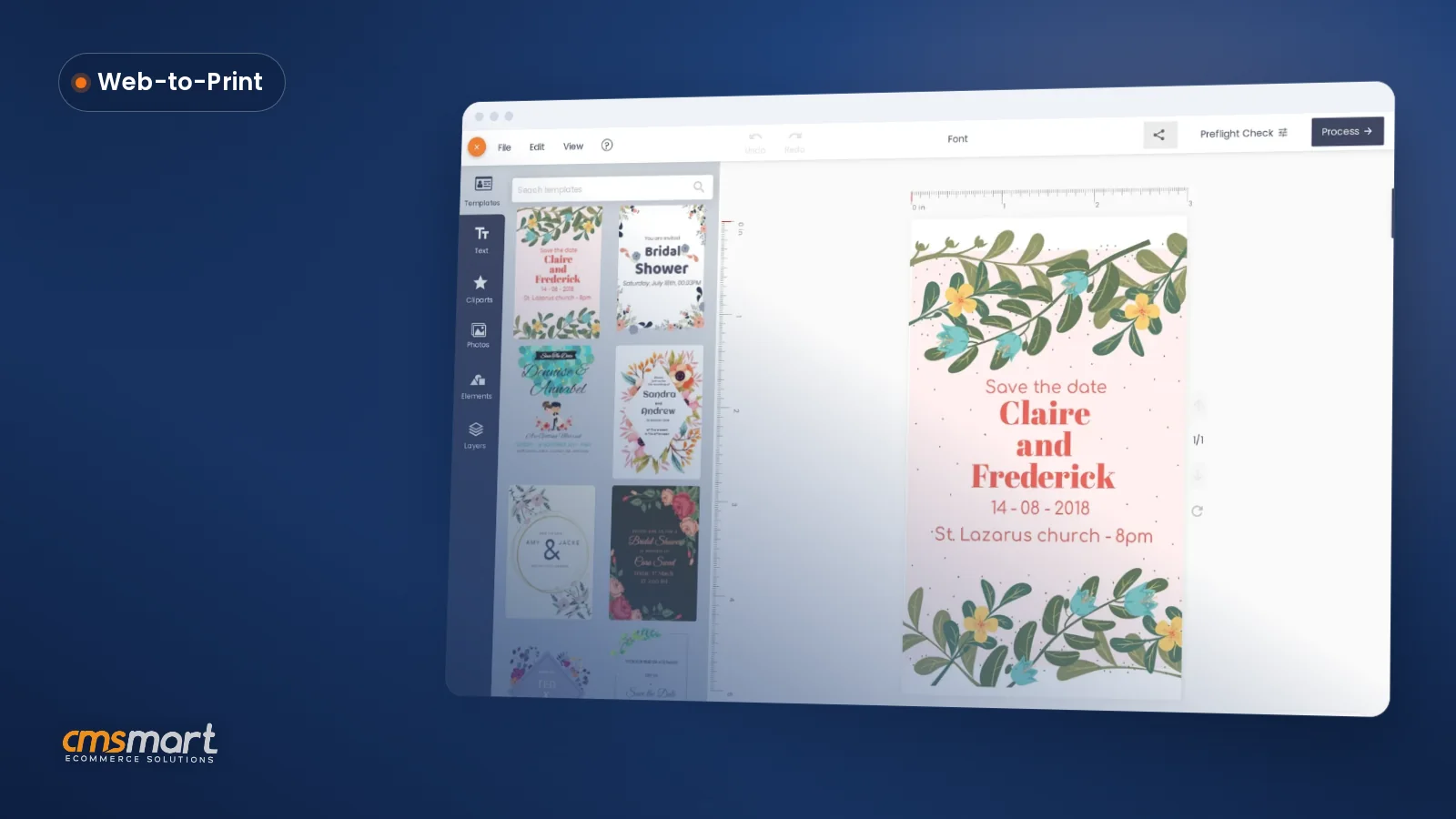
Example scenario: A stationery shop sells wedding invitations and corporate holiday cards from the same WooCommerce store. A bride opens the online designer for an invitation and sees only wedding-appropriate scripts, florals and templates. Two tabs over, a buyer designing a corporate holiday card sees a completely different, on-brand set of templates and icons — no florals, no clutter, nothing meant for the other product line. Neither buyer scrolls past assets that aren't theirs, and nothing reaches the cart that the shop owner wouldn't want printed.
How do clipart library settings for WooCommerce product designer actually work?
Clipart library settings for WooCommerce product designer work as layered permissions: Cmsmart's own global library can be switched off site-wide or restricted per product, your uploaded templates can be assigned to only the products they belong to, and everything is managed from one admin area instead of being scattered across tabs.
Cmsmart insight: check every product's clipart whitelist again after a catalog change. We see the same drift on delivery projects: a product launches with the right categories switched on, a new collection gets added months later, and nobody circles back to add it to the whitelist — so buyers can't find assets the shop owner assumed were already there.
What's the business value of curating templates, cliparts and icons?
The business value is measured in design-completion rate and staff time: Cmsmart Product Designer's per-product library settings cut the browsing a buyer has to do and the manual review your team has to run, so more designs finish clean the first time.
Rough-cut worksheet: (minutes a buyer spends hunting for the right clipart) × (orders per month) = design-time cost of a cluttered library. Separately: (designs flagged for an off-brand asset per month) × (minutes a staff member spends reviewing and messaging the buyer) = review-time cost you can remove by curating the library per product instead of catching problems after the fact.
Getting this right pays off beyond production costs, too: 57% of consumers say they'll spend more with a brand that offers a personalized experience (Shopify, 2025). A generic, cluttered design step is the opposite of that experience; a curated one is the point of running a WooCommerce product designer at all.
How do you set up and restrict the clipart, template and icon library?
You set it up in two places: an optional Flaticon key under Settings → General, then the Media admin group where you choose which clipart categories each product can use, move misfiled assets between categories, and assign template collections to specific products — all without touching code.
What can Cmsmart build beyond the built-in library?
Beyond the standard toggles, Cmsmart builds store-specific library governance as custom development: franchise permissions, ERP-driven categories, licensed-asset checks and vendor-scoped libraries, each fitted to how your business actually organizes its catalog.
Every one of these starts the same way: discovery, a solution design you review before anything is built, build sprints, QA against your real catalog, launch, and ongoing support — the same delivery model behind Cmsmart's ecommerce project work since 2012.
Plan my curated design library
Why work with Cmsmart on your product design platform?
Cmsmart has built and supported the WooCommerce product designer behind this tutorial since 2012, with 6,300+ client projects, 4,600+ projects delivered and 1,800+ live stores running today — the same team that ships the library settings described above also builds the custom work that goes beyond them.
Cmsmart has built and supported the Cmsmart Product Designer (NBDesigner) plugin since 2012, with 6,300+ client projects and 4,600+ projects delivered across 80+ countries; browse related project case studies or the full product designer customization service. Trustpilot rates Cmsmart 4.2 out of 5 from 404 reviews (Trustpilot).
"We have had the NB Designer plugin installed for three years and have experienced absolutely no problems during that time. It is wonderful to see their commitment to continuous development, with new features being added frequently to keep the software current," says a verified Trustpilot reviewer.
Frequently asked questions about clipart and template library settings
Do I have to use Cmsmart's global clipart library?
No. The global library is on by default, but you can switch it off for the whole store or restrict any product to your own categories only, from that product's Clipart settings.
Does the Flaticon icon library cost extra?
Flaticon issues its own free API key; Cmsmart only asks for that key under Settings → General so the icon panel can load inside the designer. Flaticon's own terms govern how the icons may be used.
What happens to an approved design if I change a product's library settings afterward?
Nothing changes for that order. The approved-artwork lock keeps the approved design exactly as the buyer signed off on it, and the print-ready PDF that matches the order is built from that locked file, whatever you change in the library for future buyers.
Can different product lines show completely different template collections?
Yes. Assign a template collection to only the products it belongs to from Cmsmart → Template, and buyers on other products never see it.
How is this different from letting a customer upload their own photo?
It's the other direction: this is about what you supply to buyers who have no artwork of their own. If a buyer already has a finished photo or design file, see our guide to customer photo upload instead.
Can Cmsmart build a fully custom asset library for our store?
Yes. Cmsmart builds brand-locked libraries, ERP-driven categories and licensed-asset checks as custom development — talk to the team through the quote link above, or read how we lock template fields and manage the icon library in related guides.