

Guide · Web-to-print
WooCommerce Product Designer Templates Setup Guide
WooCommerce Product Designer templates setup: configure Template, Template Tags and Template Fields, then check the storefront result. Get a custom qu...
Still running an old NBDesigner plugin? See what Cmsmart Product Designer 2.17 fixes and plan your upgrade with a free store review today.
Table of contents
Was this tutorial helpful?
Written by
Cmsmart Product Designer Plugin Engineer
Builds and supports the Cmsmart Product Designer (NBDesigner) for WooCommerce.
Reviewed by Huy Nguyen (David), Founder & CEO
More from this expert →The team behind it
 Account Manager
 Project Manager
 Business Analyst
 Developers & QA
Guide · Web-to-print
WooCommerce Product Designer templates setup: configure Template, Template Tags and Template Fields, then check the storefront result. Get a custom qu...
Guide · Web-to-print
WooCommerce product designer product settings control DPI, bleed, sides and price per SKU; see every screen in Cmsmart Product Designer, then get a qu...
Guide · Web-to-print
Complete the WooCommerce printing options price matrix setup in Cmsmart Product Designer: field types, quantity breaks and defaults. Get a custom quot...
Browse more guides, tutorials and case studies from the Cmsmart community.
Custom bag design software for WooCommerce: Cmsmart Product Designer adds live pricing and print-ready files. See how to set it up.
Read MoreCar wrap design software for WooCommerce: panel templates, size-based pricing, 3D preview and approval before you print. Plan your wrap store now.
Read MoreDiscover how the home décor industry is transforming with the rise of personalized products and the challenges retailers face. Learn how CMSmart's Product Builder offers a solution, improving customer engagement, reducing return rates, and increasing sales through real-time 3D previews and automated processes.
Read More
Cmsmart Ecommerce provides custom ecommerce and WooCommerce development services for web-to-print, product personalization, plugin support and API integration.
Cmsmart Product Designer Plugin Engineer
Builds and supports the Cmsmart Product Designer (NBDesigner) for WooCommerce.
Meet the team →



In short
Every print shop still running NBDesigner below version 2.15.0 carries a confirmed unauthenticated upload flaw, and every shop below 2.17.0 risks a print-ready PDF that does not match the custom size a customer actually ordered. Cmsmart Product Designer 2.17 closes both gaps, and adds an approved-artwork lock so a buyer's sign-off is something your production team can trust without a phone call.
What is an outdated NBDesigner plugin actually costing your print shop?
A Cmsmart Product Designer store on a pre-2.15.0 build carries a confirmed unauthenticated upload vulnerability, and any build before 2.17.0 can hand production a print-ready PDF sized to the product template instead of the customer's chosen size — both turn into reprints, disputes and support time that a current NBDesigner plugin removes.
Version drift on a product designer plugin is not cosmetic. It shows up as:
Put a number on your own exposure with a simple formula: monthly cost of drift = (reprints per month × cost per reprint, including shipping) + (hours per week spent re-exporting artwork or chasing approvals × your blended hourly rate). Most shops we review during an upgrade find the second term is larger than they expected, because it is spread across several people instead of showing up as one line item.
What does your design-to-production flow look like once you're current?
On Cmsmart Product Designer 2.17, a buyer's design, approval and print file stay in lock-step: the print-ready PDF is generated the moment they click Process, it matches their exact chosen size, and once they or your team approve it, nobody — not even an open editor tab — can quietly overwrite it.
Example scenario: A buyer opens a print shop's invitation product at 10pm, picks a custom size, designs on the canvas, and approves the on-screen proof before paying. Because the shop is on 2.17, the print-ready PDF generated at checkout already matches the custom size — not the default template — so the morning production queue has a usable file waiting, with no email asking the buyer to resend anything.
Talk to an ecommerce expert if you want a second opinion on whether your current setup already behaves this way, or whether drift has crept back in since your last update: request a free store review.
How does Cmsmart's print-ready pipeline actually work?
Cmsmart Product Designer 2.17 connects five pieces into one pipeline — the product page, the online designer, Cmsmart Cloud rendering, the approved-artwork lock, and your Orders and Files screens — so a design a buyer approves is the same file your press receives, without a manual export step.
The building blocks, in order:
Cmsmart insight: Check whether your print-ready PDF is built from the product's default template size or the buyer's actual custom size. A custom-size order rendered against the template background is the single most common reason we see a shop request a reprint after the buyer used the designer correctly.
What's the ROI of keeping your product designer plugin current?
Cmsmart Product Designer 2.17 turns version upkeep into a measurable line item: fewer reprints from size mismatches, fewer support tickets chasing approvals, and a smaller attack surface, all trackable against the KPIs your shop already watches.
ROI worksheet (use your own numbers):
Monthly savings ≈ (reprints avoided per month × cost per reprint) + (hours per week saved on manual proofing or re-exports × your blended hourly rate × 4.3 weeks).
Weigh that against the time a plugin update and settings review take — most shops complete the checklist below in under an hour.
That math matters at scale, not just per store: WooCommerce is used by 47.6% of all e-commerce systems W3Techs tracks (W3Techs, October 2026), and 96% of disclosed WordPress vulnerabilities in the most recent full year were found in plugins rather than WordPress core (Patchstack, 2024 data) — which is exactly where an outdated product designer plugin sits.
How to set up and configure the update to Product Designer 2.17
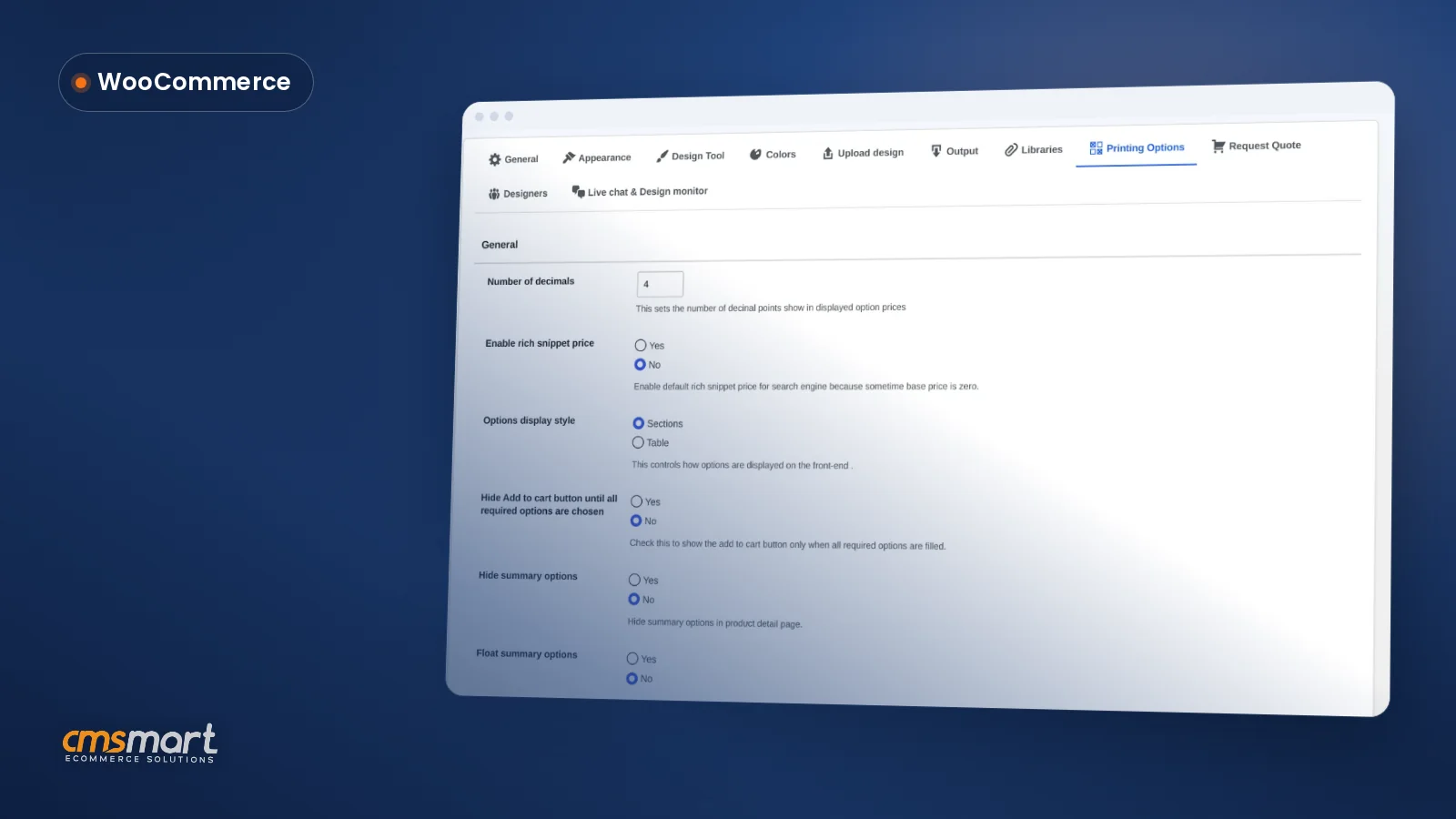
Cmsmart Product Designer 2.17 installs like any WordPress plugin update, but a print shop should set up the update with a quick settings and price-matrix review, not just click "update now" — here's how to do it without surprising your production team.
For settings not covered here, the 2.17 release note lists every change in detail, and the web-to-print solutions hub covers the wider storefront setup.
Going further: what can Cmsmart build on top of Product Designer 2.17?
Cmsmart builds the custom work that sits next to the core plugin: deeper AI preflight rules, ERP/MIS sync, bespoke pricing logic, multi-step B2B approval and production routing, all delivered by the same team that maintains NBDesigner.
Cmsmart delivers this the same way for every engagement: discovery, solution design, build sprints, QA against your real catalogue, launch, and ongoing support — see how recent builds came together on /ecommerce-projects. Most of this work is scoped under the same product designer customization service that covers the update itself.
Plan my Product Designer upgrade
Why work with Cmsmart on your Product Designer upgrade?
Cmsmart has built and supported Cmsmart Product Designer (NBDesigner) since 2012 as a Netbase JSC division, with thousands of web-to-print and WooCommerce projects behind the plugin your store already runs.
The numbers behind that: 6,300+ client projects and 4,600+ projects delivered since 2012, 1,800+ live stores and clients in 80+ countries, with a Trustpilot rating of 4.2 from 404 reviews.
One of those reviews, from a web developer who has run the plugin for three years: "It is wonderful to see their commitment to continuous development, with new features being added frequently to keep the software current and highly capable… The designer works exceptionally well across all devices." — Web Developer, Trustpilot, September 2026.
See how other stores used the designer and the team behind it on /projects.
Frequently asked questions
How long does updating the NBDesigner plugin actually take?
The plugin update itself takes minutes. Budget 20–30 minutes total for the backup, the update, a license re-sync if needed, and the settings and test-order checklist above before you call it done.
Will updating to 2.17 change my existing products, templates or price matrix?
No — your products, design areas, templates and Printing Options price matrix carry over. The checklist above has you spot-check them because any WordPress update is worth verifying on a store taking live orders, not because 2.17 is known to change them.
Our license shows Expired or LITE right after updating. What do we do?
Open Cmsmart → License and use Re-sync licence. The plan status is cached for up to 6 hours after a renewal, upgrade or migration, and the re-sync button forces an immediate check against the server.
Can Cmsmart handle the update, testing and settings review for us?
Yes — this is exactly the kind of engagement the product-designer-plugin desk handles: the update, a settings and price-matrix audit, and a test order before handoff, scoped to your store.
Does the approved-artwork lock stop a buyer from fixing a genuine mistake in their own design?
No — a store can widen or adjust the lock with the
nbd_ordered_design_edit_lockedfilter, and an admin can still manage the order normally. The lock stops an accidental or unauthorized overwrite of a design the buyer already signed off, not a legitimate correction your team allows.Can the print-ready pipeline connect to our ERP or MIS system?
Connecting print-ready files and order data to an ERP or MIS is custom integration work Cmsmart builds around your existing systems — see the Cmsmart Product Designer product page for what ships in the core plugin today, then talk to the team about the rest.