

Guide · Web-to-print
Cmsmart Stores Setup Wizard: What's New, October 2026
The Cmsmart Stores Setup wizard installs niche, B2B and Marketplace stores with sample data live in minutes. See what changed and try it free.
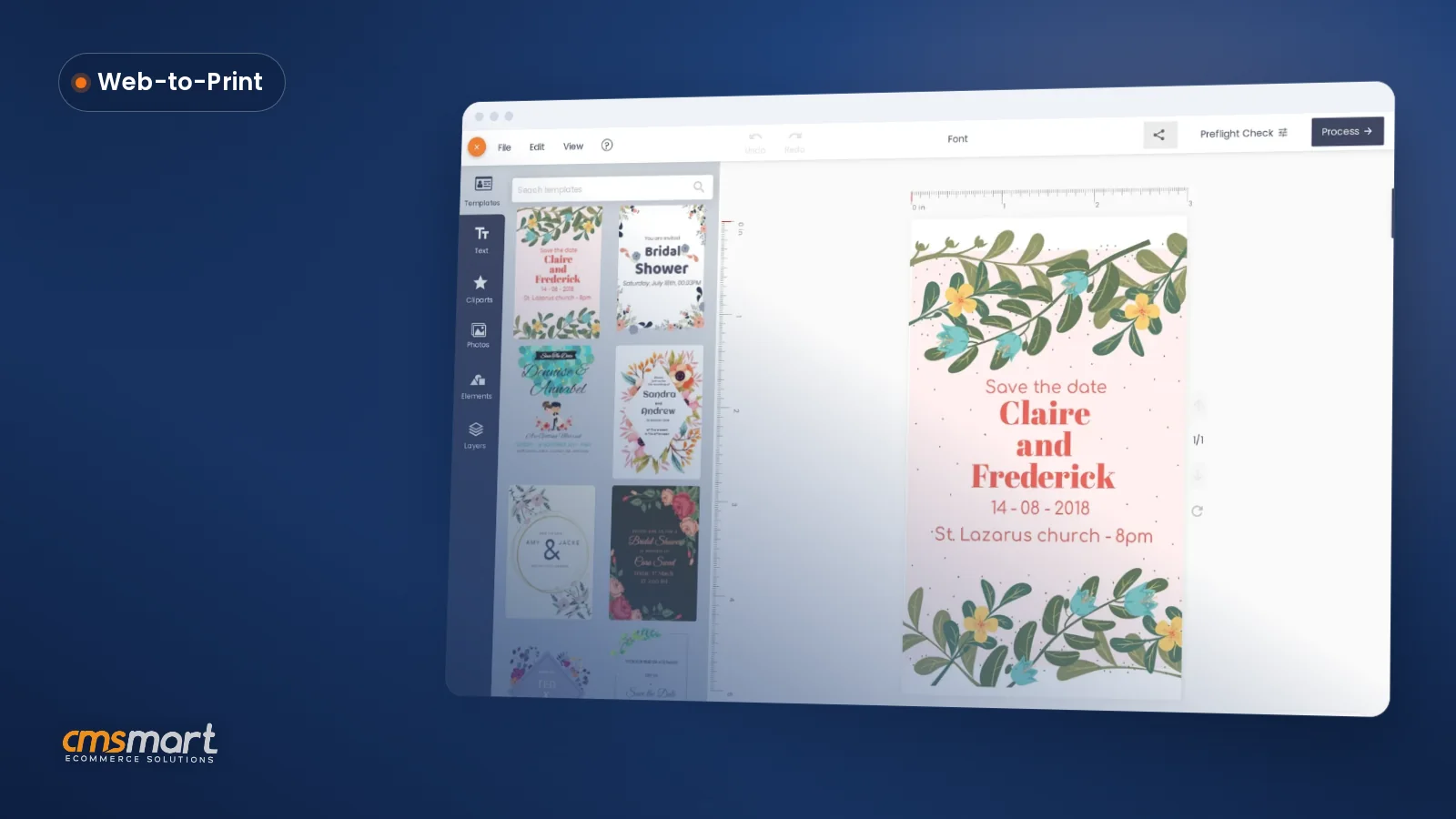
A buyer who sees a finished wedding invitation, business card or gang-sheet layout picks it, swaps the names and photos, and pays in minutes; a buyer who lands on a blank canvas closes the tab. This guide shows how to convert PSD to template designs in Cmsmart Product Designer so customers can personalize your studio's Photoshop (PSD) work, what still has to be rebuilt by hand, and where custom development closes the gap for a large catalog.
Was this tutorial helpful?
Written by
Cmsmart Product Designer Plugin Engineer
Builds and supports the Cmsmart Product Designer (NBDesigner) for WooCommerce.
The team behind it
 Account Manager
 Project Manager
 Business Analyst
 Developers & QA
Guide · Web-to-print
The Cmsmart Stores Setup wizard installs niche, B2B and Marketplace stores with sample data live in minutes. See what changed and try it free.
Guide · Web-to-print
The NBDesigner plugin now gives stationery shoppers a curated background library so print-ready PDFs always match the preview. See how to set it up.
Guide · Web-to-print
See how t-shirt artwork approval and print-ready PDFs cut POD reprints on WooCommerce; get a free workflow review from Cmsmart today.
Browse more guides, tutorials and case studies from the Cmsmart community.
Run a custom tote bag printing business with Cmsmart Product Designer: live pricing, real print specs and a print-ready PDF. See how to set it up.
Read MoreBuild a car wrap ecommerce store on WooCommerce: panel pricing, approval and print-ready PDFs before you print. Plan your wrap store today.
Read MoreDiscover how the home décor industry is transforming with the rise of personalized products and the challenges retailers face. Learn how CMSmart's Product Builder offers a solution, improving customer engagement, reducing return rates, and increasing sales through real-time 3D previews and automated processes.
Read More
Cmsmart Ecommerce provides custom ecommerce and WooCommerce development services for web-to-print, product personalization, plugin support and API integration.
Cmsmart Product Designer Plugin Engineer
Builds and supports the Cmsmart Product Designer (NBDesigner) for WooCommerce.
Meet the team →




In short
How do you convert PSD to template designs without losing a week of staff time?
Cmsmart Product Designer gives every store a Template library and a layer-based editor, but turning a finished Photoshop file into an online template is still manual work: someone has to recreate the text, photos and layout with the designer's own tools before a customer can personalize it.
Most print shops and POD sellers run the same two workflows side by side, and the gap between them is where orders get lost:
The print-on-demand category these templates sell into is not small: the global print-on-demand market was valued at $10.8 billion in 2025 and is projected to reach $57.5 billion by 2033 (Grand View Research, 2025), which is exactly why a slow template pipeline is a measurable cost, not just an annoyance.
What does it look like when your whole PSD catalog is ready to personalize?
Imagine every finished Photoshop layout living in Cmsmart's Template library, assigned to the right products, so a buyer opens your store, picks a design that already matches your brand, edits the name and photo, and checks out — no design request, no back-and-forth proof emails.
Example scenario. A print shop's design team finishes a dozen new invitation and poster layouts in Photoshop every month for an upcoming season. Today, a staff member has to rebuild each one inside the online designer before it can go live — a job that stacks up fast. In the target state, each finished PSD is rebuilt once, saved to the Template library, and assigned to every matching product in a couple of clicks; a buyer browsing that category sees the new look the same day, opens it in the editor, swaps the headline and photo, and the order lands in the queue with a print-ready PDF already attached.
That gap between "designed" and "sellable" is exactly what a faster template pipeline closes — whether that means your team working faster inside the existing editor, or talking to an ecommerce expert about automating the conversion for a large catalog.
How does Cmsmart turn a finished design into something a customer can personalize?
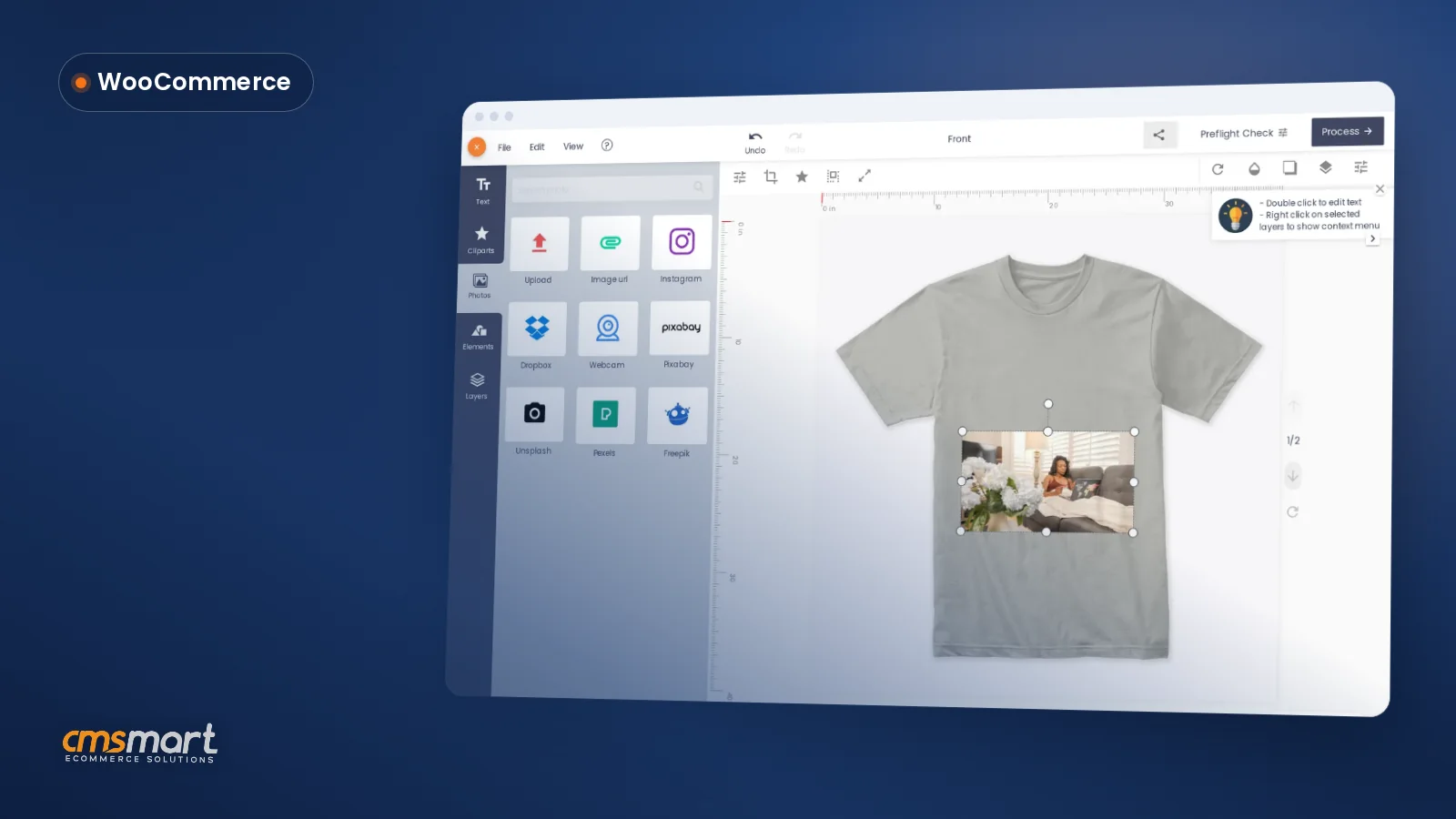
Cmsmart Product Designer's architecture has three working pieces today: the Template library that stores and assigns templates to products, the Text/Cliparts/Photos/Elements/Layers editor your team uses to rebuild a PSD on the canvas, and Upload design settings that accept a customer's own PSD, AI, EPS or TIFF as order artwork.
Here is what is real in the plugin versus custom work, so you can plan either path honestly.
psd(plusai,eps,tiff) as allowed, so a customer with finished artwork can attach it directly instead of using the editor.Cmsmart insight: When we rebuild a PSD as a template, we check three things before anything else: the safe zone matches the product's print area, fonts are either web-safe or embedded, and any gradient or shadow effect is flattened to a raster layer — vector-only effects from Photoshop don't always survive a one-to-one rebuild in a browser-based editor.
What's the business value of moving from one-off PSD files to a reusable template library?
Every PSD you convert into a Cmsmart template becomes a reusable sales asset: the ROI shows up as fewer custom-design requests, faster checkout for buyers who self-serve from the gallery, and fewer reprints once DPI and print-area checks catch bad files before production.
ROI worksheet (fill in your own numbers):
Monthly rebuild cost ≈ N × H × R. Compare that to the cost of a custom PSD-import pipeline (below) once N climbs into the dozens.
Track it with a KPI you already have in the admin: open Orders to see how many carts are abandoned at the design step, and Files to see how many uploads get flagged for low resolution before they reach production.
For context on why this category is worth the setup time: WooCommerce powers about 33.4% of tracked ecommerce stores (StoreLeads, August 2025) — a large share of the print shops and POD sellers you're competing with are on the same platform you are.
How do you set up PSD-based templates in Cmsmart Product Designer?
To configure Cmsmart Product Designer so your PSD designs become buyer-ready templates, you rebuild each layout once with the editor's own tools, publish it through the Template library, and set Upload design to accept PSD files for customers who bring their own artwork.
psd(plusai,eps,tiffif you accept them) to Allowed file types, so customers with their own finished artwork can upload it directly instead of using the editor.For the design-area and print-boundary settings referenced in step 3-4, see configuring a design area for WooCommerce products; for the buyer-facing preview step, see creating a preview builder for your product.
What can Cmsmart build on top of the template library for a large PSD catalog?
For stores with dozens or hundreds of PSD templates, manual rebuilding doesn't scale — Cmsmart builds custom PSD-to-template pipelines, brand-kit automation and catalog import tools on top of the Online Designer so your entire design library goes live without a rebuild queue.
None of the following ships in the core plugin today. Each is custom development Cmsmart scopes and builds:
Delivery follows the same process for every custom project: discovery call, solution design, build sprints, QA, launch and ongoing support — you can see how that's structured on the Ecommerce Projects page before you commit to scope, or read how this fits under product designer customization services.
Plan my PSD-to-template pipeline
Why work with Cmsmart on your product designer templates?
Cmsmart has built and supported the Online Designer plugin and the custom projects around it since 2012 as a Netbase JSC division, so a template or import pipeline you commission is built by the same team that maintains the plugin's release notes.
Cmsmart has delivered 6,300+ client projects and 4,600+ completed projects since 2012, supports 1,800+ live stores across 80+ countries, and holds a 4.2 rating on Trustpilot from 404 reviews. Want a broader starting library instead of rebuilding every PSD by hand? Cmsmart also sells a Premium Templates pack of 680+ ready-to-edit designs across 23 collections. See the Cmsmart Product Designer plugin page for the full feature set, and the web-to-print solutions hub for the wider picture.
Frequently asked questions
Can NBDesigner import a PSD file directly as an editable template?
Not automatically — there's no built-in PSD parser. You rebuild the layout once with the editor's Text, Photos, Cliparts, Elements and Layers tools, then publish it through the Template library. For a large catalog, Cmsmart builds an automated PSD-import pipeline as custom development.
What file types can a customer upload if they already have finished artwork?
Whatever you allow in Settings → Upload design. The field takes a comma-separated list, and common print source formats including
psd,ai,epsandtiffcan be added so customers attach ready files instead of using the editor.How many templates can I keep in the Global template store?
License & activation shows your plan's limit: Free/Trial is capped at a small number, and Premium is unlimited, alongside hi-res PNG export, JPG with CMYK/ICC profile and print-ready PDF export.
Will the print-ready PDF actually match the template I built?
As of version 2.17.0, the automatic export, the order screen's Create PDF action and the cloud renderer all read the same page geometry — including custom sizes — so the production file matches what was approved, and an approved design is locked from further edits.
How long does a custom PSD-to-template pipeline take to build?
It depends on catalog size and how much brand-kit automation you want, but custom product-designer projects follow the discovery, solution design and build-sprint cycle described on the Ecommerce Projects page. Share your template count and launch date in a project proposal and Cmsmart will scope it.