

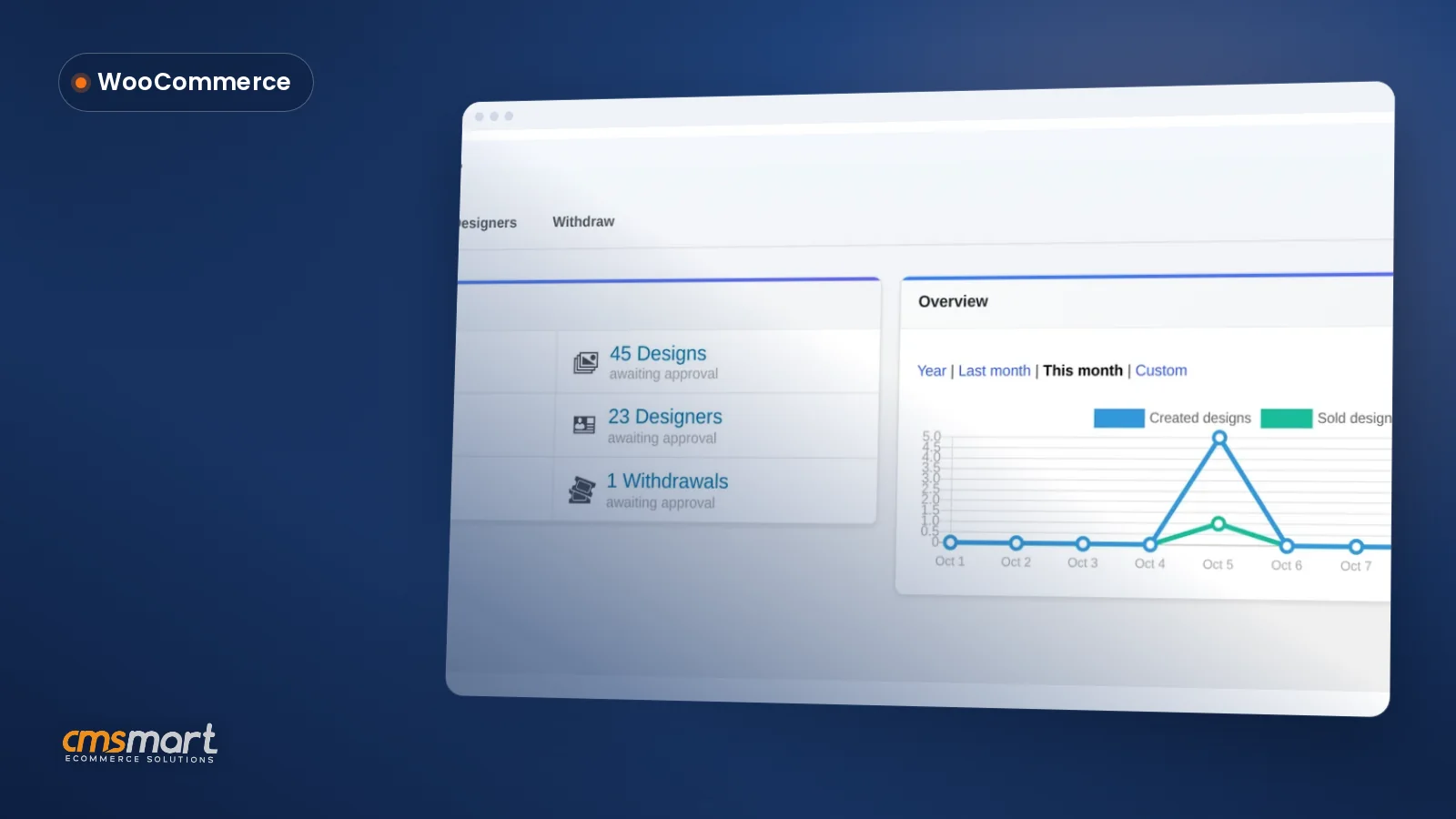
Guide · Web-to-print
Designer Marketplace WooCommerce Commission Setup
Run a designer marketplace woocommerce commission setup: freelance designers sell templates, earn fairly, and request withdrawals you approve.
WooCommerce Product Designer templates let buyers personalize a ready-made layout, not a blank canvas. See the Cmsmart setup steps and get a custom quote.
Table of contents
Was this tutorial helpful?
Written by
Cmsmart Product Designer Plugin Engineer
Builds and supports the Cmsmart Product Designer (NBDesigner) for WooCommerce.
The team behind it
 Account Manager
 Project Manager
 Business Analyst
 Developers & QA
Guide · Web-to-print
Run a designer marketplace woocommerce commission setup: freelance designers sell templates, earn fairly, and request withdrawals you approve.
Guide · Web-to-print
Approve customer artwork WooCommerce orders carry before they print: set up Cmsmart's approval box, notify customers, and start production.
Guide · Web-to-print
See how Cmsmart generates a print ready pdf woocommerce orders can send to production: bleed, CMYK, watermark off, automatically. Get a quote.
Browse more guides, tutorials and case studies from the Cmsmart community.
Custom bag design software for WooCommerce: Cmsmart Product Designer adds live pricing and print-ready files. See how to set it up.
Read MoreCar wrap design software for WooCommerce: panel templates, size-based pricing, 3D preview and approval before you print. Plan your wrap store now.
Read MoreDiscover how the home décor industry is transforming with the rise of personalized products and the challenges retailers face. Learn how CMSmart's Product Builder offers a solution, improving customer engagement, reducing return rates, and increasing sales through real-time 3D previews and automated processes.
Read More
Cmsmart Ecommerce provides custom ecommerce and WooCommerce development services for web-to-print, product personalization, plugin support and API integration.
Cmsmart Product Designer Plugin Engineer
Builds and supports the Cmsmart Product Designer (NBDesigner) for WooCommerce.
Meet the team →



In short
Every blank canvas is a buyer who has to become a designer before they can buy from you, and most of them won't. WooCommerce Product Designer templates flip that: Cmsmart Product Designer lets a WooCommerce store hand buyers a finished layout they only need to personalize, which is the fastest path from product page to paid order.
Why does a blank design canvas cost you orders?
Cmsmart Product Designer's blank online designer asks every buyer to build a layout from scratch, which is the single biggest reason print and customization stores lose carts. A template library removes that step: the buyer opens a finished design and only edits the parts that are theirs.
If you sell business cards, banners, invitations, mugs or any product through the online designer, a blank canvas creates the same five problems on repeat:
Cmsmart insight: the stores that get the most mileage from templates aren't the ones with the most designs — they're the ones that put one good template on every high-traffic product, even if it's a single layout. One template for your best-selling banner size beats twenty templates nobody can find.
What would it look like if every product started from a finished design?
Cmsmart Product Designer's template flow lets a buyer pick a ready-made layout from the storefront chooser or the designer's Templates panel, swap in their own text and photo, and reach checkout with a print-ready design — no blank canvas, no back-and-forth proof emails.
Example scenario. A buyer lands on a door-hanger product at 9pm. Instead of the design button opening an empty stage, they tap the templates option, pick a layout from the gallery, swap the heading text for their own business name, and drop in their logo. Process renders the finished artwork preview on the product page, the item goes into the cart with that preview attached, and checkout shows the same design the buyer approved. By the next morning the order's print-ready PDF is already rendered and waiting in the queue — nobody on your team touched a design tool.
How does Cmsmart Product Designer's template library work?
Cmsmart Product Designer stores template layouts centrally in Manager → Templates, assigns them to specific products, and surfaces them to buyers through a searchable Templates panel inside the online designer — so the same layout can serve every product you attach it to.
Three building blocks make this work, all in the plugin today:
What's deliberately not in the core plugin: franchise-style template locking per location, automatic seasonal template rotation tied to a marketing calendar, and variable-data personalization that merges a buyer's own CRM record into a template at scale. Those are real requests we hear from B2B and franchise shops — Cmsmart builds them as custom development on top of the template library (see "Going further" below).
What's the ROI of putting a template on your best-selling products?
A template library pays back in fewer abandoned design sessions, less manual layout work for staff, and fewer reprints from off-brand or badly proportioned designs — all trackable from data Cmsmart Product Designer already records in Orders and Files.
The underlying demand keeps growing: the global print-on-demand and personalized-product market was valued at $10.8 billion in 2025, projected to grow at a 23.6% CAGR through 2033. A template library is how you handle more of that volume without adding design staff.
Rough-cut ROI worksheet. Take your own numbers: (orders/month using the designer) × (minutes of staff design time saved per order) × (your loaded hourly rate ÷ 60) = monthly staff-time saved. Add: (reprints/month avoided) × (your average cost per reprint) for the production-cost side. Even a modest cut in manual layout work and reprints on a product doing a few dozen orders a month adds up over a quarter.
How do you set up WooCommerce Product Designer templates?
Cmsmart Product Designer lets you set up templates in two places: Manager → Templates for the shared catalog, and each product's own Templates tab to assign designs to that product — buyers then pick them from the storefront chooser or the designer's Templates panel.
Here's how to configure it, start to finish, using the Media menu group that 2.17.0 introduced:
Deep settings for upload types, DPI and output format live in the plugin's Cmsmart Product Designer settings guide rather than repeated here.
Going further: what custom development can Cmsmart build on your template library?
Beyond the built-in template library, Cmsmart builds custom development on top of it for stores that need rules the core plugin doesn't ship with — brand locking per franchise location, personalization at scale, or template packs synced from an outside system.
Common requests we hear from print shops, franchises and B2B sellers, and what we build for them:
Delivery follows the same path for all of it: discovery call → solution design → build sprints → QA → launch → ongoing support, the same model behind the case studies on our ecommerce project delivery page. See the full range of tailored design work on our product designer customization service page.
Get a custom template library quote
Why work with Cmsmart on your product designer templates?
Cmsmart has built and supported Cmsmart Product Designer (NBDesigner) since 2012 as a division of Netbase JSC, with thousands of client projects delivered and a template library that ships in the plugin every store already runs.
Cmsmart has delivered 6,300+ client projects since 2012, with 4,600+ projects delivered and 1,800+ live stores running today across 80+ countries. Reviews on Trustpilot average 4.2 out of 5 from 404 reviews, including from buyers of the template library itself:
See related work on our projects page or explore the Design Templates product page for what ships in the box. If you're setting up bulk or large-format work alongside templates, see batching designs with the gang sheet builder; if your products need configurable components rather than a single flat layout, see building components with Product Builder.
Frequently asked questions
Do I need a separate plugin to use templates with Cmsmart Product Designer?
No. Template management (Manager → Templates, the per-product Templates tab, and the storefront/designer Templates panel) ships inside Cmsmart Product Designer (NBDesigner) 2.17.0 — there's nothing extra to install.
Can I assign the same template to more than one product?
Yes. A template collection managed under Manager → Templates has an "Assign to products" action that pushes it to every product you pick, instead of rebuilding the layout per product.
Will a template-based order still get a print-ready PDF?
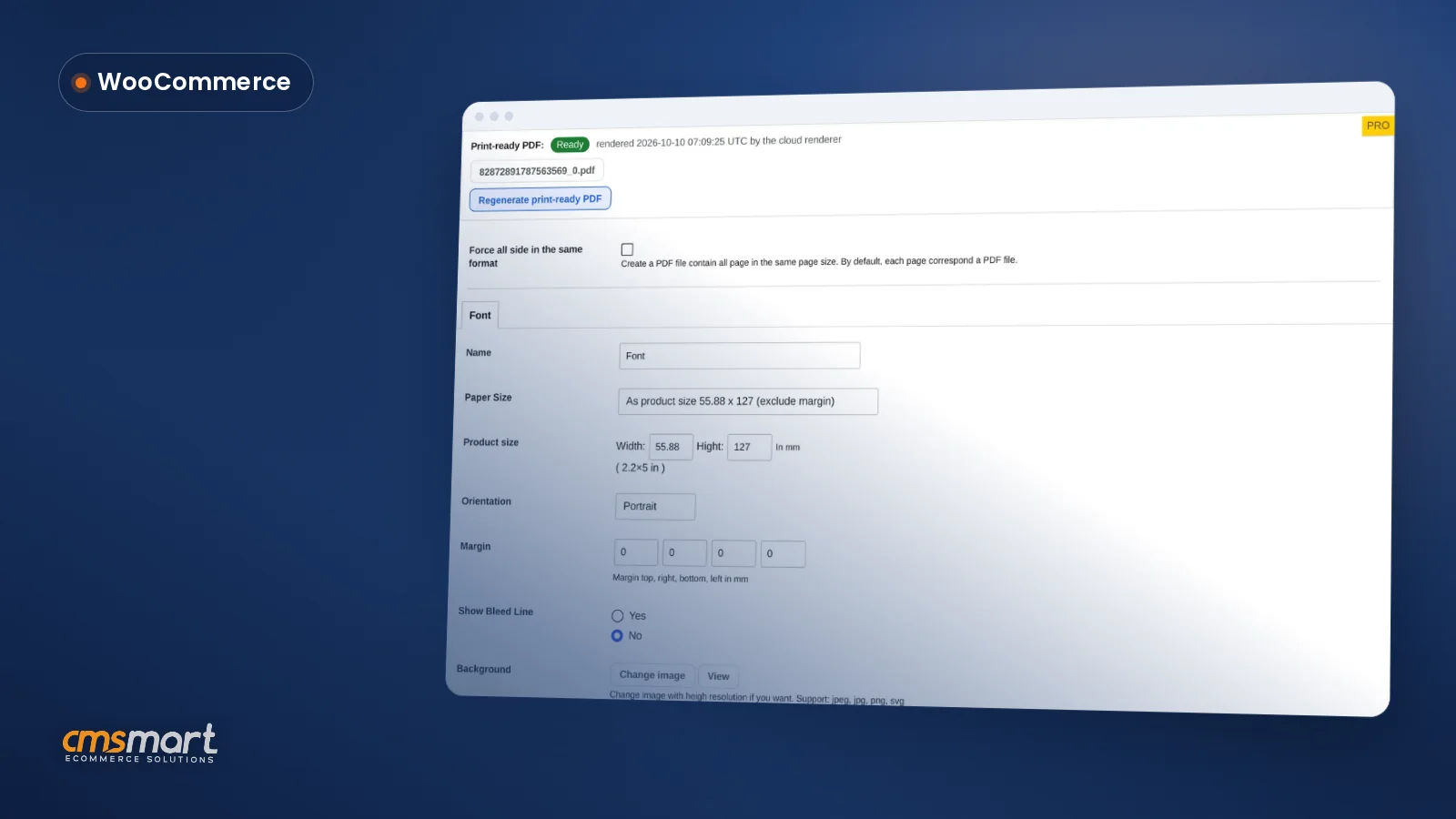
Yes. A template-based design goes through the same Create PDF and automatic print-ready pipeline as any other order — paper size, margins, bleed and the cloud renderer all work the same way once the buyer has personalized the template.
Can buyers still upload their own design instead of using a template?
Yes. The storefront chooser offers "Upload a full design" alongside "Design here online," so a buyer with finished artwork can skip templates entirely.
Can Cmsmart build template rules the core plugin doesn't have, like per-location brand locking?
Yes — that's custom development, not a core feature. Cmsmart builds franchise-level locking, variable-data personalization and ERP-synced template rotation as tailored projects on top of the template library; see the going-further section above.