

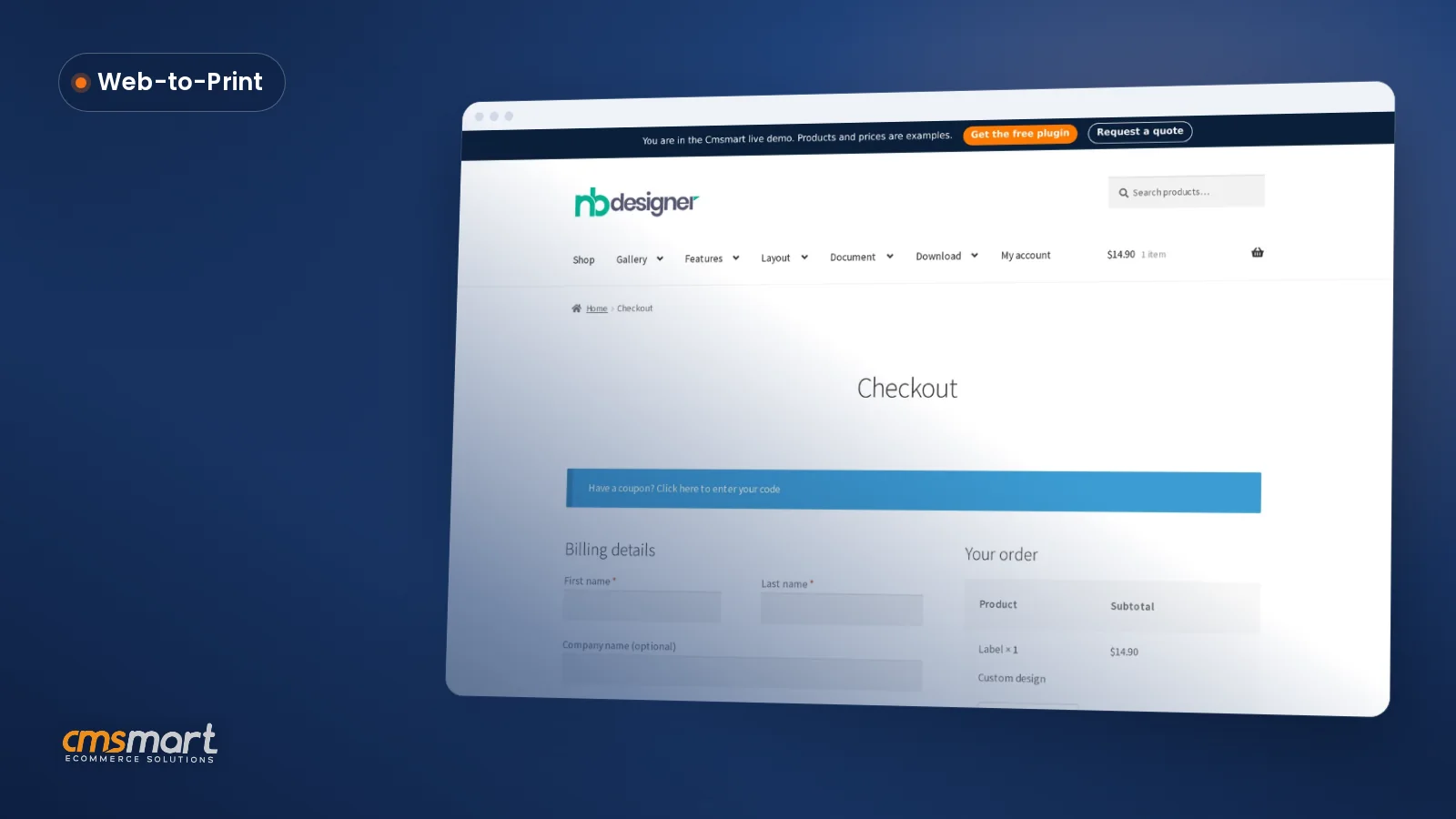
Case study · Web-to-print
Web-to-Label Printing: Sell Custom Product Labels Online
Set up web-to-label printing for product labels with Cmsmart Product Designer: upload, proofing and print-ready PDFs. Get a quote today.
Cmsmart Product Designer lets a WooCommerce print shop set upload rules for customer artwork directly in WooCommerce Settings, covering allowed file types, minimum and maximum file counts and sizes, and a minimum resolution for JPG and JPEG files. Bad uploads get rejected at the product page instead of discovered after the order is paid.
Was this tutorial helpful?
See also: Cmsmart pricing and Cmsmart products.
← Match Brand Colors in Your Product Designer · Sell Custom Products Internationally with WooCommerce →
Written by
Cmsmart Product Designer Plugin Engineer
Builds and supports the Cmsmart Product Designer (NBDesigner) for WooCommerce.
The team behind it
 Account Manager
 Project Manager
 Business Analyst
 Developers & QA
Case study · Web-to-print
Set up web-to-label printing for product labels with Cmsmart Product Designer: upload, proofing and print-ready PDFs. Get a quote today.
Guide · Web-to-print
See a sourced WooCommerce product designer plugin comparison: pricing, features and print-ready files, then request a free migration quote today.
Guide · Web-to-print
Translate WooCommerce product designer screens with Loco Translate or Frontend Translate: see every setting, its default, and how to set it up.
Browse more guides, tutorials and case studies from the Cmsmart community.
Run a custom tote bag printing business with Cmsmart Product Designer: live pricing, real print specs and a print-ready PDF. See how to set it up.
Read MoreBuild a car wrap ecommerce store on WooCommerce: panel pricing, approval and print-ready PDFs before you print. Plan your wrap store today.
Read MoreDiscover how the home décor industry is transforming with the rise of personalized products and the challenges retailers face. Learn how CMSmart's Product Builder offers a solution, improving customer engagement, reducing return rates, and increasing sales through real-time 3D previews and automated processes.
Read More
Cmsmart Ecommerce provides custom ecommerce and WooCommerce development services for web-to-print, product personalization, plugin support and API integration.
Cmsmart Product Designer Plugin Engineer
Builds and supports the Cmsmart Product Designer (NBDesigner) for WooCommerce.
Meet the team →


In short
A customer uploads a phone photo or a layered design file, and three days later it turns up unprintable — wrong format, too small, too low-resolution — after the order is already paid and queued. Cmsmart Product Designer lets a WooCommerce print shop set clear customer artwork file rules up front, and lets buyers download their own finished files back without a support ticket. Result: fewer unusable files reach production, fewer staff hours chasing replacements.
Most shops that let customers supply their own artwork — business cards, labels, packaging proofs, signage — learn the hard way that "just let them upload a file" is not a policy. A packaging label and a wedding invitation have different acceptable formats, sizes and resolutions, and the rules that protect one product can block a legitimate order on another. Order volume with a customer-supplied file keeps growing with it: the global print-on-demand market alone was valued at $10.8 billion in 2025, projected at a 23.6% CAGR through 2033 (Grand View Research, 2025) — so a loose upload policy gets more expensive every month you run it.
What's the real cost of accepting any file a customer sends?
Cmsmart Product Designer's Upload design settings stop the five most common causes of production delay — wrong format, oversized file, no file, too few files, and resolution too low to print — before an order reaches your print queue, so staff spend less time reworking files after checkout.
If your product pages accept uploads with no rules at all, the cost shows up later, usually after the order has already been paid:
None of this is a volume problem — a single bad file in a 10-order week can cost more staff time than the other nine orders combined, because nobody budgets time for "fix a customer's file" on the calendar.
What does it look like when your upload rules are dialed in?
Cmsmart Product Designer applies your allowed file types, size limits and minimum resolution at the moment a customer uploads, so bad files are rejected on the product page with a plain-English reason — not discovered by a production worker three days later.
Example scenario. A buyer orders a box of 500 die-cut labels at 11 p.m. and uploads a vector file straight from their design software. The upload form only accepts the formats your press can run, checks the file is within your size and resolution limits, and confirms on the spot — no "we'll email you if there's a problem." The order lands in your queue already proof-ready. A second buyer on the same night tries to upload a screenshot for the same product; the form tells them immediately that the file is below your resolution minimum, with a plain explanation of why, instead of letting the order through and surprising your prepress team in the morning.
Talk to an ecommerce expert if you want this tuned per product category rather than store-wide — start a conversation about your upload policy.
How does Cmsmart's upload and file-governance architecture work?
Cmsmart Product Designer checks every upload against store-wide rules, records the result on a central Files dashboard, and keeps the approved file locked through production — so the same policy protects every product without a developer touching code.
The architecture has four building blocks, and all four ship in the plugin today:
Cmsmart insight: in delivery work, the stores that skip a file-type allowlist are the ones still fielding "why won't my file upload" tickets from customers sending formats the product was never designed to print. Setting the allowlist per product category once is cheaper than explaining it by email every week.
What's the business value of controlling customer uploads?
Cmsmart Product Designer turns upload quality into a KPI you can watch on the Files dashboard, instead of a complaint you hear about after a reprint — so the value shows up as fewer wasted print runs and fewer support hours, not a promised sales lift.
Your numbers: if you run N orders a month with a customer-supplied file, and a share r of them currently need rework, each costing roughly m minutes of staff time at c per hour, loose upload rules cost you approximately
N × r × m ÷ 60 × cper month in rework alone — before counting the cost of a reprint (materials + press time + a missed delivery date) on the files that go all the way to production before anyone notices.How do you set up customer artwork file rules in Cmsmart Product Designer?
Cmsmart Product Designer's Upload design tab sets your store-wide rules in one screen, then the Files dashboard and order approval box carry the policy through to production — all inside WooCommerce > Settings > Cmsmart, no code required.
Set the store-wide defaults once, then tighten individual products that need stricter rules:
jpg,pdf,psd,ai). Leave it empty to allow everything except what you list under Disallowed file types.A print-ready file (often built to the PDF/X family of standards) packages fonts, color and page geometry so a press can run it without guesswork (Datalogics, 2026). Cmsmart's own Output settings (CMYK/ICC profile, bleed, AI preflight) sit one tab over from Upload design, and are covered in our DPI configuration guide if you want the resolution number to display to the buyer as well as enforce it server-side.
Going further with custom development
Cmsmart builds upload and file-governance rules that go beyond the two-tier (global + per-product) settings — per-customer-group rules, automated correction workflows and ERP-connected file intake — as custom development for stores whose policy needs are more specific than one settings screen.
The built-in settings cover most stores. For a few business models, the policy itself needs to be smarter than "same rule for everyone":
Projects like these follow the same delivery model as the rest of our ecommerce project work: a short discovery call, a written solution design, build in sprints you can review, QA against your real catalog, launch, and support afterward.
Get a custom file-governance quote
Why work with Cmsmart on your upload policy?
Cmsmart has built and supported Cmsmart Product Designer (NBDesigner) for WooCommerce print shops since 2012 as a Netbase JSC division, with 6,300+ client projects delivered and a 4.2/5 Trustpilot rating from published reviews.
Cmsmart Product Designer is used across 1,800+ live stores in 80+ countries, and the same team that builds the plugin also takes on the custom-development work above. A long-time user summed up the day-to-day experience on Trustpilot:
If your store lets buyers add their own photo as a design element inside the online editor, rather than upload a finished print file, our guide on the background tab and image upload feature covers that side of the designer. See also the web-to-print solutions hub and our AI integration services if you want AI preflight added to the same workflow. The plugin itself lives on the Cmsmart Product Designer product page.
Frequently asked questions
Can I set different upload rules for different products?
Yes. The Upload design tab sets your store-wide defaults, and individual products can override file type, size and DPI limits where a specific item needs stricter or looser rules.
Does the Min. resolution DPI setting check PDF and vector uploads too?
The built-in DPI check applies to JPG/JPEG uploads. PDF and vector files carry their own resolution characteristics; AI Preflight (configured in Cmsmart Cloud) can be set to review those formats before an order reaches production.
Can customers download the file they uploaded, after it's been processed?
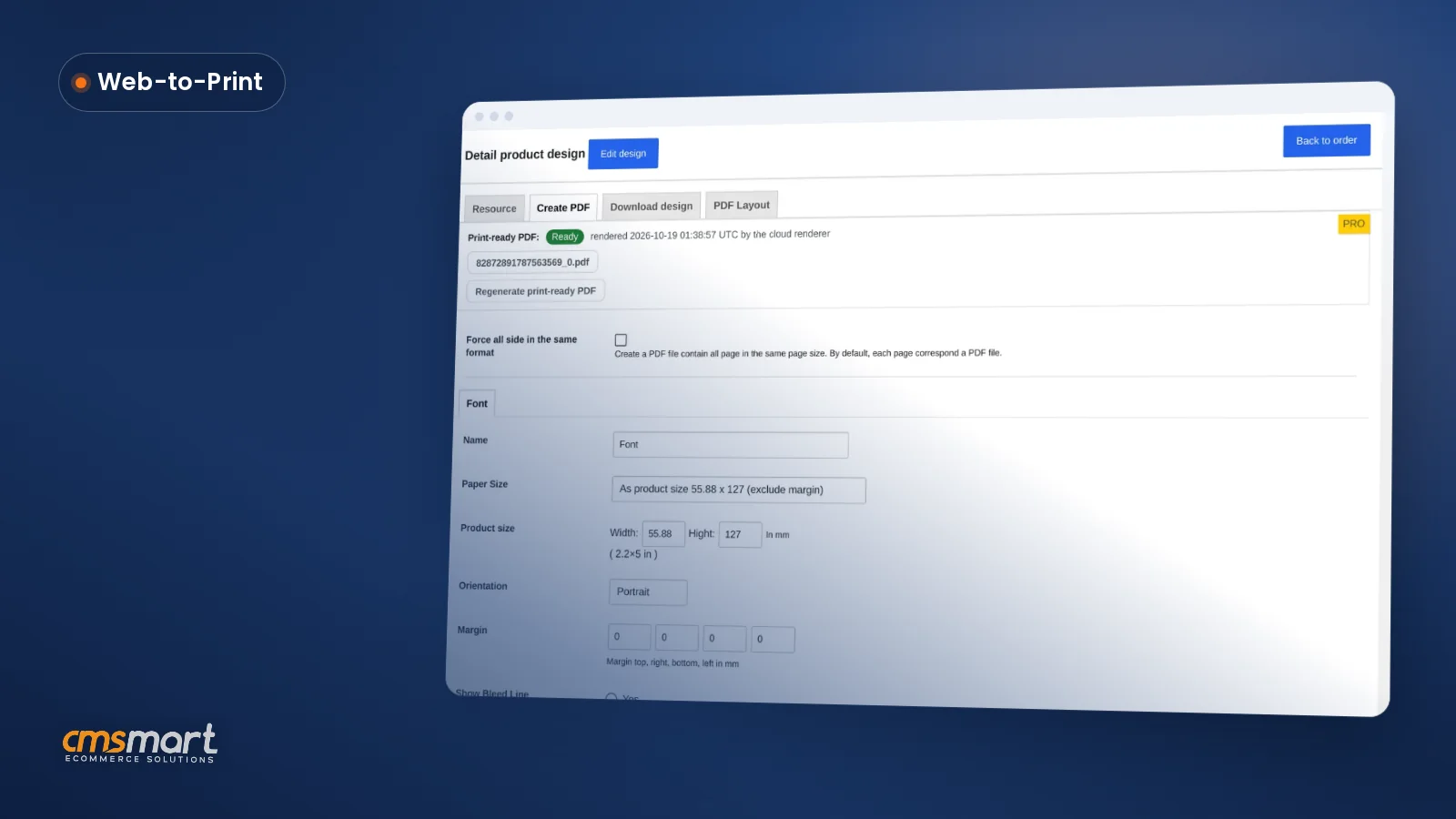
Yes, once a design is approved you can offer the Download design tab's SVG, PNG, CMYK/ICC JPG and PDF formats to the customer or keep them for staff-only use — the choice is yours.
What happens to a file that fails the rules?
The upload is rejected at the product page with the reason (wrong type, too large, too small, too few/many files), so the customer can fix it before checkout instead of after.
How long does it take to see the backlog of existing low-resolution files?
The Files dashboard totals not-checked, print-ready and low-DPI files for your whole catalog as soon as you open it — no separate report needed.
Can Cmsmart connect our upload rules to our print MIS or ERP?
That's custom development: Cmsmart builds a pipeline that pushes approved, print-ready files into your production system automatically, matched to your existing MIS/ERP.
What does the Files dashboard show about uploaded artwork?
The Files dashboard indexes every upload with its order, customer, preflight status and DPI, and totals not-checked, print-ready and low-DPI files across the whole catalog. This gives staff one place to see the real backlog of artwork needing a decision instead of searching through old email threads.
Which cloud or social sources can customers import artwork from during upload?
Depending on the Upload file mode set in Cmsmart, customers can import artwork not only from their device but also from cloud and social sources such as Dropbox, Google Drive, Facebook and Instagram. Store owners choose which of these import sources to allow when reviewing the Upload design tab.
Why does a store need a minimum and maximum file upload setting?
Min files uploads and Max files uploads stop two opposite problems: a product that needs artwork being ordered with zero files attached, and a simple product being flooded with more uploads than it needs. Setting both limits in the Upload design tab keeps each product's file requirement matched to what it actually needs.
How do I pay securely?
Contracts and payments go to the company, Netbase JSC: plans are paid through PayPal; services are invoiced by Netbase JSC under a written proposal and paid by bank transfer to Netbase JSC's company account or by PayPal Business. Cmsmart (Cmsmart Ecommerce) is the ecommerce brand of Netbase JSC, a company based in Hanoi, Vietnam.
How do I contact Cmsmart or get a quote?
Message the Cmsmart team on WhatsApp at +84 937 869 689 or email project@cmsmart.net; the contact page at cmsmart.net/contact lists every channel, and Request a quote (cmsmart.net/project-proposal) sends a project brief. Customers with a licence open a ticket from the dashboard.
Further reading