

Guide · Web-to-print
Cmsmart Stores Setup Wizard: What's New, October 2026
The Cmsmart Stores Setup wizard installs niche, B2B and Marketplace stores with sample data live in minutes. See what changed and try it free.
A product customization tool for WooCommerce lets shoppers change the text, color, photo and layout on a product before they pay, instead of emailing a print shop back and forth over every detail. Cmsmart Product Designer (NBDesigner) puts that live editor right on the product page, then locks the approved artwork and renders it into a print-ready file for your production team.
Was this tutorial helpful?
Written by
Cmsmart Product Designer Plugin Engineer
Builds and supports the Cmsmart Product Designer (NBDesigner) for WooCommerce.
The team behind it
 Account Manager
 Project Manager
 Business Analyst
 Developers & QA
Guide · Web-to-print
The Cmsmart Stores Setup wizard installs niche, B2B and Marketplace stores with sample data live in minutes. See what changed and try it free.
Guide · Web-to-print
The NBDesigner plugin now gives stationery shoppers a curated background library so print-ready PDFs always match the preview. See how to set it up.
Guide · Web-to-print
See how t-shirt artwork approval and print-ready PDFs cut POD reprints on WooCommerce; get a free workflow review from Cmsmart today.
Browse more guides, tutorials and case studies from the Cmsmart community.
Run a custom tote bag printing business with Cmsmart Product Designer: live pricing, real print specs and a print-ready PDF. See how to set it up.
Read MoreBuild a car wrap ecommerce store on WooCommerce: panel pricing, approval and print-ready PDFs before you print. Plan your wrap store today.
Read MoreDiscover how the home décor industry is transforming with the rise of personalized products and the challenges retailers face. Learn how CMSmart's Product Builder offers a solution, improving customer engagement, reducing return rates, and increasing sales through real-time 3D previews and automated processes.
Read More
Cmsmart Ecommerce provides custom ecommerce and WooCommerce development services for web-to-print, product personalization, plugin support and API integration.
Cmsmart Product Designer Plugin Engineer
Builds and supports the Cmsmart Product Designer (NBDesigner) for WooCommerce.
Meet the team →




In short
Why does letting customers edit their own design cost you orders — or reprints?
Cmsmart Product Designer replaces the email thread with a live editor, so a WooCommerce print shop stops re-quoting every color change by hand and stops finding a stretched logo or a missing bleed only after the job is already on press.
Grand View Research sizes the global print-on-demand market at USD 10.8 billion in 2025 — volume a manual, email-based process struggles to absorb. If your shop still takes custom orders by email or a static "upload your file" field, the real cost shows up in a few places:
What would it look like if your shoppers could edit the design themselves?
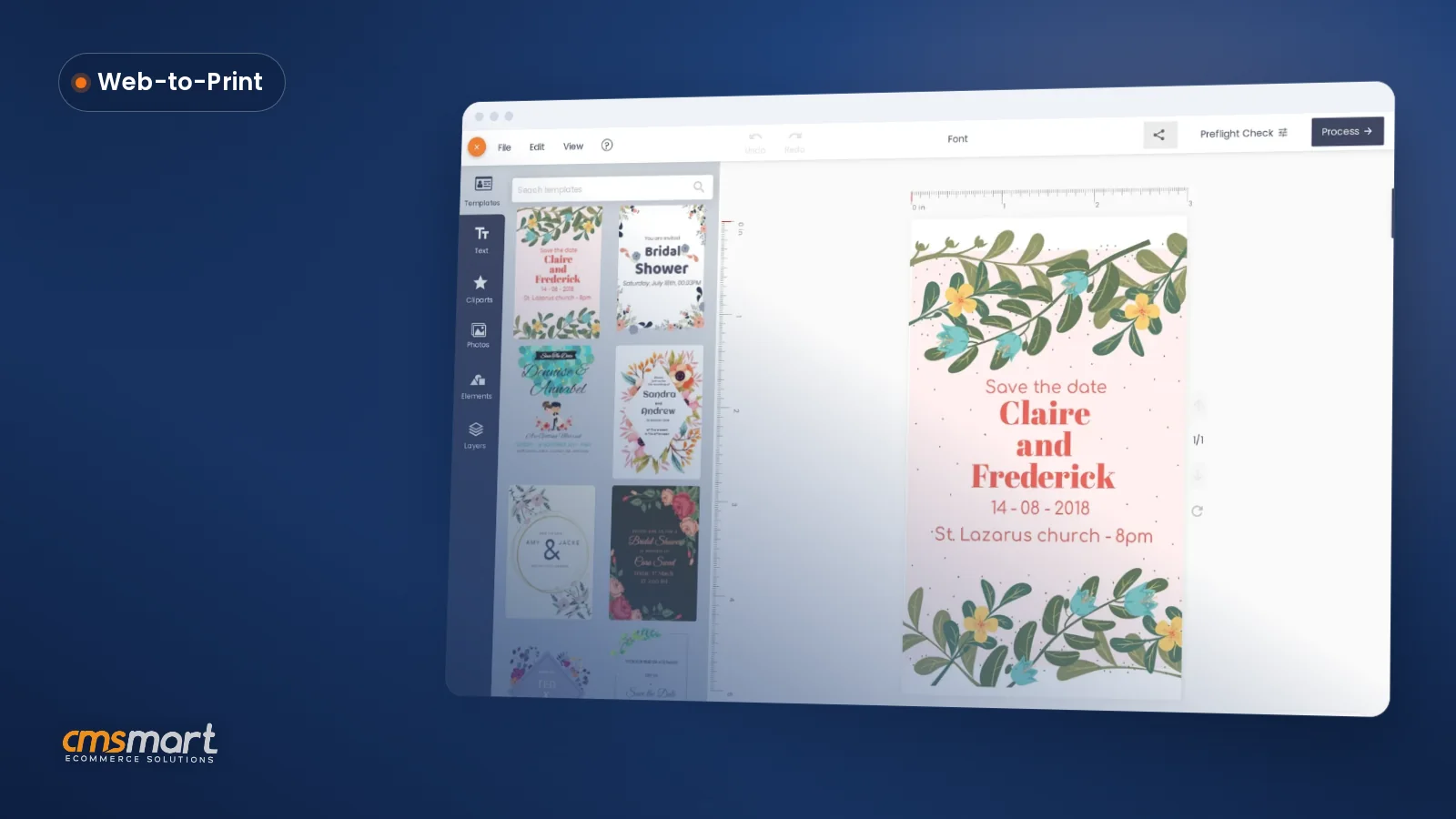
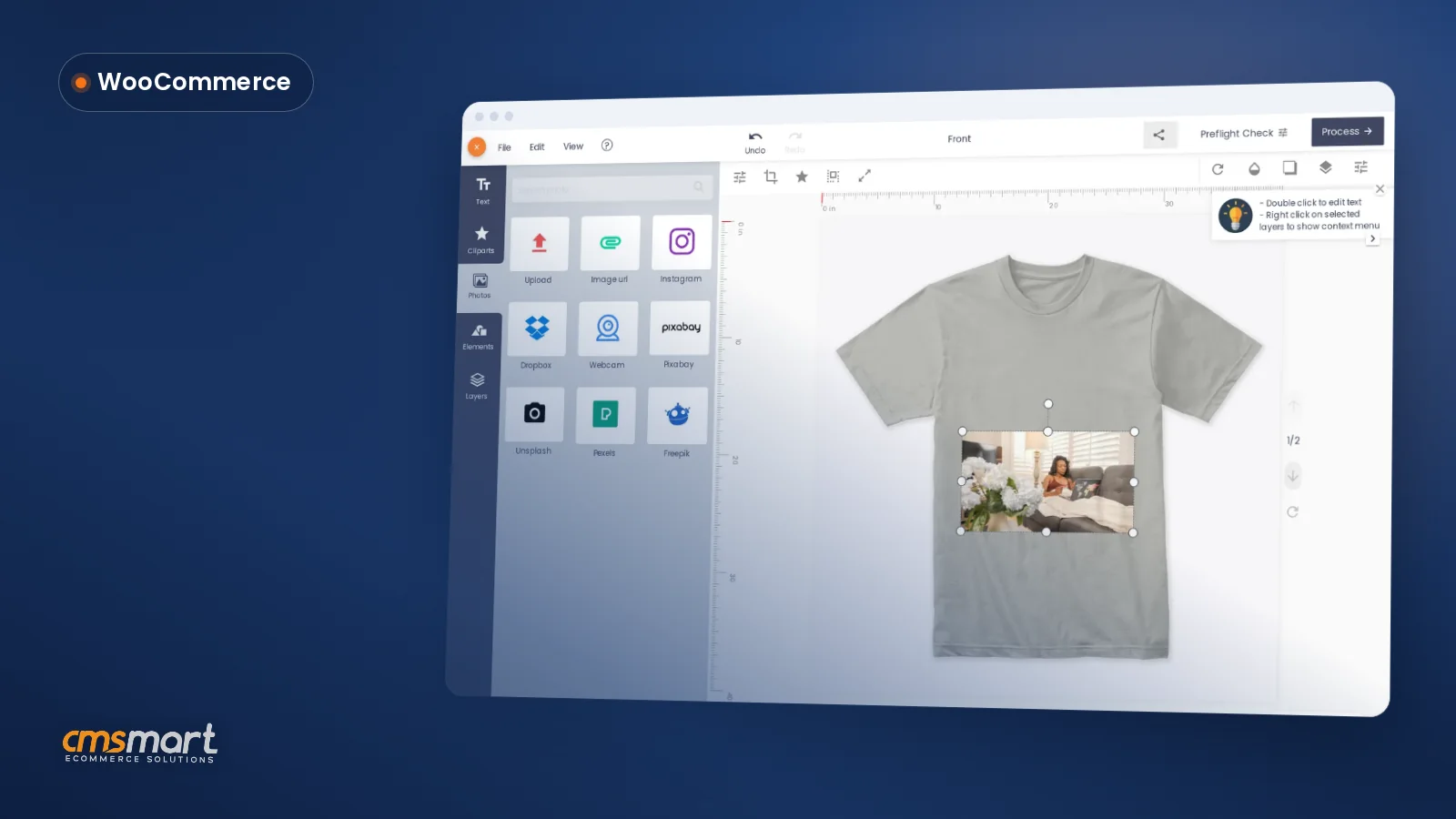
With Cmsmart Product Designer, a WooCommerce shopper opens the product, edits text, color, photos and layout directly on the canvas, and sees the finished look and the price before they add it to cart — no email, no wait, no guessing.
Example scenario: A gift-shop buyer opens a tote bag product at 9pm. They drag on a monogram, bump the text up two sizes, and pick a thread color to match a bridesmaid's dress — the price on the page doesn't move, because the edit is covered by the product's existing options. They click Process, see "Your artwork" sitting next to Add to cart, and check out through WooCommerce's standard Cart and Checkout blocks, with the design carried through as a normal cart line item. By the time the shop opens the next morning, the design is already locked, approved and sitting in the print queue.
How does this product customization tool for WooCommerce actually work?
Cmsmart Product Designer's online editor keeps every element — text, image, clipart, layer — in one design record on the server, so the same data a shopper edits is what gets rendered into the print-ready PDF, with nothing retyped or re-exported by hand.
The pieces, and which ones ship in the plugin today versus what Cmsmart builds as custom development:
Cmsmart insight: in delivery work, most of the reprints we get asked to fix trace back to a buyer-uploaded image that looked sharp on a laptop screen but was well under print resolution at full size. Turn on AI preflight and require it before Process, not just as an optional button — it's cheaper to ask for a bigger file than to redo a print run.
What's the business value of letting shoppers edit their own designs?
Live editing in Cmsmart Product Designer turns proofing from a back-and-forth cost center into a one-time setup: shoppers resolve their own text and color decisions on the canvas, and your team spends its time on production, not on re-quoting small changes.
Rough ROI worksheet — use your own numbers:
Add the three and compare it to the cost of setting up and maintaining the editor on your product catalogue.
How do you set up live editing on a WooCommerce product?
Setting up Cmsmart Product Designer's editing tools means turning on the designer for a product, confirming your print specs in Settings, and testing the buyer path from "Start design" through to an approved, print-ready file.
What can Cmsmart build on top of the standard editor?
Beyond the editing tools in the box, Cmsmart builds custom development on the same design data — edit-aware pricing, ERP handoff, mobile and interactive 3D, and batch production tools — for stores whose workflow needs more than the standard canvas.
The standard editor covers text, image and layer editing well for most catalogs. When a store's workflow needs more, these are the extensions we build most often, each as custom development on top of the same design record:
These are scoped and built through our product designer customization service, following the same delivery rhythm every time: discovery and scoping, solution design, build in sprints, QA, launch, then ongoing support — see how that works on Cmsmart's ecommerce projects page.
Get a custom editor quote
Why work with Cmsmart on your product editor?
Cmsmart has built and supported web-to-print storefronts as a Netbase JSC division since 2012, with 6,300+ client projects delivered and a 4.2-star Trustpilot rating, including the Product Designer editing tools covered in this guide.
Cmsmart is a Netbase JSC division that has been building ecommerce and web-to-print software since 2012, across 6,300+ client projects and 80+ countries, with a 4.2-star rating on Trustpilot from 404 reviews. One recent five-star review, from a web developer who has run the plugin for three years, put it this way:
You can see the editing tools in this guide live on the Cmsmart Product Designer plugin page, and how they fit a wider web-to-print storefront on the web-to-print solutions hub. If your catalog mixes single products with multi-part builds, our guide to creating components in Product Builder covers the assembly side.
Frequently asked questions
What can a buyer actually change in the Cmsmart editor?
Text (wording, font, size, color, curve), images (upload or pull from a connected source, then crop, resize and position), clipart and layout, plus layer order — all live on the product's canvas, within whatever design areas and options you've configured for that product.
How long does it take to turn on live editing for a product?
Turning the designer on for an existing product and setting its production specs is a short admin task, typically well under an hour per product once you know your bleed, resolution and print option settings. Catalogs with many unique product types take longer because each one needs its own specs.
What stops a buyer from approving a design that will print badly?
AI preflight flags low-resolution images and layout issues inside the editor, before the buyer ever clicks Process. On the admin side, the approved-artwork lock (2.17.0) means once your team accepts a design, it can't be quietly changed afterward — if it needs a fix, it goes back through a real decline-and-redo step.
Does the editing experience work on mobile?
Yes — the same design tools render on mobile product pages, and the designer's stage resizes to fit the viewport rather than overflowing it, a fix shipped in recent releases.
Can approved designs feed into our ERP or print management system?
Not out of the box today — the plugin's 2.17.0 release laid a connector foundation for the CMSmart Dashboard, but a direct push into your specific ERP or MIS is custom development. Cmsmart builds that integration against your existing systems.
What if our workflow needs something the standard editor doesn't include yet?
That's exactly what the custom development section above is for — pricing tied to specific edits, mobile and interactive 3D, batch nesting and multi-step approval are all things Cmsmart builds on top of the same design data, scoped to your catalog and workflow.