

Guide · Web-to-print
Cmsmart Stores Setup Wizard: What's New, October 2026
The Cmsmart Stores Setup wizard installs niche, B2B and Marketplace stores with sample data live in minutes. See what changed and try it free.
Custom font management for WooCommerce turns an open, anything-goes text tool into a curated library your brand controls. Cmsmart Product Designer (NBDesigner) lets shoppers personalize mugs, invitations and apparel from fonts you approve, so every order looks on-brand and the print-ready PDF matches exactly what the buyer designed — no reprints, no license surprises.
Was this tutorial helpful?
Written by
Cmsmart Product Designer Plugin Engineer
Builds and supports the Cmsmart Product Designer (NBDesigner) for WooCommerce.
The team behind it
 Account Manager
 Project Manager
 Business Analyst
 Developers & QA
Guide · Web-to-print
The Cmsmart Stores Setup wizard installs niche, B2B and Marketplace stores with sample data live in minutes. See what changed and try it free.
Guide · Web-to-print
The NBDesigner plugin now gives stationery shoppers a curated background library so print-ready PDFs always match the preview. See how to set it up.
Guide · Web-to-print
See how t-shirt artwork approval and print-ready PDFs cut POD reprints on WooCommerce; get a free workflow review from Cmsmart today.
Browse more guides, tutorials and case studies from the Cmsmart community.
Run a custom tote bag printing business with Cmsmart Product Designer: live pricing, real print specs and a print-ready PDF. See how to set it up.
Read MoreBuild a car wrap ecommerce store on WooCommerce: panel pricing, approval and print-ready PDFs before you print. Plan your wrap store today.
Read MoreDiscover how the home décor industry is transforming with the rise of personalized products and the challenges retailers face. Learn how CMSmart's Product Builder offers a solution, improving customer engagement, reducing return rates, and increasing sales through real-time 3D previews and automated processes.
Read More
Cmsmart Ecommerce provides custom ecommerce and WooCommerce development services for web-to-print, product personalization, plugin support and API integration.
Cmsmart Product Designer Plugin Engineer
Builds and supports the Cmsmart Product Designer (NBDesigner) for WooCommerce.
Meet the team →



In short
What does it cost your brand when customers can type in any font?
An open font list looks generous but it is a hidden cost center: Cmsmart Product Designer replaces it with a curated library, so you stop paying for proofing calls, reprints and off-brand orders that slip through an unmanaged text tool.
Most stores that let buyers add their own text never decided on a font policy — the designer simply exposed whatever the browser or the plugin shipped with, and the problems showed up later, in production:
None of this needs an invented percentage to make the business case: every one of those five failure modes is a direct line item — staff minutes, reprint cost, or a disputed order — that a curated font list removes before it starts.
What does on-brand, print-ready text personalization look like?
Cmsmart Product Designer limits the storefront's text tool to a font list you control and ready-made heading/subheading/body presets, so a buyer builds a confident, on-brand design in a couple of clicks and the file that reaches your press matches it exactly.
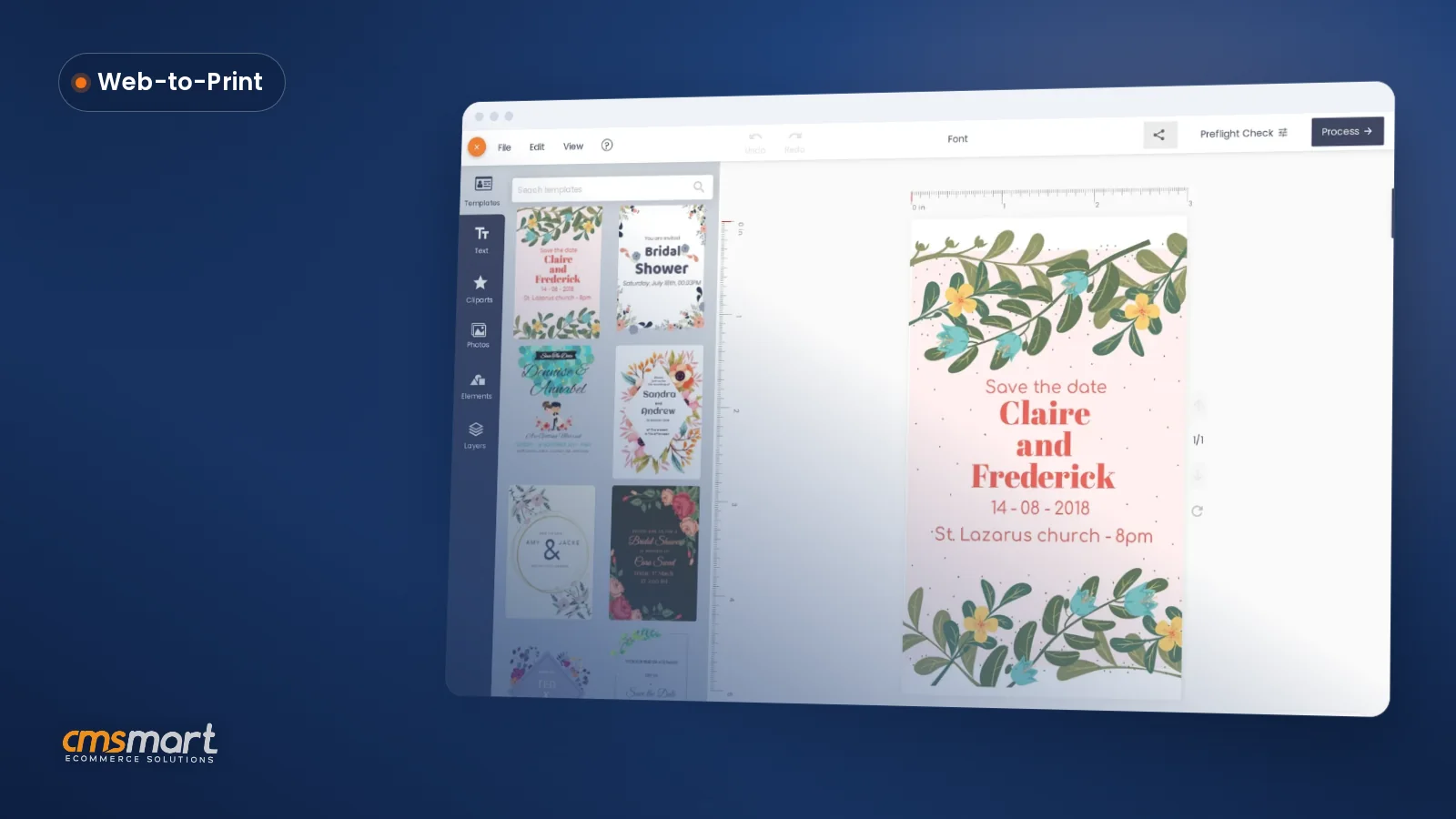
Example scenario. A buyer opens an invitation product at 10 p.m., clicks Add heading, and is offered presets built from your own font pairings rather than a blank font dropdown: a display face for the couple's names, a complementary serif for the date and venue. They swap in their own wording, see the price and the design update live, and check out. The design they approved is the same file your press runs the next morning — no email round-trip, no back-and-forth about which font they meant, no font substituted at render time.
That gap between looking fine on screen and printing the way it looked is exactly what the PDF/X print-production standard exists to close — it requires every font in a print-ready file to be embedded rather than referenced, precisely so a press never has to guess or substitute a typeface. Cmsmart calls its own version of this a print-ready PDF that matches the order (2.17): the file your team downloads is built from the same font and layout data the buyer approved. Talk to an ecommerce expert if you want help mapping your current font set to a production-safe shortlist before you switch it on.
How does Cmsmart control fonts across your designer, cart and print files?
Cmsmart Product Designer keeps fonts in one managed library that feeds the storefront text tool, the live price and preview, and the print-ready PDF renderer, so the typeface a buyer picks is the typeface that gets embedded in the file your team downloads.
Four building blocks carry a personalized text order from the product page to the press:
Cmsmart insight: in our delivery work, most font-related reprint disputes trace back to a face that was never tested at production size — a hairline script that reads fine at 48pt on a monitor but drops strokes on a 10mm mug press or an embroidery run. Test every font in your library at the smallest size you will actually sell before you add it, not after a customer complains.
What's the business value of curating your font library?
A managed font library turns personalization from a support cost into a conversion feature: Cmsmart Product Designer keeps design consistent, cuts the manual review your team does on every order, and lowers reprint risk — each with a KPI you can watch in your own order data.
Quick ROI check: (minutes of manual font/design QA saved per order) × (personalized orders per month) × (your loaded staff cost per minute) − (one afternoon to curate and test the font library). Most print and POD shops already know their current QA minutes per order and their monthly personalized-order count; plug in your own numbers rather than a generic uplift figure.
The underlying opportunity is not small: the global print-on-demand market is projected to reach USD 57.49 billion by 2033, growing at a 23.6% CAGR from 2026 to 2033, with apparel as the single largest category (Grand View Research, December 2025). Personalized text is one of the cheapest ways into that demand — provided the font behind it is one your production line can actually run.
How do you set up custom font management for WooCommerce?
You install or confirm Cmsmart Product Designer 2.17.x or newer, open the Fonts manager under the Media menu, add the faces you have cleared for commercial print, pair them into heading/subheading/body presets, and test one order end to end before you open it to customers.
Keep deep per-setting detail in the Cmsmart Product Designer settings guide; the steps below cover the font-specific path:
What can Cmsmart build on top of the standard font tools?
The Fonts manager and presets cover most stores out of the box; for bigger catalogs or brand-governance needs, Cmsmart builds custom development on top — role-based font permissions, per-product font restrictions and automated license auditing included.
The standard font library is deliberately simple: one list, grouped by category, available to every design-enabled product. Several real-world needs sit outside that by design, and Cmsmart builds them as custom development rather than bending the core plugin to fit every edge case:
Cmsmart delivers this through its product designer customization service: discovery call, solution design, fixed-scope sprints, QA against your real catalog, launch, then ongoing support — the same model behind the 6,300+ projects Cmsmart has run since 2012.
Get a custom font-governance quote
Why work with Cmsmart for your product personalization store?
Cmsmart has run web-to-print and product-personalization builds since 2012 as a Netbase JSC division, with a published Trustpilot rating and real client projects across 80+ countries — proof you can verify before you commit a budget.
Cmsmart (a Netbase JSC division, operating since 2012) has delivered 6,300+ client projects and 4,600+ completed builds across 80+ countries, with 1,800+ stores currently live on Cmsmart-built platforms. The company holds a 4.2-star rating from 404 reviews on Trustpilot.
See related ecommerce project case studies, or read how other stores use the same designer for custom-text personalization and general WooCommerce product customization. For the full picture of what a web-to-print storefront needs beyond fonts, see the Cmsmart web-to-print hub.
Frequently asked questions about custom fonts and WooCommerce personalization
Can I restrict which fonts customers are allowed to use?
Yes. The Fonts manager under Cmsmart > Media holds the font list the storefront text tool draws from; only the faces you upload or approve there appear to buyers. There is no built-in setting to open the system font list instead — the designer always offers your curated library.
Do I need to buy font licenses for use in Cmsmart Product Designer?
You need a license that covers your use, same as with any design tool. Fonts under the SIL Open Font License can be used in print, artwork and products without extra permission; many free-for-personal-use desktop fonts explicitly exclude commercial resale, so check each font's license before adding it to the library.
Will the font in the print-ready PDF match what the customer saw on screen?
Yes, for fonts in your library. The 2.17.0 release aligned the automatic export, the cloud renderer and the admin's manual Create PDF button so all three read the same page geometry and font data, closing the gap where a custom-size order previously rendered against the product template instead of the buyer's actual design.
Can customers upload or request their own font?
Not through the standard text tool — the designer is built around your approved library so every order stays license-safe and brand-consistent. If your business genuinely needs buyer-submitted fonts (common in some B2B and signage use cases), Cmsmart can build that intake and a review step as custom development.
How many fonts should I add to the library?
Fewer than you think. A short, tested, on-brand shortlist with two or three heading/body pairings per product category outperforms a long list that was never checked at production size — most of the value comes from curation, not quantity.
Does the font library and text panel work the same way on mobile?
Yes — the online designer and its text presets render on the same 390px mobile product page as desktop, using the same font library and the same print-ready pipeline.