

Guide · Web-to-print
Set Up WooCommerce Product Designer Plugin (Full Guide)
Set up WooCommerce product designer plugin licensing, uploads and pricing with Cmsmart so you launch ready to take paying orders.
Cmsmart Product Designer (NBDesigner) ships a clipart library plugin for WooCommerce that lets shoppers search thousands of ready-to-use images without leaving the online designer, so stationery, apparel and print-on-demand stores stop losing orders to slow, manual art hunts and get a finished, print-ready design in minutes.
Was this tutorial helpful?
Written by
Cmsmart Product Designer Plugin Engineer
Builds and supports the Cmsmart Product Designer (NBDesigner) for WooCommerce.
The team behind it
 Account Manager
 Project Manager
 Business Analyst
 Developers & QA
Guide · Web-to-print
Set up WooCommerce product designer plugin licensing, uploads and pricing with Cmsmart so you launch ready to take paying orders.
Guide · Web-to-print
See how a product customization tool for WooCommerce lets shoppers edit designs live and ships a print-ready file. Get a quote today.
Guide · Web-to-print
Automate print-ready file export for every custom WooCommerce order: certified PDFs plus SVG, PNG and CMYK files your press can use today.
Browse more guides, tutorials and case studies from the Cmsmart community.
Run a custom tote bag printing business with Cmsmart Product Designer: live pricing, real print specs and a print-ready PDF. See how to set it up.
Read MoreBuild a car wrap ecommerce store on WooCommerce: panel pricing, approval and print-ready PDFs before you print. Plan your wrap store today.
Read MoreDiscover how the home décor industry is transforming with the rise of personalized products and the challenges retailers face. Learn how CMSmart's Product Builder offers a solution, improving customer engagement, reducing return rates, and increasing sales through real-time 3D previews and automated processes.
Read More
Cmsmart Ecommerce provides custom ecommerce and WooCommerce development services for web-to-print, product personalization, plugin support and API integration.
Cmsmart Product Designer Plugin Engineer
Builds and supports the Cmsmart Product Designer (NBDesigner) for WooCommerce.
Meet the team →



In short
A bride-to-be opens your invitation product on her phone at 9 p.m., wants a watercolor wreath around the couple's names, and does not want to email you asking what clip art you have. If she has to leave your site to search for it somewhere else, you may never see her again. This is the moment a searchable clipart library either keeps the sale moving or loses it.
This guide builds on our earlier walkthrough of inserting clipart in Product Designer, this time with the 2.17 search experience and the business case behind it: what a built-in clipart library does for a WooCommerce store's conversion rate and support load, how Cmsmart ships it today, and what we build on top of it for shops with bigger brand or catalog needs.
Why do manual clipart hunts cost WooCommerce shops sales?
Cmsmart Product Designer removes the manual clipart hunt that stalls customization: instead of emailing files back and forth or hunting stock sites, shoppers search a built-in library inside the designer and keep moving toward checkout — which is where stores actually lose these orders.
A few concrete ways a missing or weak clipart library costs a customization-heavy store money:
Checkout friction is already expensive before a shopper ever goes looking for clip art: online stores lose an average of 70.22% of carts (Baymard Institute, 2025), and a slow or incomplete design step is one more reason to leave before paying rather than one less.
What does a fast, self-service clipart experience look like?
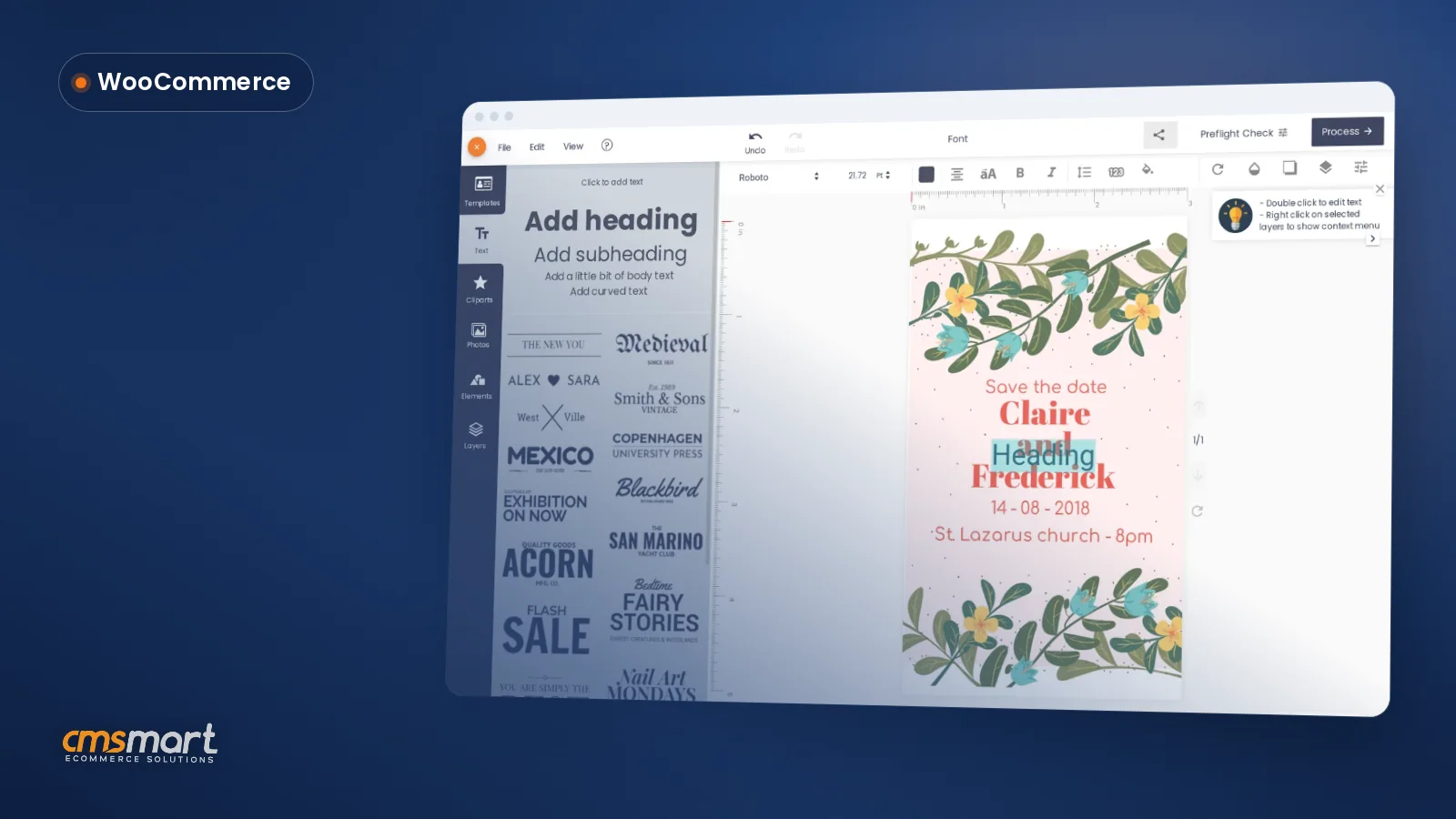
Imagine a shopper who opens "Design here online," searches a motif in the Cliparts tab, drags a result onto the canvas next to her own text, and clicks Process — all before you would have finished reading her support ticket. Cmsmart Product Designer makes that the default path, not the exception, on every product you enable it on.
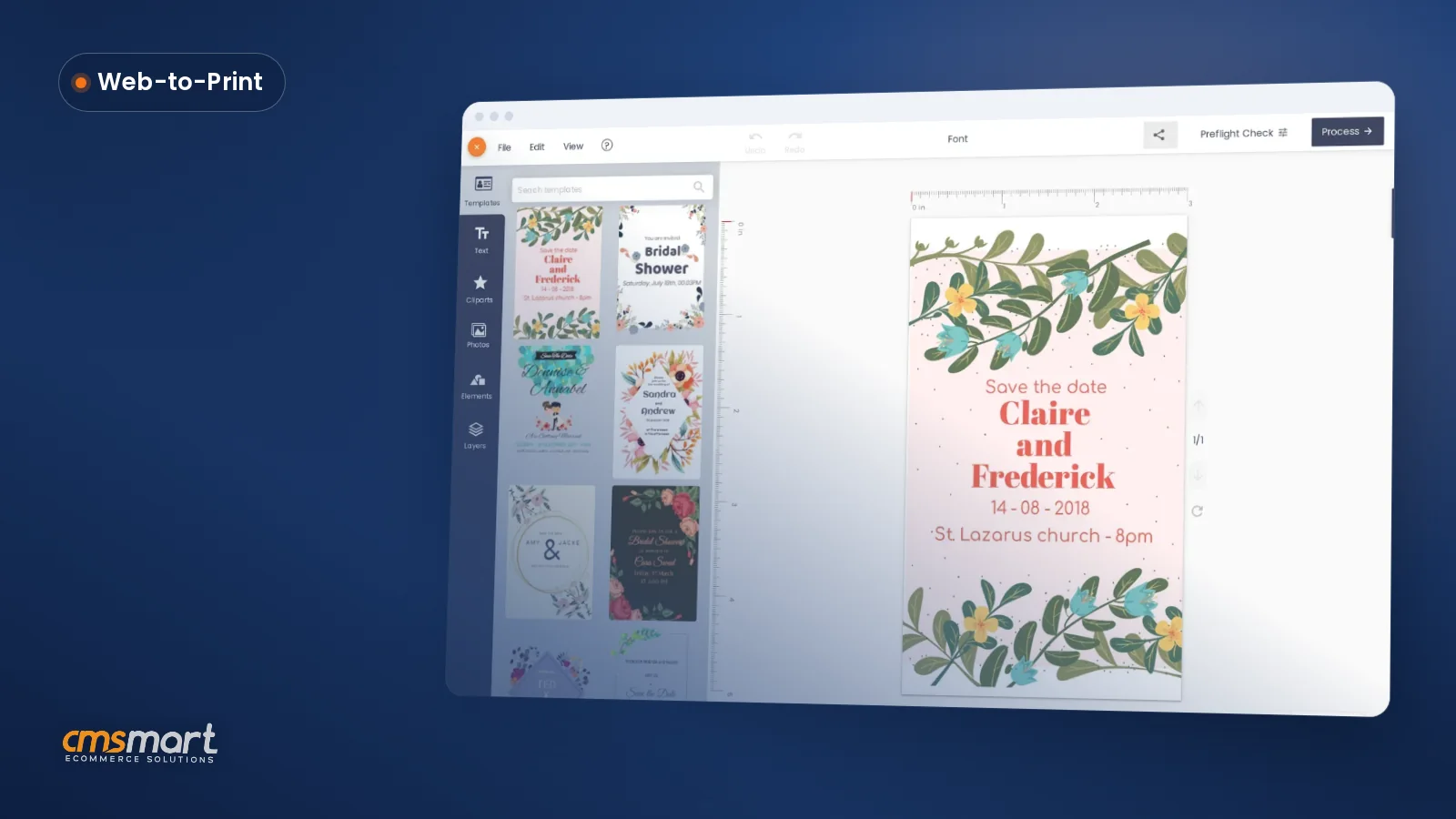
Example scenario: A small stationery store sells wedding invitations online. A shopper picks a template, opens the Cliparts tab, searches for a motif that matches her color scheme, drags it onto the design, adds her names and date with the Text tool, and clicks Process. She adds the finished design to her cart and pays without contacting the store. Overnight, the owner opens the order, sees the approved design and a print-ready PDF already waiting, and sends it straight to the press.
How does Cmsmart's clipart library plugin for WooCommerce work?
Cmsmart's clipart library plugin for WooCommerce lives inside the online designer as a dedicated Cliparts tab: it searches your own uploaded art first, then a shared studio catalog organized into categories, paging in more results as a shopper scrolls so even a large shared catalog opens quickly.
The building blocks, and what is core plugin today versus custom development:
Cmsmart insight: if an older store only ever shows a handful of the shared categories with any art in them, check whether the Cliparts panel is paging each category from the server as the shopper scrolls, or just filtering one cached batch on the page. That mismatch was the single most common clipart complaint we fixed going into 2.17, and it is usually a five-minute setting change, not a rebuild.
What's the business value of a searchable clipart library?
A searchable clipart library plugin for WooCommerce cuts two costs at once: the minutes your team spends emailing art back and forth, and the orders that quietly abandon because customization felt slow. Cmsmart Product Designer ties both to KPIs you already track — conversion rate and support-ticket volume — not just to a prettier editor.
The category this plugin serves is not a niche one: WooCommerce alone powers over 7 million active installations (WordPress.org, 2026), and a large share of those stores still ask shoppers to either upload a finished file or settle for whatever clip art happens to be sitting in one folder. The web-to-print software category Cmsmart competes in reflects that same demand: it was valued at $26.59 billion in 2025 (Mordor Intelligence), and buyers increasingly expect a design step that feels as fast as ordinary shopping.
Rough ROI worksheet
Minutes saved per order, multiplied by the orders needing custom art each month, multiplied by your team's hourly design-support cost, gives you the monthly hours you get back from self-service search. Add your current abandonment rate on customized products, multiplied by your average order value, to see what each recovered sale is worth. Plug in your own numbers — Cmsmart's role is to shrink the first factor by moving the search inside the designer instead of into your inbox.
How to set up and configure your clipart library for WooCommerce shoppers
Setting up Cmsmart's clipart library plugin for WooCommerce takes minutes, because the shared studio catalog ships on, store-wide, by default. You only need to configure it when you want to restrict a product to your own art or specific categories. The steps below cover the buyer path and the admin settings worth checking.
Going further: what can Cmsmart build beyond the built-in library?
The built-in Cliparts tab covers search, categories and a shared studio catalog out of the box. For stores that need brand-locked asset libraries, licensed stock-art integrations, or smarter tagging so staff stop filing images by hand, Cmsmart builds that as custom development on top of Product Designer, the same way we scope any other storefront feature.
We scope this the way we scope any Product Designer extension: discovery call, a short solution design, build in sprints, QA against your catalog, launch, then ongoing support — the same approach behind our product designer customization service. See examples of that process on our ecommerce project deliveries, or talk to an ecommerce expert about your own catalog.
Plan my clipart library upgrade
Why work with Cmsmart on your product designer?
Cmsmart has built and supported Product Designer (NBDesigner) storefronts since 2012 as part of Netbase JSC, the team behind thousands of client projects. That is the same team maintaining the clipart library's search, categories and print-ready output release after release, not a one-off plugin author.
Cmsmart has delivered 6,300+ client projects and 4,600+ completed builds since 2012, across 1,800+ live stores, rated 4.2 on Trustpilot (404 reviews) as published on our platform page. You can browse related work on our project case studies or see the designer itself on its product page, part of our wider web-to-print solutions. If your shop also uses clip art creatively once it is on the canvas, our earlier guide on making designs come alive with cliparts is a good next read.
Get a product designer quote
Frequently asked questions about clipart libraries and WooCommerce product design
Does the clipart library work on every WooCommerce product?
It works on any product you enable Product Designer on. You can also restrict a specific product to your own categories, or turn the shared studio catalog off for that product, in its Clipart settings.
Can I stop shoppers from using the shared studio library?
Yes. Turn off the store-wide "Enable global clipart library" setting, or restrict individual products to selected categories, and shoppers will only see your own uploaded art.
What happens once a shopper's design is approved?
The order item's design is locked on the server once it is approved, so staff and shoppers cannot accidentally resave over it before it goes to print.
How is the print file produced after checkout?
Clicking Process in the designer saves the finished design; from the order, Create PDF renders a print-ready PDF through Cmsmart Cloud, which you can regenerate if the product's print settings change.
Can Cmsmart connect our own brand asset library instead of the shared one?
Yes, as custom development. We have built brand-locked and stock-library integrations for stores with stricter asset rules — see how we scope that kind of build on our ecommerce project page.
Which plugin version do I need for this to work correctly?
This guide applies to Cmsmart Product Designer 2.17 and later. Earlier versions could open an empty grid on most shared categories; 2.17 fixed that by paging each category from the server instead of filtering one cached batch.