

Case study · Web-to-print
Sticker Design Plugin for WooCommerce
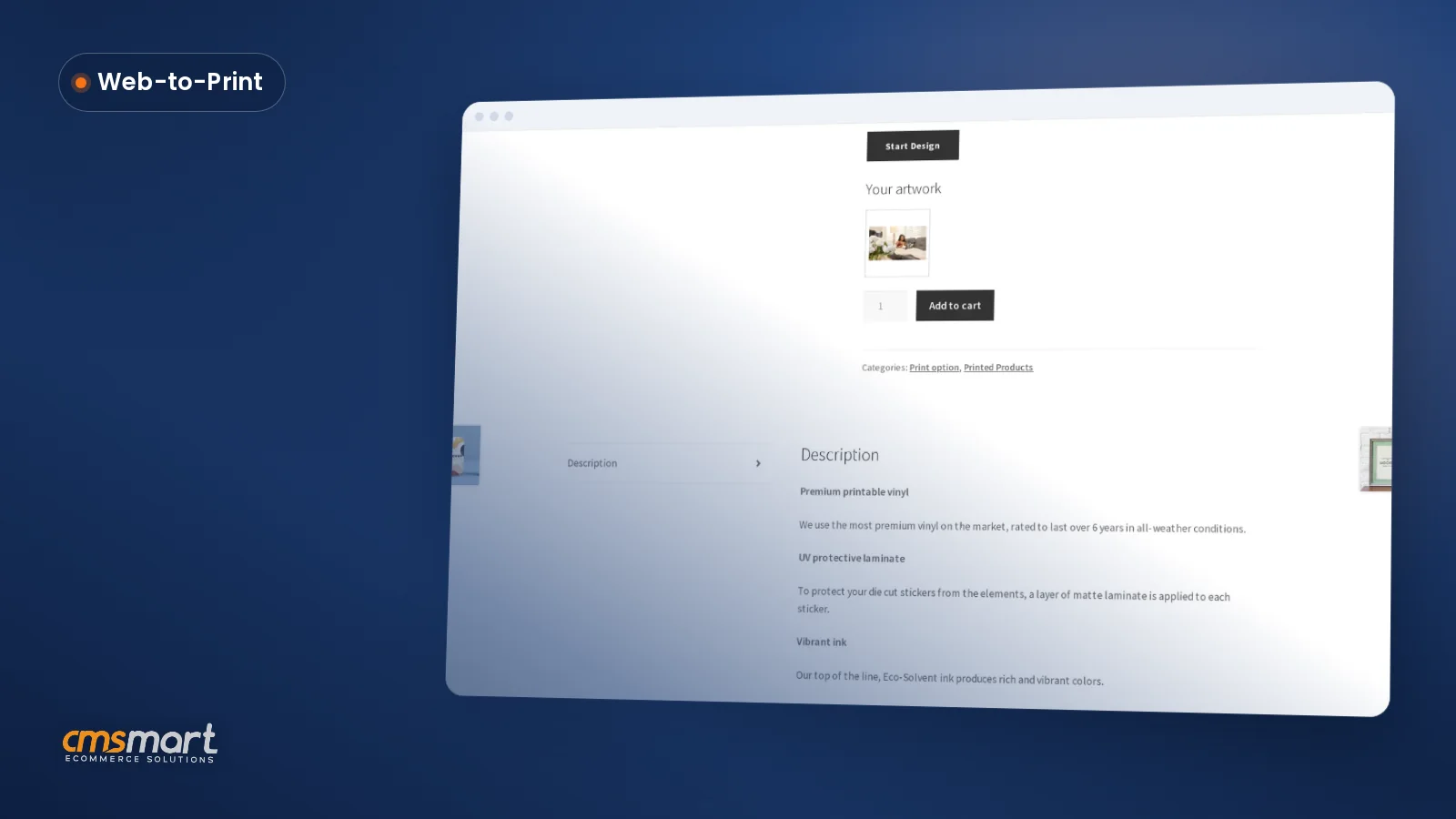
This sticker design plugin for WooCommerce lets shoppers pick a background color or material before checkout, then ships a matching print-ready PDF.
A WooCommerce price matrix inside Cmsmart Product Designer lets a print or custom-product store quote every paper, size, material and quantity combination instantly on the product page, replacing the spreadsheet-and-email quoting that slows down orders and loses sales to a faster competitor.
Was this tutorial helpful?
Written by
Cmsmart Product Designer Plugin Engineer
Builds and supports the Cmsmart Product Designer (NBDesigner) for WooCommerce.
The team behind it
 Account Manager
 Project Manager
 Business Analyst
 Developers & QA
Case study · Web-to-print
This sticker design plugin for WooCommerce lets shoppers pick a background color or material before checkout, then ships a matching print-ready PDF.
Guide · Web-to-print
Cmsmart's wedding invitation design software lets stationery shops sell custom WooCommerce invitations with built-in proofing. Get a custom quote toda...
Guide · Web-to-print
Run every product line on one multi-product online designer plugin for WooCommerce, then ask Cmsmart to build the rest of your catalog.
Browse more guides, tutorials and case studies from the Cmsmart community.
Run a custom tote bag printing business with Cmsmart Product Designer: live pricing, real print specs and a print-ready PDF. See how to set it up.
Read MoreBuild a car wrap ecommerce store on WooCommerce: panel pricing, approval and print-ready PDFs before you print. Plan your wrap store today.
Read MoreDiscover how the home décor industry is transforming with the rise of personalized products and the challenges retailers face. Learn how CMSmart's Product Builder offers a solution, improving customer engagement, reducing return rates, and increasing sales through real-time 3D previews and automated processes.
Read More
Cmsmart Ecommerce provides custom ecommerce and WooCommerce development services for web-to-print, product personalization, plugin support and API integration.
Cmsmart Product Designer Plugin Engineer
Builds and supports the Cmsmart Product Designer (NBDesigner) for WooCommerce.
Meet the team →



In short
A buyer lands on your business card product page at 11 PM. They want silk-laminated 300gsm stock, a custom size and 250 copies — and they want the price now, not after an email the next morning. If your store still prices that combination by hand, the tab closes and the order goes to whichever site already knows the number.
Why does manual print pricing cost you orders?
Cmsmart Product Designer's Printing Options remove the manual quote step: every paper, size, material and quantity combination gets its price rule once in wp-admin, so WooCommerce shows the final price the moment a buyer finishes choosing — on the product page, in the cart and at checkout.
Print and custom products rarely fit WooCommerce's plain variations, and the cost of working around that shows up in a handful of familiar places:
Cmsmart insight: When a size or color sells out mid-run, the durable fix is never a note on the product page — it's a conditional-logic rule on the option field itself, so the unavailable choice is never offered in the first place.
What would it look like if every option priced itself?
Picture Cmsmart Product Designer doing the pricing work instead of your team: a shopper changes paper, material or quantity and the price on the page updates immediately, and only the combinations you can actually produce are selectable — so every order that reaches your inbox is already priced and buildable.
Example scenario: A print shop sells business cards in four paper stocks, four weights, a custom size range and five quantity tiers. A buyer picks silk paper at 300gsm, enters a custom width and height, and sets quantity to 250. The price matrix prices the paper-and-weight combination, the quantity-break table applies the 250-unit rate, and the final price appears on the page before the buyer adds the item to the cart — no email, no wait, no second guess for your team on what was actually promised.
If your option set doesn't fit a standard rule, talk to an ecommerce expert before you build it — it's often faster than discovering the gap after launch.
How does Cmsmart's WooCommerce price matrix and conditional logic actually work?
Cmsmart Product Designer's Printing Options module is a rule engine behind every print option field: a price type (fixed, percentage, formula, matrix, quantity break or area), an optional conditional-logic rule that shows or hides the field, and an output that writes the final choice and price to the cart and the order line — all configured once in wp-admin.
Six building blocks make up the engine, and each one is either in the plugin today or built on top of it as custom development:
Every field you add here lives on the product page the moment you publish the option set. If you want the deeper, column-by-column walkthrough of the matrix fields themselves, our price matrix setup guide covers it in detail.
What's the ROI of pricing options that price themselves?
A WooCommerce price matrix pays back the setup time quickly: Cmsmart Product Designer cuts the minutes your team spends quoting each custom order, lowers abandonment from buyers who would otherwise leave to get a price elsewhere, and keeps quantity discounts consistent so every buyer at the same order size sees the same rate.
ROI worksheet: (quotes you currently handle by hand each month) × (minutes per quote) × (your team's hourly cost ÷ 60) = the monthly cost of manual pricing. Compare that number to the hours it takes to build one option set — for most single-product setups, that's the cost you're trying to beat.
How do you set up a price matrix and conditional print options in Cmsmart?
Setting up Cmsmart's price matrix takes one option set per product or category: add the fields buyers choose from, give each one a price rule, add a conditional-logic rule wherever a choice should disappear, apply the set, then test it on the live product page before you publish it.
Once it's live, the choice and its price follow the item everywhere: into the cart, through checkout, and onto the order line your production team works from. For the full field reference across both the store-wide Settings and the per-product editor, see our Printing Options configuration guide.
How far can you take pricing with custom development?
Cmsmart builds custom development on top of the standard price matrix for stores that need more: role or contract pricing for repeat B2B buyers, a price list synced from an ERP or MIS, an approval step before a negotiated price is confirmed, or a quote-first workflow for jobs too specific for a fixed rule.
Cmsmart delivers this kind of work the same way as any other project: discovery, solution design, build in sprints, QA against your real price list, launch and ongoing support — the same delivery model behind our ecommerce project delivery.
Get a custom pricing engine quote
Why work with Cmsmart for print and product pricing?
Cmsmart has built WooCommerce print and product-customization stores since 2012, as a Netbase JSC division, with 6,300+ client projects and 1,800+ live stores behind the same pricing engine covered in this guide — a track record, not a demo.
Cmsmart has built web-to-print and product-customization stores since 2012, as a division of Netbase JSC, with 6,300+ client projects, 4,600+ projects delivered and 1,800+ live stores across 80+ countries. The plugin is rated 4.2 on Trustpilot (404 reviews).
"NBDesigner has lots of variable options, including colour and image swatches and pricing tables and much much more," wrote Ray Barlow in a Trustpilot review. See more of how option sets and pricing come together in real stores in our recent ecommerce projects, or explore the wider web-to-print platform and the Cmsmart Product Designer plugin page. For custom pricing specifically, see our web-to-print pricing engine development service.
Frequently asked questions about price matrix and conditional print options
Does Cmsmart Product Designer include a real price matrix, or is that custom development?
It's a native display layout inside Printing Options. Open Cmsmart > Printing Options, choose the fields that form the rows and columns under Appearance, and the plugin builds the grid — or you can enter each combination by hand. No separate extension or custom build is needed for the matrix itself.
Can I combine a price matrix with quantity discounts?
Yes. Add Quantity breaks to the same option set; the plugin shows a pricing table on the product page, or charges the discount as a one-off cart fee, independently of the matrix cell the buyer picked.
Can I hide a size or color when it's out of stock?
Yes, with conditional logic. Set a field or a single value to show only when all or any of the rules you define match, based on quantity or another field's value, so a sold-out combination is never offered to begin with.
Does the chosen price travel with the order?
Yes. Every selected option and its price is written to the cart item and the order line, and the same choices come back automatically if the customer reorders.
Can Cmsmart add role-based or contract pricing for B2B accounts?
Not in the standard option engine today — the plugin only stores unused role-pricing fields. Cmsmart builds role- or account-based pricing as custom development on top of your existing option set.
How long does it take to set up one product's pricing?
A single option set with a price matrix, quantity breaks and a couple of conditional rules typically takes under an hour to configure and test. Rolling the same pattern out across many product types, or syncing it to an ERP, is a custom-development project.