

Guide · Web-to-print
Cmsmart Stores Setup Wizard: What's New, October 2026
The Cmsmart Stores Setup wizard installs niche, B2B and Marketplace stores with sample data live in minutes. See what changed and try it free.
Running a T-shirt or print-on-demand store on WooCommerce means every product - a tee, a mug, a tote bag - needs its own design area, its own price rules and its own print file. This guide shows how to configure product designer per product in Cmsmart Product Designer (NBDesigner) 2.17, so a buyer designs online, sees the price before they pay, and your team receives an order that already carries a print-ready file.
Was this tutorial helpful?
Written by
Cmsmart Product Designer Plugin Engineer
Builds and supports the Cmsmart Product Designer (NBDesigner) for WooCommerce.
The team behind it
 Account Manager
 Project Manager
 Business Analyst
 Developers & QA
Guide · Web-to-print
The Cmsmart Stores Setup wizard installs niche, B2B and Marketplace stores with sample data live in minutes. See what changed and try it free.
Guide · Web-to-print
The NBDesigner plugin now gives stationery shoppers a curated background library so print-ready PDFs always match the preview. See how to set it up.
Guide · Web-to-print
See how t-shirt artwork approval and print-ready PDFs cut POD reprints on WooCommerce; get a free workflow review from Cmsmart today.
Browse more guides, tutorials and case studies from the Cmsmart community.
Follow the steps to plan a T-shirt business, choose hosting and a WordPress theme, add key plugins, create product samples and promote the store.
Read MoreStarting to get money from home by selling t-shirts. Here is an easy guideline on How to start a t-shirt business from home to follow. Let’s discover.
Read MoreThe print on demand business benefits are real, but only with the right tools in place. See how Cmsmart turns orders into print-ready files. Get a quote.
Read More
Cmsmart Ecommerce provides custom ecommerce and WooCommerce development services for web-to-print, product personalization, plugin support and API integration.
Cmsmart Product Designer Plugin Engineer
Builds and supports the Cmsmart Product Designer (NBDesigner) for WooCommerce.
Meet the team →



In short
Shoppers now expect to see their design before they pay, not after a round of emailed proofs. If every product on your site is configured by hand, with no shared pattern between a T-shirt and a sticker, that setup work becomes the bottleneck that keeps new products off your store.
What is the real cost of configuring every product by hand?
Configuring a design area, DPI and a price matrix one product at a time, by trial and error, is where most WooCommerce print stores lose time. Cmsmart Product Designer puts production specs, the designer canvas and printing options on the same product screen, so launching a new design-enabled product is a checklist, not a guessing game.
What does a great product designer experience look like?
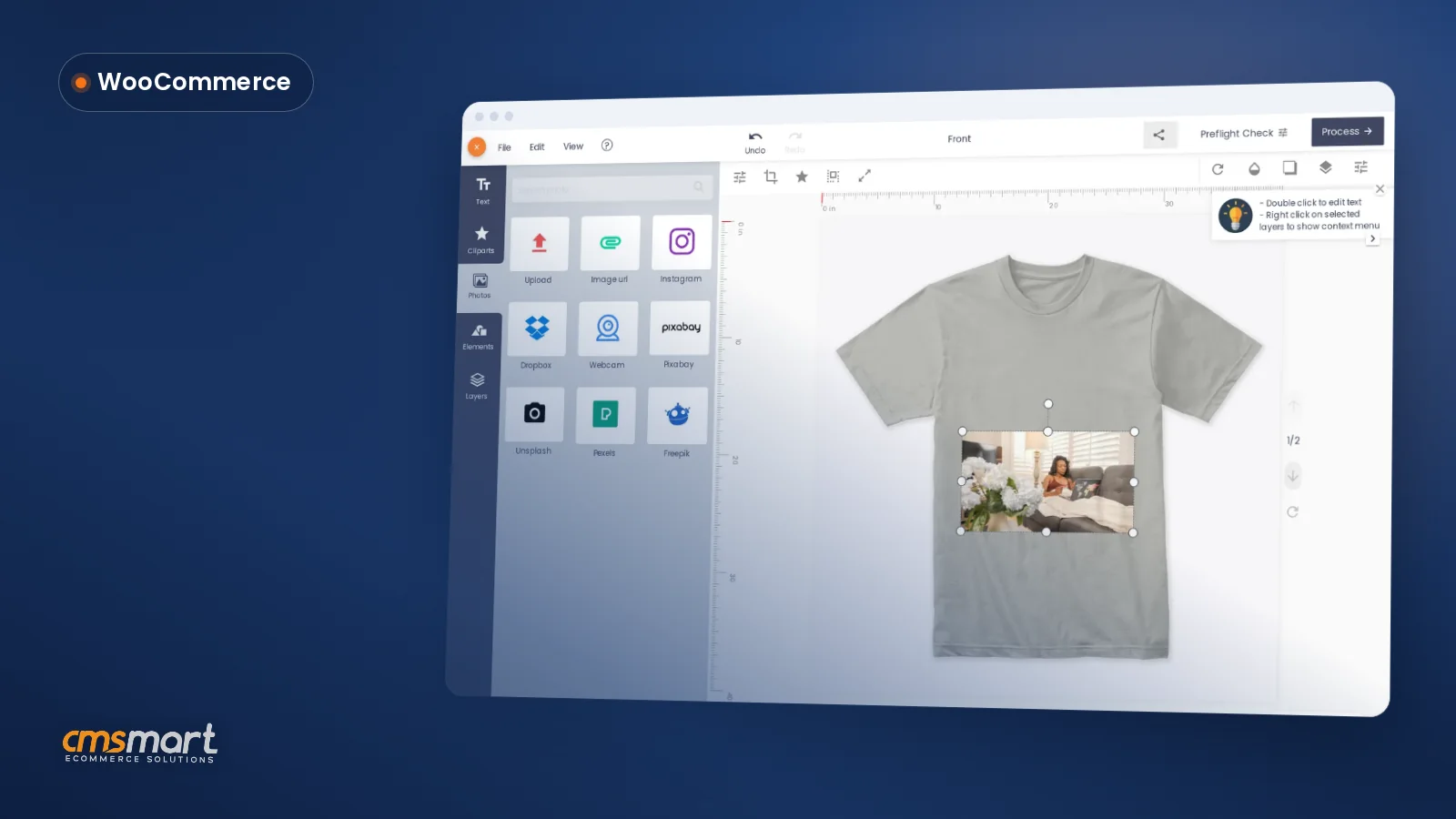
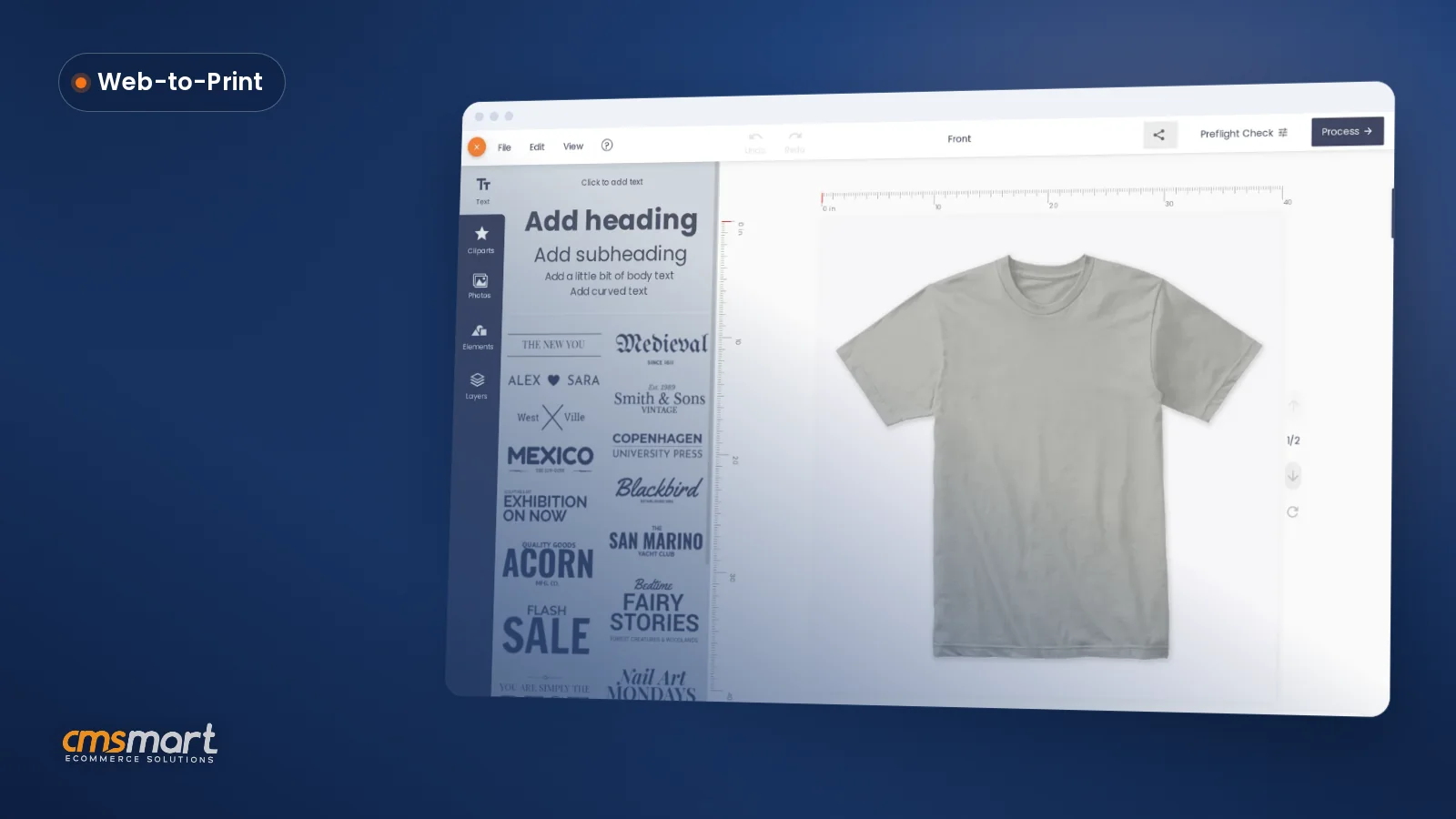
Picture a product page where the design button, the price and the print specs are all driven by the same product configuration - so a buyer never sees a mismatch between what they designed and what ships. Cmsmart Product Designer keeps the canvas, the pricing rules and the production specs on one product record, so that promise holds for every SKU.
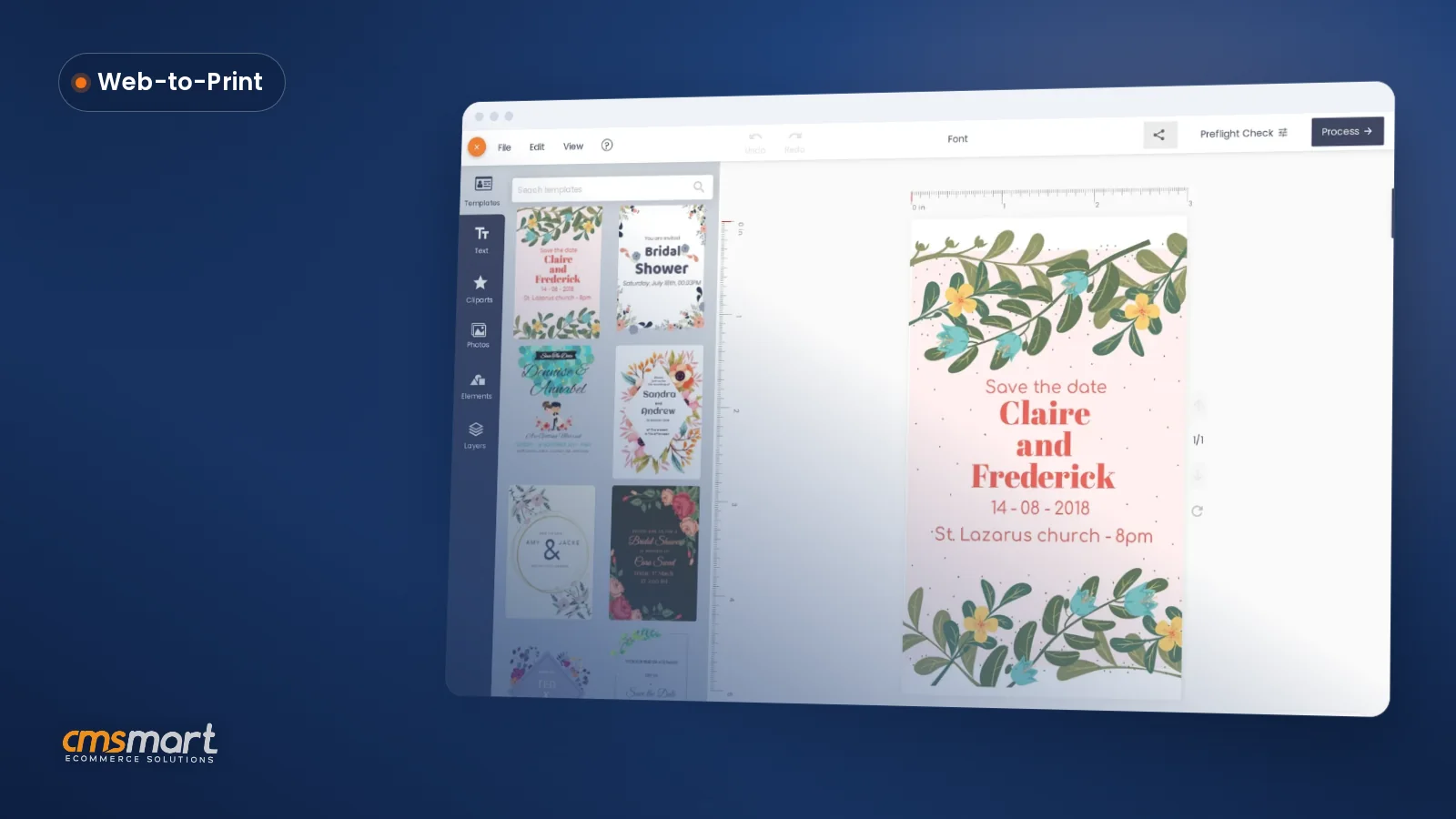
Example scenario. A buyer opens an invitation product at 9pm, picks "Design here online" instead of uploading a file, drops in a template, swaps the names and the date, and watches the price update as they add a second side. They check out. By the next morning the order already carries a print-ready PDF sized to that exact product, with the bleed and color profile the product was configured with - no one on the team touched a proof.
Talk to an ecommerce expert about your product catalog if you are planning this for more than a handful of products.
How does Cmsmart connect product configuration to print-ready output?
Cmsmart Product Designer stores four things against every product: the designer canvas (sides, DPI, design areas), production specs (material, bleed, resolution, color profile), printing options (fields and pricing) and the output path that turns an order into a print-ready file. Changing one product never touches another.
Cmsmart insight: set the bleed area and print resolution on the product before you build its design templates, not after. Templates built against the wrong canvas size are the most common reason a store ends up reprinting its own catalog once real orders start arriving.
What is the business value of configuring product designer per product?
A product configured correctly once means fewer reprints, fewer support tickets about "why does my order look wrong," and a storefront where every new SKU launches as fast as the last one. Cmsmart Product Designer turns that into a per-product checklist instead of tribal knowledge held by one person.
Rough-cut ROI worksheet. Take the number of design-enabled products you plan to add this quarter (N), the minutes a correct first-time setup saves your team per product versus a trial-and-error setup (M), and your team's loaded hourly cost (C). Time saved on setup alone is N × M × C ÷ 60. Add your current reprint rate (R reprints per 100 orders) and your average reprint cost (P) to estimate what a lower reprint rate from correct bleed and resolution settings is worth: orders per month × R ÷ 100 × P.
The category this sits in keeps growing: the global custom t-shirt printing market was valued at USD 5.2 billion in 2024, projected to reach USD 9.8 billion by 2030 (Grand View Research), which is exactly the kind of growth that rewards a store that can add new design-enabled products quickly instead of rebuilding each one from scratch.
How do you configure product designer per product in WooCommerce?
Configuring product designer per product means working through one product's General, Production specs and Online Designer sections, then pointing it at a printing option set. Cmsmart Product Designer keeps all three on the same screen so nothing is set twice.
For WooCommerce's own product basics - categories, galleries, variations - the WooCommerce product management documentation is the reference; Cmsmart's screens sit directly on top of that same product record. For the design-area shape specifically, see how to configure the area design shape, and for quantity and option pricing, see how to build a price matrix with printing options.
Going further: what can Cmsmart build on top of product designer per product?
The product screen above covers one store on one set of rules. Cmsmart builds the parts that go beyond a single product's settings as custom development, scoped to how your catalog and production floor actually work.
Delivery follows the same path for all of it: discovery, solution design, build sprints, QA against your real catalog, launch and ongoing support - see how that plays out in Cmsmart's ecommerce project case studies.
Plan my product configuration project
Why work with Cmsmart to configure your product designer?
Cmsmart has built web-to-print storefronts since 2012 as a Netbase JSC division, with Cmsmart Product Designer (NBDesigner) as its core WooCommerce plugin. Stores already running it rate the plugin and its support highly, in public reviews anyone can check.
"We have had the NB Designer plugin installed for three years and have experienced absolutely no problems during that time. It is wonderful to see their commitment to continuous development, with new features being added frequently to keep the software current and highly capable." - Web Developer, Trustpilot review
Frequently asked questions
Do I have to configure every product separately?
Yes for production specs and the designer canvas, since each product can have its own bleed, resolution and design area. Printing Options are the exception: one option set with its pricing rules can be applied to many products or a whole category at once.
Can I turn the Online Designer on for only some products?
Yes. The Enable the Online Designer for this product checkbox is per product, so a store can mix design-enabled products with ordinary WooCommerce products on the same site.
What happens if I change a product's bleed or DPI after templates already exist?
Existing templates keep the canvas size they were built with. Change production specs before building templates for a product where possible, and treat a later change as a reason to review that product's templates, not just its settings.
Does the print-ready PDF update if a customer edits their design after ordering?
Yes - as of 2.17, editing a design after ordering queues a new print-ready PDF automatically when automatic export is on, and approved artwork is locked against further edits unless a shop manager reopens it.
Can Cmsmart configure our whole catalog for us?
Cmsmart's team can configure products directly or set up the templates and printing-option sets your team then applies across the catalog, and builds bulk or ERP-driven configuration as custom development for larger catalogs.
Related reading: Cmsmart Product Designer (NBDesigner) for WooCommerce, the web-to-print solutions hub, product designer customization services, and the 2.17.0 release notes for the print-ready PDF and approved-artwork lock mentioned above.