

Guide · Web-to-print
The Print Ready PDF WooCommerce Orders Need
See how Cmsmart generates a print ready pdf woocommerce orders can send to production: bleed, CMYK, watermark off, automatically. Get a quote.
Set up print-ready PDF export for WooCommerce in Cmsmart Product Designer so every approved order matches the file production gets. See how.
Table of contents
Was this tutorial helpful?
Written by
Cmsmart Product Designer Plugin Engineer
Builds and supports the Cmsmart Product Designer (NBDesigner) for WooCommerce.
The team behind it
 Account Manager
 Project Manager
 Business Analyst
 Developers & QA
Guide · Web-to-print
See how Cmsmart generates a print ready pdf woocommerce orders can send to production: bleed, CMYK, watermark off, automatically. Get a quote.
Guide · Web-to-print
Set up a WooCommerce file upload print shop that takes print-ready PDF, AI and PSD files with file-type, size and DPI checks built in.
Guide · Web-to-print
Install and configure NBDesigner on WooCommerce: license it, set print-ready output and pricing, then launch. Get a setup quote today.
Browse more guides, tutorials and case studies from the Cmsmart community.
Custom bag design software for WooCommerce: Cmsmart Product Designer adds live pricing and print-ready files. See how to set it up.
Read MoreCar wrap design software for WooCommerce: panel templates, size-based pricing, 3D preview and approval before you print. Plan your wrap store now.
Read MoreDiscover how the home décor industry is transforming with the rise of personalized products and the challenges retailers face. Learn how CMSmart's Product Builder offers a solution, improving customer engagement, reducing return rates, and increasing sales through real-time 3D previews and automated processes.
Read More
Cmsmart Ecommerce provides custom ecommerce and WooCommerce development services for web-to-print, product personalization, plugin support and API integration.
Cmsmart Product Designer Plugin Engineer
Builds and supports the Cmsmart Product Designer (NBDesigner) for WooCommerce.
Meet the team →


In short
Your customer approves their design at 11pm. Somewhere between that click and the morning print run, someone has to turn a browser-based design into a file your press operator can actually use — right size, right bleed, right color space, no missing fonts. For a lot of WooCommerce print shops that step is still manual: open the order, re-export, check it, email it to production, hope nothing shifted.
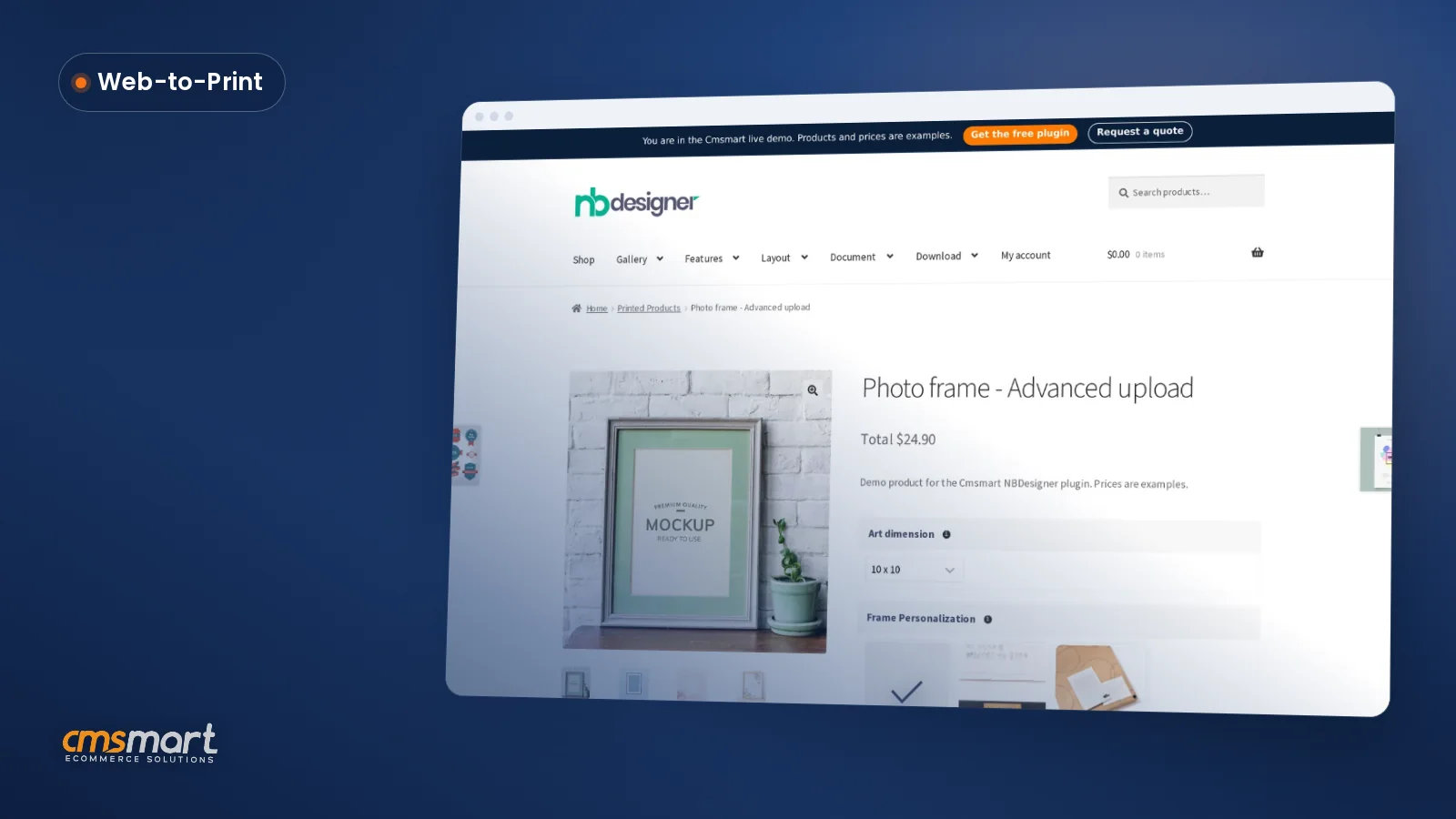
Cmsmart Product Designer (NBDesigner) ships print-ready PDF export for WooCommerce stores, built into the wider web-to-print workflow, so that step stops being manual. Here's exactly how the plugin gets a buyer's design to a print-ready PDF on the current 2.17.0 release — and where custom development takes over when your pipeline needs more.
What's the cost of manual PDF export — and what's the problem with it?
Most WooCommerce print shops lose time to the same five problems: manual re-exports, font substitution, mismatched custom sizes, approved designs edited after the fact, and orders that silently never get a print file. Cmsmart Product Designer closes each gap at the plugin level, not by relying on a person to catch it.
None of this shows up as one dramatic failure. It shows up as a slow accumulation of staff minutes and avoidable reprints:
Each of these is an hourly cost (staff time per order) or a material cost (reprint plus rush shipping) that scales with order volume — worth tracking against your own numbers once you're past a few hundred orders a month.
What would it look like if every order just arrived print-ready?
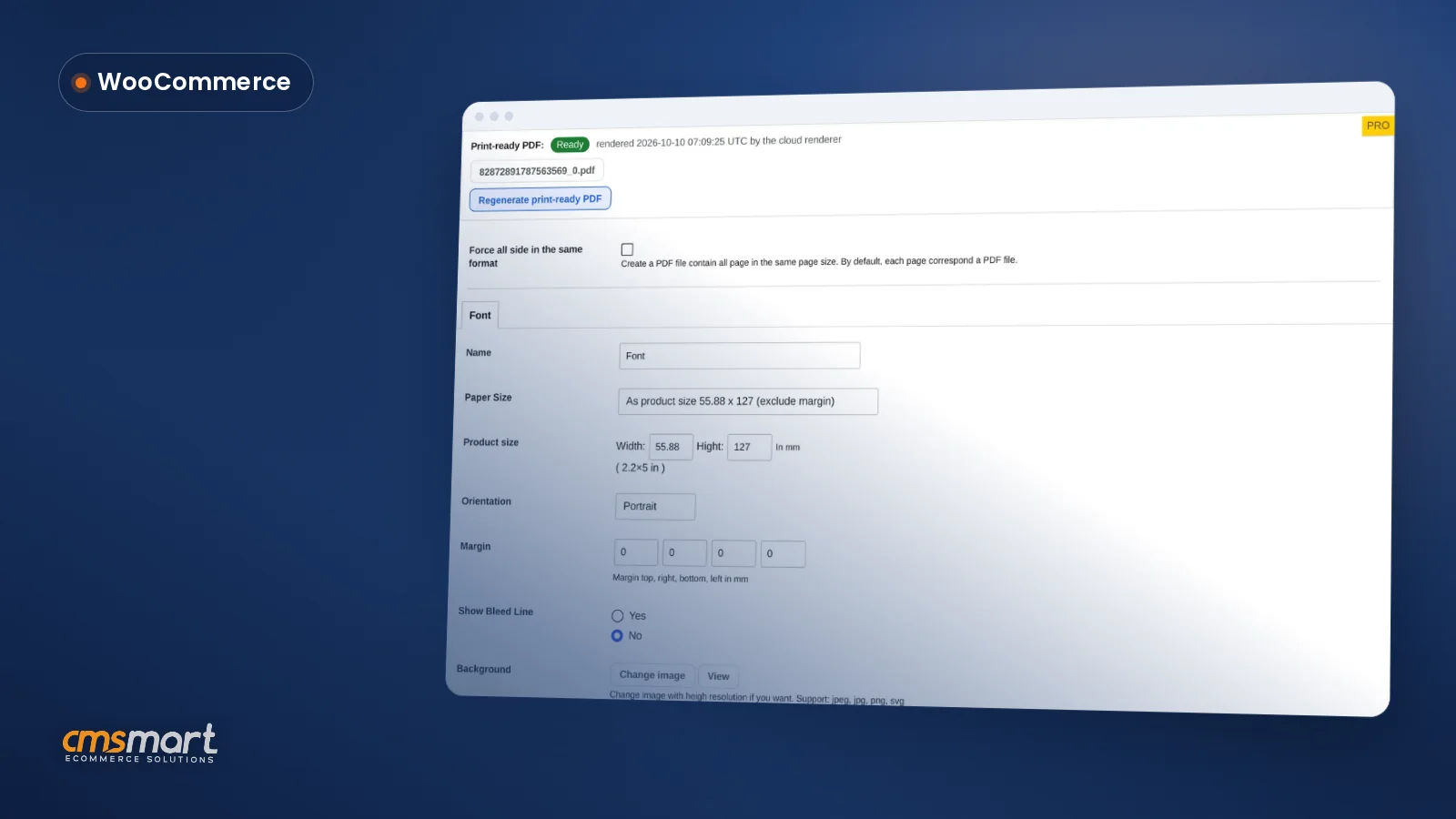
With Cmsmart Product Designer, the print-ready PDF is already rendered and certified by the time production opens the order — not something staff builds after the fact. The file they open is the same file the system already generated from the approved design.
Example scenario. A promotional-products shop sells custom tumblers and invitations through WooCommerce. A buyer finishes their design at 10pm and clicks Process. By morning, the order already shows a Ready print-ready PDF, rendered overnight by the cloud renderer, sized exactly to the product ordered — not the template default. If the customer reopens that design afterward, the system refuses to save over it, because the artwork is already approved. Production downloads the file and starts the job. Nobody re-exported anything.
The global print-on-demand market is valued at USD 11.76 billion in 2025, projected to reach USD 84.70 billion by 2034 (Straits Research, 2025) — the volume of exactly this kind of one-off, print-ready-on-demand order is only climbing. Shops still treating PDF export as a manual step are adding headcount to a problem software already solves.
How does Cmsmart turn a buyer's design into a print-ready PDF?
Cmsmart Product Designer renders the print-ready PDF the moment a buyer clicks Process, using the order's exact page geometry, then reuses that one certified render for Create PDF, the order-status export and the order email.
The pipeline has five building blocks — three in the plugin, two typically custom development:
nbd_ordered_design_edit_lockedfilter.Cmsmart insight: in our delivery work, most file-mismatch support tickets trace back to a custom product size the mockup renderer never knew about. Since 2.17, the cloud renderer, server renderer, preview and Create PDF all read the same page geometry — so this is now a plugin-level fix rather than a custom patch to maintain across every update.
What's the business value of automatic print-ready PDFs?
Automatic print-ready export turns a per-order manual task into a background process — the payoff shows up in staff minutes per order, reprint rate, and how many orders get stuck without a print file.
Rough ROI worksheet — plug in your own numbers: (orders/month) × (minutes spent manually exporting each file) × (hourly staff cost) = monthly cost of manual export. Add (reprint rate %) × (orders/month) × (cost per reprint, materials + rush shipping) for the rest of the picture. Automatic export and the approved-artwork lock target both lines at once.
How do you set up print-ready PDF export for WooCommerce in Cmsmart Product Designer?
Turning on automatic print-ready export takes a handful of settings in WooCommerce → Settings → Cmsmart, then it runs itself — no per-order action unless a render genuinely fails.
Want AI to catch resolution, bleed, color-mode and font problems before this screen? That's the Preflight Quality Checker in Cmsmart Cloud → AI Tools — a DPI, color-mode, bleed, font and transparency scan with a per-issue AI auto-fix.
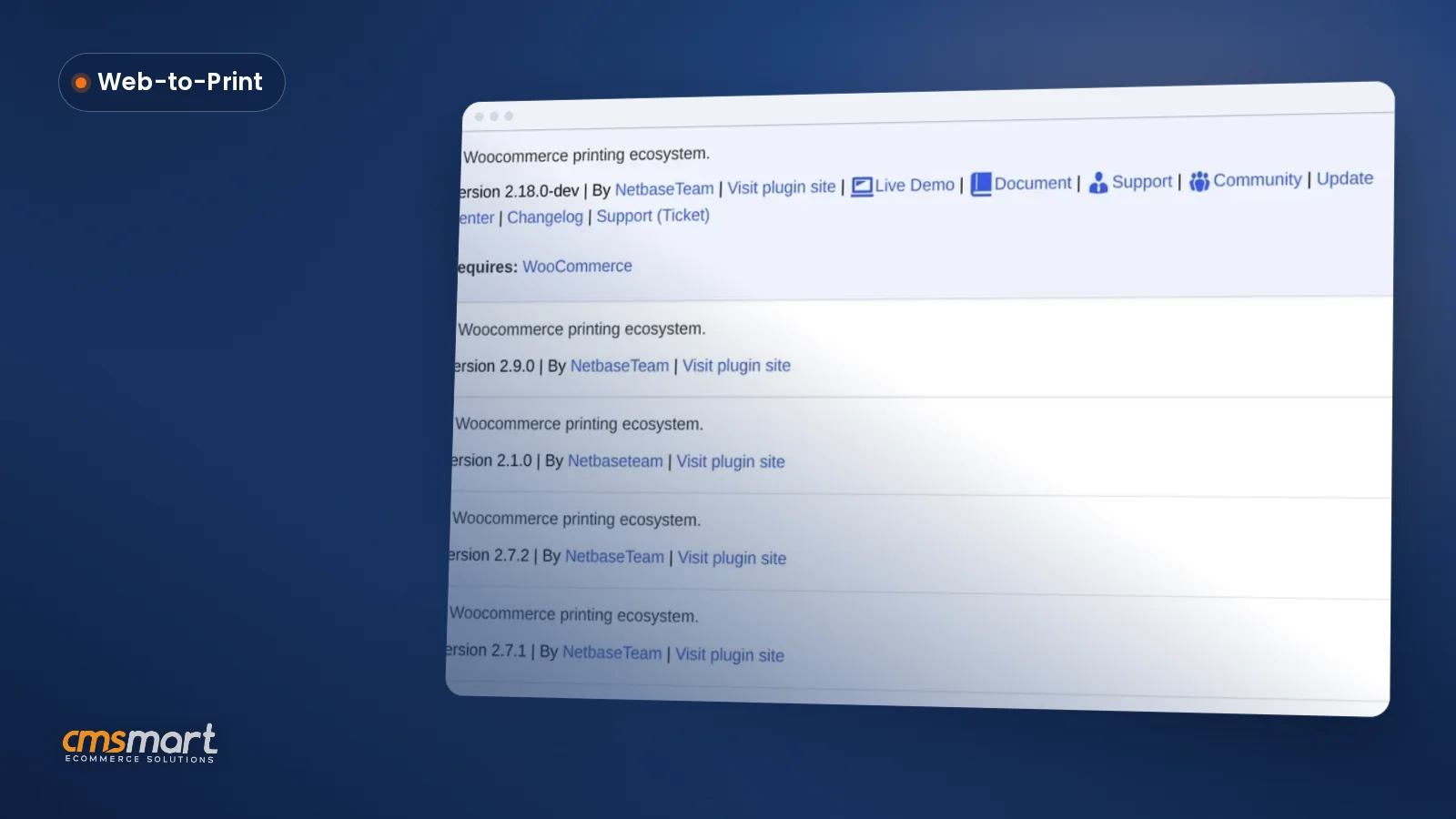
Confirm the plugin version you're setting this up on — this walkthrough is 2.17.0:
How far can you take print-ready automation with custom development?
Once the built-in pipeline is running, Cmsmart builds on top of it: routing certified files into your MIS/ERP, nesting orders onto one press sheet, and brand-specific preflight rules — work the plugin doesn't do out of the box.
The plugin's export pipeline is deliberately generic — it has to work for every WooCommerce print shop. Most established shops eventually need something specific to how they produce work:
We deliver every custom build the same way: discovery, solution design, sprints, QA, launch, ongoing support — see how we run custom ecommerce projects, or talk to an ecommerce expert about which would move the needle first.
Get a custom print-pipeline quote
Why work with Cmsmart on your print-ready pipeline?
Cmsmart has been building WooCommerce print and customization tools as a Netbase JSC division since 2012, with 6,300+ client projects and 500+ custom development projects delivered — including the print-ready export pipeline this tutorial walks through.
Cmsmart (a Netbase JSC division since 2012) has run 6,300+ client projects and delivered 500+ custom development projects, with 1,800+ live stores running today across 80+ countries — see our delivery platform. One review from a shop running this print workflow day to day, published on Trustpilot:
Cmsmart holds a 4.2 rating from 404 reviews on Trustpilot — see the full profile on Trustpilot.
Related reading: how DPI affects print quality, and how to configure print pricing options on NBDesigner.
Frequently asked questions about exporting print-ready PDFs
Does Cmsmart's print-ready PDF actually match the design the buyer approved?
Yes, as of 2.17.0. The cloud renderer, the server renderer, the designer preview and the order screen's Create PDF button all read the same page geometry now, including a buyer's custom width and height — previously the automatic render could fall back to the product template's default size instead.
What happens if the automatic PDF render fails?
It's retried after 1 and 5 minutes, then marked Failed in WooCommerce → Status → Scheduled Actions. With Print-ready artwork emails on, your team gets one alert naming the order, the design and the reason, deduplicated per design revision for 12 hours so one bad render doesn't spam your inbox.
Can a customer still edit their design after we've approved it?
No, not by default. Saving over an approved order item's design is refused server-side, from any link or open designer tab — the approved-artwork lock. A shop that needs to allow specific post-approval edits can widen that with the
nbd_ordered_design_edit_lockedfilter.Which file formats can we hand to production besides PDF?
The Download design tab offers SVG, high-resolution PNG, and CMYK JPG with an ICC color profile, alongside the PDF itself.
Do we need our own server to render the PDFs?
No. Cmsmart Cloud renders by default and falls back to the plugin's local TCPDF renderer if the cloud service can't produce a file; a store can also render locally from the General tab.
Can Cmsmart build a fully custom print pipeline on top of this?
Yes — MIS/ERP job routing, gang-sheet imposition, brand-specific preflight rules and multi-step B2B approval chains are custom development built on top of the plugin's export pipeline. See "Going further" above.
Stop hand-building print files, order by order
Every approved design already has the data it needs to become a print-ready PDF automatically. Let's find out what that's worth for your order volume, and whether your production workflow needs custom routing on top.
Plan my print-ready pipeline See the product designer customization service