

Guide · Web-to-print
Cmsmart Stores Setup Wizard: What's New, October 2026
The Cmsmart Stores Setup wizard installs niche, B2B and Marketplace stores with sample data live in minutes. See what changed and try it free.
A buyer who opens your product designer to a blank canvas has to make every decision alone — layout, colors, wording — before they ever see a price. Cmsmart's product designer template store removes that first decision: it hands the buyer a finished, editable design the moment they click into the online designer, so they are personalizing in seconds instead of staring at an empty page.
Was this tutorial helpful?
Written by
Cmsmart Product Designer Plugin Engineer
Builds and supports the Cmsmart Product Designer (NBDesigner) for WooCommerce.
The team behind it
 Account Manager
 Project Manager
 Business Analyst
 Developers & QA
Guide · Web-to-print
The Cmsmart Stores Setup wizard installs niche, B2B and Marketplace stores with sample data live in minutes. See what changed and try it free.
Guide · Web-to-print
The NBDesigner plugin now gives stationery shoppers a curated background library so print-ready PDFs always match the preview. See how to set it up.
Guide · Web-to-print
See how t-shirt artwork approval and print-ready PDFs cut POD reprints on WooCommerce; get a free workflow review from Cmsmart today.
Browse more guides, tutorials and case studies from the Cmsmart community.
Run a custom tote bag printing business with Cmsmart Product Designer: live pricing, real print specs and a print-ready PDF. See how to set it up.
Read MoreBuild a car wrap ecommerce store on WooCommerce: panel pricing, approval and print-ready PDFs before you print. Plan your wrap store today.
Read MoreDiscover how the home décor industry is transforming with the rise of personalized products and the challenges retailers face. Learn how CMSmart's Product Builder offers a solution, improving customer engagement, reducing return rates, and increasing sales through real-time 3D previews and automated processes.
Read More
Cmsmart Ecommerce provides custom ecommerce and WooCommerce development services for web-to-print, product personalization, plugin support and API integration.
Cmsmart Product Designer Plugin Engineer
Builds and supports the Cmsmart Product Designer (NBDesigner) for WooCommerce.
Meet the team →




In short
That one change touches the whole front of your funnel: fewer abandoned designs, fewer support emails asking staff to recreate a layout by hand, and a shorter path from product page to cart. This guide covers what the template store does today, what it costs you when it is off, how to turn it on for a product, and where Cmsmart builds further on top of it.
What does it cost you when every buyer starts from a blank canvas?
A blank design area forces every buyer to be their own designer before they can buy anything. Cmsmart's product designer removes that barrier by opening straight into a template they can edit, so shoppers who were never going to design from scratch still complete an order.
Run a design-enabled product without any templates assigned and you tend to see the same handful of problems on repeat:
None of that is unique to custom-product stores. Checkout abandonment across ecommerce in general runs high for the same underlying reason — friction between wanting something and actually buying it: the average cart abandonment rate sits at 70.22% across the studies Baymard Institute tracks, and 17% of US shoppers specifically blame a process that felt too long or too complicated (Baymard Institute, updated September 2025). A design step with no starting point is exactly that kind of friction, placed before the buyer has even reached checkout.
What would a pick-a-template storefront look like for your shop?
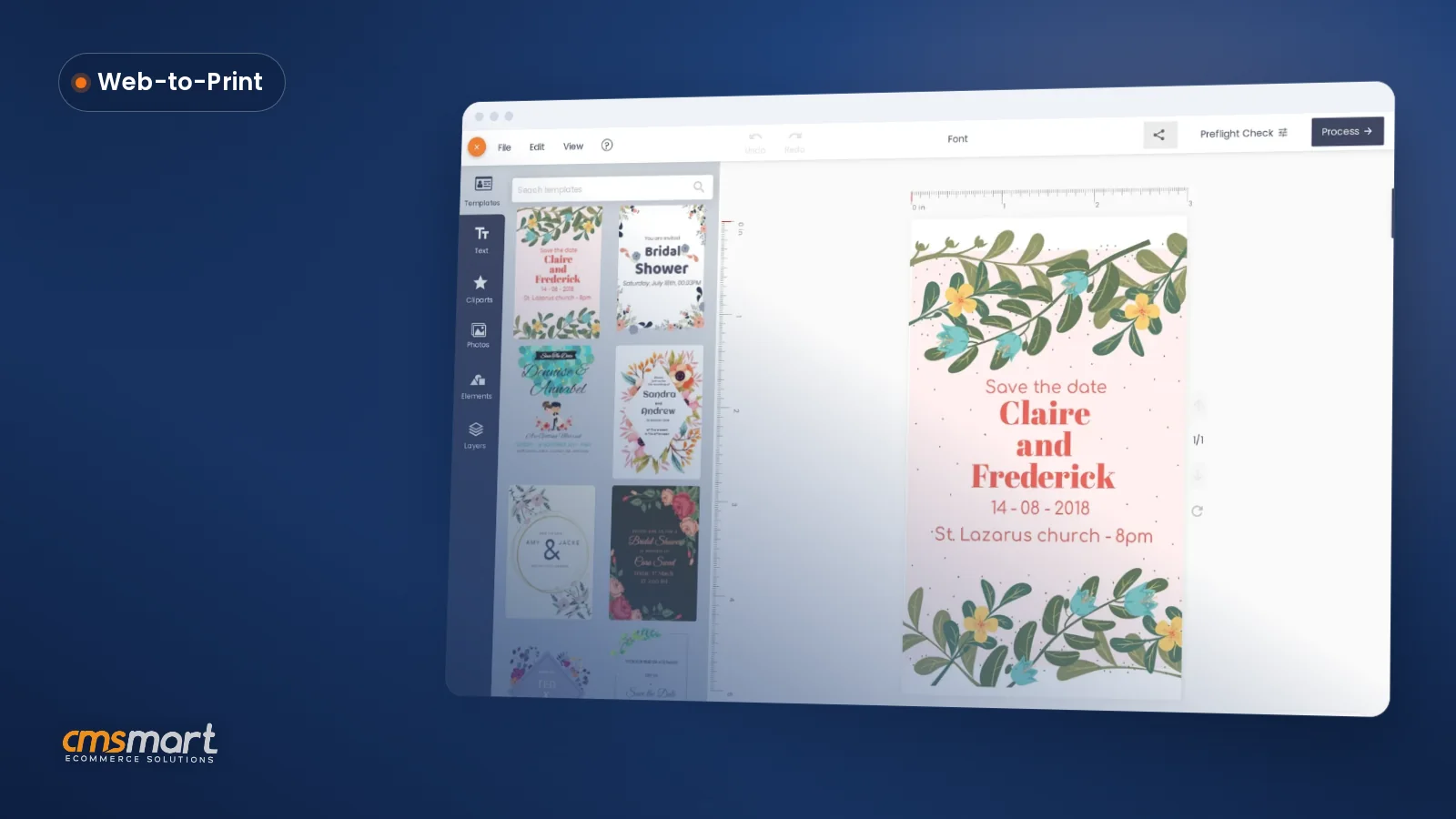
With Cmsmart's Global Template Store turned on, a buyer never meets an empty canvas: the product designer opens with a curated layout already in place, ready to personalize and order in a couple of minutes.
Example scenario. A gift shop lists a photo mug. A shopper opens the product page at 9pm, skips the upload-a-file option, and opens the online designer instead. The Templates panel on the left already shows a birthday-themed layout assigned to that product. They search for a birthday layout, pick one, swap in two photos and a name, watch the price update, and check out — no emailed proof, no back-and-forth, and no blank canvas at any point.
Demand for that kind of self-serve personalization keeps climbing: the global print-on-demand market is projected to grow from $10.8 billion in 2025 to $57.5 billion by 2033, a 23.6% CAGR (Grand View Research, 2025). Shoppers increasingly expect a store to meet them with a starting point, not a blank tool.
How does Cmsmart's product designer template store work?
Cmsmart's Global Template Store pairs a template library with your product's own design area: you assign a collection of templates to a product from its Templates tab, and the online designer shows that collection in a searchable panel the moment a buyer starts designing.
Four pieces work together, and it is worth being clear about which ones ship in the plugin today and which ones are delivery work:
Cmsmart insight: in our delivery work, the shops that still see design abandonment are usually the ones that only assigned templates to one or two hero products. Give every design-enabled product at least two or three templates — even a thin collection beats a blank canvas.
For the gallery view of everything in the library, see Cmsmart's templates library — it is the same collection your product's Templates tab draws from.
What's the business value of turning on the template store?
A template store turns design time into personalization time: buyers spend their minutes editing a layout instead of building one, which shows up as fewer abandoned designs, fewer support emails, and more consistent print-ready artwork.
Rough-cut math, with your own numbers: if N buyers a month start from a template instead of a blank canvas, and each one saves roughly M minutes of back-and-forth proofing email at your support rate of H per hour, that is
N × M ÷ 60 × Hin support time saved each month — before counting the orders that complete only because the buyer did not abandon a blank canvas. Plug in your own N, M and H to see what the switch is worth to your shop.You are not alone in running this workflow on WooCommerce: more than 4 million stores run on it today, 31% of the top 1 million ecommerce sites by WooCommerce's own count (WooCommerce, 2026) — which is also why a template library that is easy to search and assign matters at that scale.
How do you set up the Global Template Store on a product?
You configure the template store once per product: turn on the online designer, open that product's Templates tab, assign a collection, then confirm it on the storefront — Cmsmart's Product Manager shows exactly how many templates each product already carries.
For the deeper settings behind each step — upload limits, output DPI, print options — see the companion guide on using the product designer plugin in the back end, and for building a single template by hand rather than assigning a collection, see how to create a template with the product designer plugin.
Going further: how does Cmsmart build custom development on top of the template store?
Cmsmart builds template experiences beyond the stock library as custom development — niche-specific collections, data-merge templates, brand-locked sets for multi-location accounts — fitted to your catalog instead of a generic demo.
The Global Template Store ships a general-purpose library. Most shops eventually want something sharper than a general-purpose library, and that is where Cmsmart's project teams come in:
Cmsmart delivers this the same way as any other engagement: discovery, solution design, build sprints, QA, launch and ongoing support — see the delivery model on Cmsmart ecommerce projects, or the full scope of product-designer work on the product designer customization service page.
Get a custom template library quote
Cmsmart insight: before you roll a template collection out to every variant of a product, check that every font it uses is already in your font library under Settings. A template that looks right in the editor can fall back to a substitute font in the print-ready PDF if nobody proofed it first — easy to catch once, easy to miss at scale.
Why work with Cmsmart on your template strategy?
Cmsmart has built and supported web-to-print storefronts since 2012 as a Netbase JSC division, with thousands of client projects behind the product designer you are configuring today.
Cmsmart has delivered 6,300+ client projects and 4,600+ completed projects since 2012, with 1,800+ live stores running today across 80+ countries. Trustpilot rates Cmsmart 4.2 out of 5 across 404 reviews. One buyer who purchased a template through Cmsmart put it simply: "My first time with this developer and am very impressed with the template that I purchased and the quick turnaround and assistance" — Lillian Fidler, Trustpilot review. See related delivery work on Cmsmart projects, or start from the plugin itself on the Cmsmart Product Designer (NBDesigner) page, or explore the broader web-to-print solutions hub.
Frequently asked questions
What is the Global Template Store in Cmsmart Product Designer?
It is Cmsmart's library of ready-made designs that you assign to a product from its Templates tab; buyers then see those templates in a searchable panel inside the online designer instead of an empty canvas.
Does turning on templates stop buyers from designing from scratch?
No. The product page still offers both the upload-your-own-file option and the online designer, and inside the editor the Templates tab sits alongside Text, Cliparts and Photos — a buyer can ignore every template and build a layout from nothing if they want to.
Do I need to assign templates to every product?
No, but it helps. Manager Products shows a running template count per product, so you can see which design-enabled products still have zero templates assigned and prioritize the ones with the most traffic first.
Does a template change how the print-ready file is produced?
No. Whether a buyer starts from a template or a blank canvas, Process renders the same print-ready PDF that matches the order, and approved artwork is protected the same way either path.
Can Cmsmart build us a custom template collection instead of using the general library?
Yes — niche-specific packs, data-merge templates and brand-locked B2B collections are all custom development Cmsmart builds on top of the core template store; get a quote to scope it.