

Guide · Web-to-print
Cmsmart Stores Setup Wizard: What's New, October 2026
The Cmsmart Stores Setup wizard installs niche, B2B and Marketplace stores with sample data live in minutes. See what changed and try it free.
Business card template fields WooCommerce buyers can edit - name, title, phone - on one locked design. See the setup steps and get a custom quote.
Was this tutorial helpful?
Written by
Cmsmart Product Designer Plugin Engineer
Builds and supports the Cmsmart Product Designer (NBDesigner) for WooCommerce.
The team behind it
 Account Manager
 Project Manager
 Business Analyst
 Developers & QA
Guide · Web-to-print
The Cmsmart Stores Setup wizard installs niche, B2B and Marketplace stores with sample data live in minutes. See what changed and try it free.
Guide · Web-to-print
The NBDesigner plugin now gives stationery shoppers a curated background library so print-ready PDFs always match the preview. See how to set it up.
Guide · Web-to-print
See how t-shirt artwork approval and print-ready PDFs cut POD reprints on WooCommerce; get a free workflow review from Cmsmart today.
Browse more guides, tutorials and case studies from the Cmsmart community.
Run a custom tote bag printing business with Cmsmart Product Designer: live pricing, real print specs and a print-ready PDF. See how to set it up.
Read MoreBuild a car wrap ecommerce store on WooCommerce: panel pricing, approval and print-ready PDFs before you print. Plan your wrap store today.
Read MoreDiscover how the home décor industry is transforming with the rise of personalized products and the challenges retailers face. Learn how CMSmart's Product Builder offers a solution, improving customer engagement, reducing return rates, and increasing sales through real-time 3D previews and automated processes.
Read More
Cmsmart Ecommerce provides custom ecommerce and WooCommerce development services for web-to-print, product personalization, plugin support and API integration.
Cmsmart Product Designer Plugin Engineer
Builds and supports the Cmsmart Product Designer (NBDesigner) for WooCommerce.
Meet the team →




In short
Business card template fields WooCommerce buyers fill in — name, title, phone — turn one locked design into a personal, print-ready card for every employee, with no designer redrawing the layout each time an order comes in.
Why does manually editing business cards cost you time and consistency?
Cmsmart Product Designer gives every business card product a reusable template with name, title and phone text layers already placed, so a WooCommerce store stops rebuilding the same card in a graphics app for each new hire and instead lets the buyer fill in three fields and order.
Walk into most print shops' order folders and you will find the same business card redrawn many different ways: a slightly different logo size here, a title in the wrong font there, a phone number typed with the wrong country code. A few concrete costs show up every week:
The card still does real work: about 72% of people form an opinion of a company from its business-card quality, and a sloppy one costs trust before a conversation starts (UPrinting, 2025). The same research found 88% of cards are discarded within a week — all the more reason the ones that survive carry your brand correctly.
Formula for the reader's own numbers: cards ordered per month × minutes of manual editing × your loaded hourly rate is the design-time cost alone, before counting reprints from a typo that slipped through.
What would it look like if every staff card was right the first time?
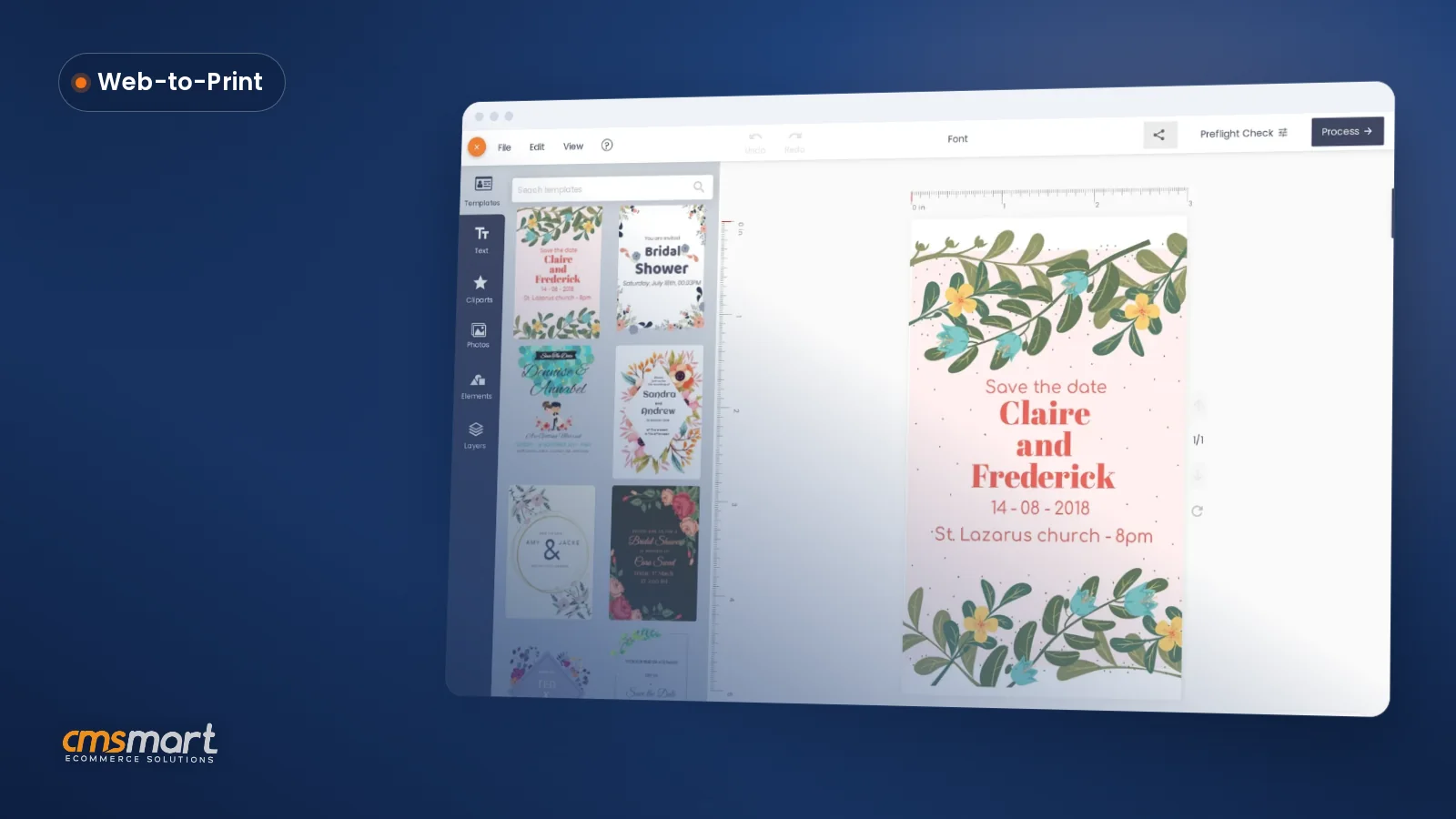
With a Cmsmart template, a new hire opens the business card product, picks "Design here online," sees the company layout already in place, and only types their name, title and phone — the logo, colors and QR code stay exactly as the brand team built them.
Example scenario: A regional print shop sells "Staff Business Card" as a WooCommerce product to its B2B clients. A client's office manager orders a card for a new hire: pick the locked company template, type name, title and phone into the three editable fields, click Process. The logo, color scheme and QR code render untouched — no design request, no proof email — and a print-ready PDF lands in the shop's queue seconds later. (Talk to an ecommerce expert about building this for your store.)
How does Cmsmart build business card template fields WooCommerce stores can use?
Cmsmart Product Designer stores templates in the Manager → Template library, assigns them to specific products, and opens them inside the online designer, where every text layer a buyer is allowed to touch is already defined — the rest is building blocks the plugin and, where needed, Cmsmart's custom development team put together.
The moving parts behind filling in three fields to get a print-ready card:
Cmsmart insight: most "the logo moved" support tickets we see on template-based products trace back to a text or image layer that was left unlocked. Before you launch a business card template, check every layer's edit permission in Layers rather than relying on buyers to leave things alone.
What's the ROI of a locked business card template?
A locked Cmsmart template turns a design request into a three-field form, which shows up as fewer support tickets, fewer reprints from brand mistakes, and a self-serve ordering flow your B2B clients can run without calling your studio.
ROI worksheet (use your own numbers): if your team currently hand-edits N business-card orders a month at M minutes each and a loaded rate of R/hour, manual design time costs
N × M × R ÷ 60per month. A template that needs no manual edit removes that line entirely and only leaves the minutes a buyer spends typing their own name, title and phone.The underlying market keeps growing: the global business card market is projected to reach roughly $242.3 million by 2027, growing at an 11.2% CAGR from 2021 (Tapni, business card statistics) — and selling that product through WooCommerce puts it on the platform already running an estimated 33.4% of tracked ecommerce stores worldwide, 4.53 million of them, as of August 2025 (Red Stag Fulfillment, StoreLeads data). A template-driven card product plugs into that large addressable base.
How do you set up an editable business card template in WooCommerce?
Setting up a Cmsmart business card template means turning on the designer for the product, building or picking a template with editable text layers in the Template library, assigning it to the product, and confirming the print options and print-ready PDF before you publish — all inside your existing WooCommerce admin.
For the print-option side of this same product — paper, weight, quantity discounts — see how to configure print pricing options on NBDesigner, and for building the template itself from scratch, see how to create a template with the WooCommerce product designer plugin.
Going further: what custom business card features can Cmsmart build?
Beyond the core editor, Cmsmart builds locked company templates, account-based auto-fill, QR vCard generation and directory sync as custom development, so a franchise or B2B client can hand every location a template that only accepts a name, title and phone number — never a redesign.
Once the core template and print-ready pipeline are live, these are the extensions we build most often for business-card and staff-card use cases. None of them ship in the core plugin today — each is scoped, sourced and delivered as a project:
Delivery follows the same path as any Cmsmart project: discovery call, a short solution design, build sprints, QA against your live catalog, launch, then support — see how that runs on real Cmsmart project deliveries.
Get a custom business-card template quote
Why work with Cmsmart on your WooCommerce business card templates?
Cmsmart has built WooCommerce print and customization stores since 2012 as a Netbase JSC division, with thousands of delivered projects and the same Cmsmart Product Designer (NBDesigner) plugin powering this template workflow on your own store.
Cmsmart has run 6,300+ client projects and delivered 4,600+ of them since 2012, with 1,800+ live stores running today across 80+ countries. Reviewers on Trustpilot rate the company 4.2 out of 5 across 404 reviews. One of them, printing-business customer M. Idema, wrote: "The tool has so many options. We are very happy with it. […] We would recommend the NB Designer tool for printing personalized cards." See more delivered work on Cmsmart projects, the product designer customization service, or browse the templates library for ready-made starting points.
Frequently asked questions
Does NBDesigner auto-fill a buyer's name, email or phone from their account today?
Not as a core-plugin toggle in 2.17.0. The template's text layers are edited manually by the buyer in the designer. Pulling a logged-in buyer's saved details into those fields automatically is custom development Cmsmart builds for stores that need it.
Can I lock the logo and background so only name, title and phone are editable?
Layer-by-layer edit locking for a template is not a built-in setting today — the core editor lets a buyer edit any unlocked text or image layer on a template. A per-field lock for B2B company templates is something Cmsmart builds as custom development.
How many templates can one product have?
As many as you assign from the Template library — the demo store's Manager Products screen shows products with anywhere from zero to ten templates attached, and a buyer picks one from the product's Templates panel in the designer.
Does this work for bulk, variable-data printing (CSV import of hundreds of names)?
No — NBDesigner's template fields are edited per order by a buyer in the designer, not from a CSV of records. True variable-data printing (VDP) at bulk scale is outside the core plugin; talk to Cmsmart about a custom pipeline if that is your use case.
What file do I get once a template-based card is ordered?
Once the buyer clicks Process, the plugin queues a print-ready PDF render; the order screen shows Ready, Rendering or Failed with a Regenerate button, and the admin can download the artwork in the formats configured for the product.
Can staff reorder their own card later without design help?
With the core template and designer, yes — they reopen the product, pick the same template, and retype their details. Pre-filling those fields automatically from an account or directory is the custom-development option above.