

Case study · Web-to-print
Sell Personalized Products with Custom Text
Sell personalized products with custom text: let shoppers curve it, pick a font and preview it live before checkout, then get a quote.
Translate WooCommerce product designer screens: pick the right Cmsmart layout, set up Loco Translate or WPML, and sell in every buyer's language.
Table of contents
Was this tutorial helpful?
Written by
Cmsmart Product Designer Plugin Engineer
Builds and supports the Cmsmart Product Designer (NBDesigner) for WooCommerce.
The team behind it
 Account Manager
 Project Manager
 Business Analyst
 Developers & QA
Case study · Web-to-print
Sell personalized products with custom text: let shoppers curve it, pick a font and preview it live before checkout, then get a quote.
Guide · Web-to-print
Business card template fields WooCommerce buyers can edit - name, title, phone - on one locked design. See the setup steps and get a custom quote.
Guide · Web-to-print
Compare product design tools for online store owners: Cmsmart vs Zakeke, Fancy Product Designer and Lumise on features, pricing and print output.
Browse more guides, tutorials and case studies from the Cmsmart community.
Custom bag design software for WooCommerce: Cmsmart Product Designer adds live pricing and print-ready files. See how to set it up.
Read MoreCar wrap design software for WooCommerce: panel templates, size-based pricing, 3D preview and approval before you print. Plan your wrap store now.
Read MoreDiscover how the home décor industry is transforming with the rise of personalized products and the challenges retailers face. Learn how CMSmart's Product Builder offers a solution, improving customer engagement, reducing return rates, and increasing sales through real-time 3D previews and automated processes.
Read More
Cmsmart Ecommerce provides custom ecommerce and WooCommerce development services for web-to-print, product personalization, plugin support and API integration.
Cmsmart Product Designer Plugin Engineer
Builds and supports the Cmsmart Product Designer (NBDesigner) for WooCommerce.
Meet the team →



In short
A shopper who cannot read your design tool will not finish a design in it, no matter how good your product catalogue is. Here is how to translate WooCommerce product designer screens on Cmsmart Product Designer (NBDesigner), so your editor sells in the buyer's own language, not just your theme's checkout text.
What does it cost you when your design tool only speaks English?
An English-only design tool loses international buyers mid-edit, generates support tickets asking what a button does, and pushes customers to competitors whose storefront already matches their language. Cmsmart Product Designer removes that cost once its UI strings are translated through a standard WordPress translation plugin.
If you sell product customization to more than one country, a handful of pains show up in your analytics and your inbox:
The scale of this is not a guess: in a CSA Research survey of 8,709 online shoppers across 29 countries, 66% chose the product listed in their own language over an identical one described only in English (CSA Research, 2020). And English still covers only about half the open web — W3Techs measured it at 49.5% of all websites as of October 2026 — so most of your potential buyers are reading a second language every time they shop with you.
What would a fully localized design experience look like?
Picture a buyer who never notices they are using translated software: templates, toolbar labels, the printing-option form and the order confirmation all read in their language, so the only thing standing between them and checkout is the design itself. That is what Cmsmart Product Designer delivers once its strings are translated.
Example scenario. A buyer in Lyon opens a sticker product on a French-language WooCommerce store. The Start and upload design button already reads Démarrer et importer un design, because the shop translated the designer's strings months ago. They drop a logo, adjust the text panel — also in French — pick a print option from a localized price list, and check out without ever switching the page to English or opening a support chat.
That is the whole promise: the buyer's attention stays on their design, not on decoding your interface.
How does Cmsmart Product Designer handle translation?
Cmsmart Product Designer ships every interface string as standard, translatable WordPress text, so the same tools that translate your theme — Loco Translate, WPML, or any
.pot/.moworkflow — translate the designer too, with no code changes required.Three building blocks make up the translated experience, and which ones you touch depends on the layout a product uses:
.pottemplate (regenerated to 4,107 strings as of the 2.12.2 translation release). A plugin such as Loco Translate — 1M+ active installs on WordPress.org — edits these in-browser; WPML works the same way across language directories or subdomains..potfiles at all. It still works in 2.17.0, but the General settings screen below now marks Classic layout as deprecated, with no new features planned for it.In practice: new stores and anyone building out multiple languages should translate the Modern layout's strings with Loco Translate or WPML. Stores still running Classic-layout products can keep using Frontend Translate, but Cmsmart is not adding features to that path going forward.
Cmsmart insight: translate the Modern layout first even if you still have Classic-layout products live. Most of a store's strings — cart text, account pages, your theme — are shared across layouts, so the Loco Translate / WPML work carries over, while Frontend Translate only ever covers the Classic designer itself.
.potfile / Frontend Translate list per store as the source of truthWhat's the business value of multilingual product design?
Translating Cmsmart Product Designer turns language from a silent drop-off point into a measurable lever: fewer abandoned designs, fewer repeat support tickets, and a storefront that can expand into a new country without a developer re-building the editor.
Back-of-envelope ROI: take your monthly designer sessions in a given language, multiply by your current abandonment rate in that language, then by your average order value. That is the revenue a translated designer is competing for in that market — compare it to the one-time hour or two of translation work plus the cost of a translation plugin or translator pass.
How to set up and translate WooCommerce Product Designer
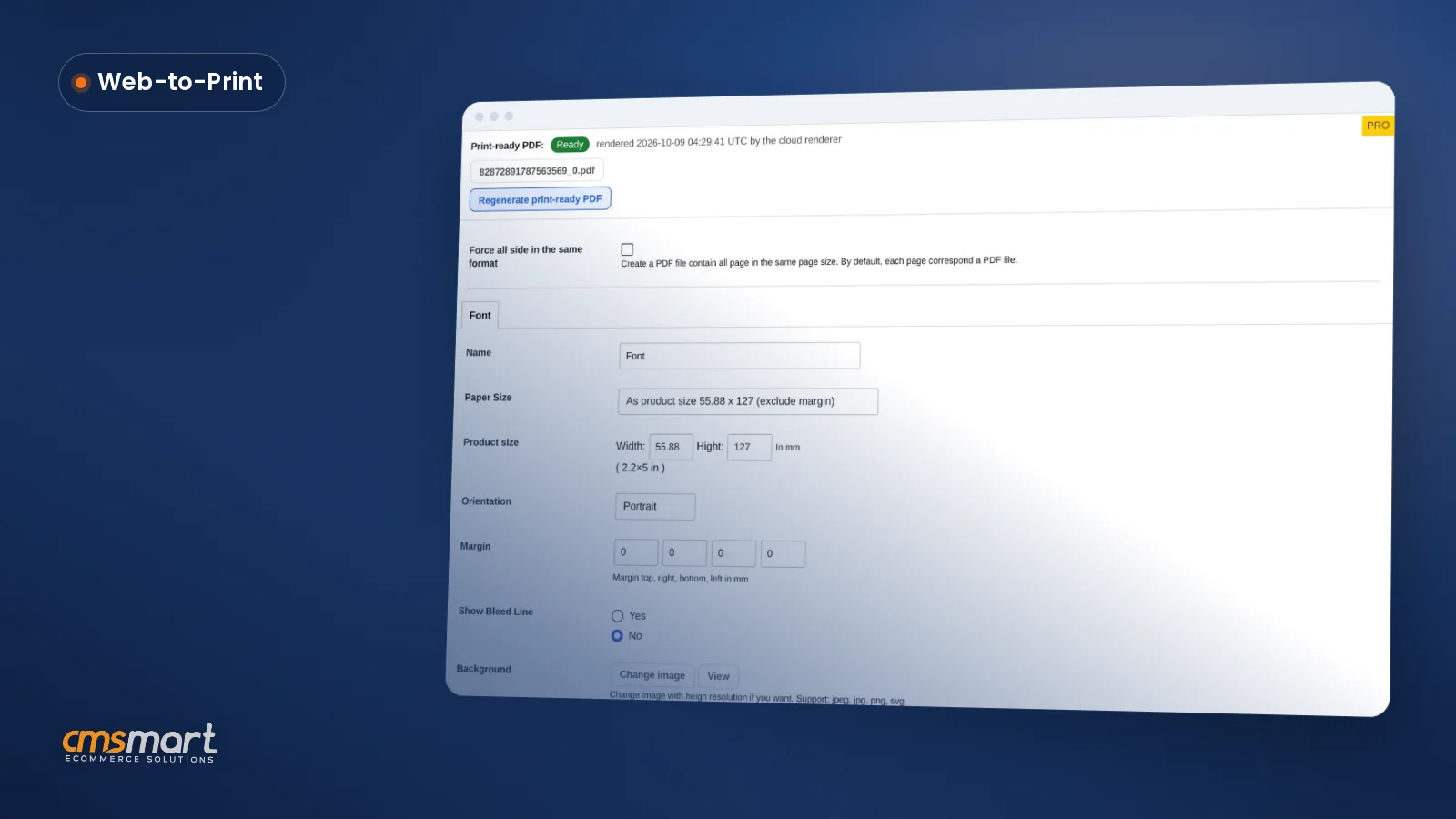
Setting up translation starts with the Default design editor layout in Settings → General, then runs through either Loco Translate/WPML (Modern/Visual) or the Frontend Translate screen (Classic), finishing with WordPress's own site-language switch so buyers actually see the result.
Pick the path that matches your products' layout. Most 2.17.0 stores should use the Modern/Visual path below.
Modern or Visual layout (recommended):
Classic layout (deprecated, still supported):
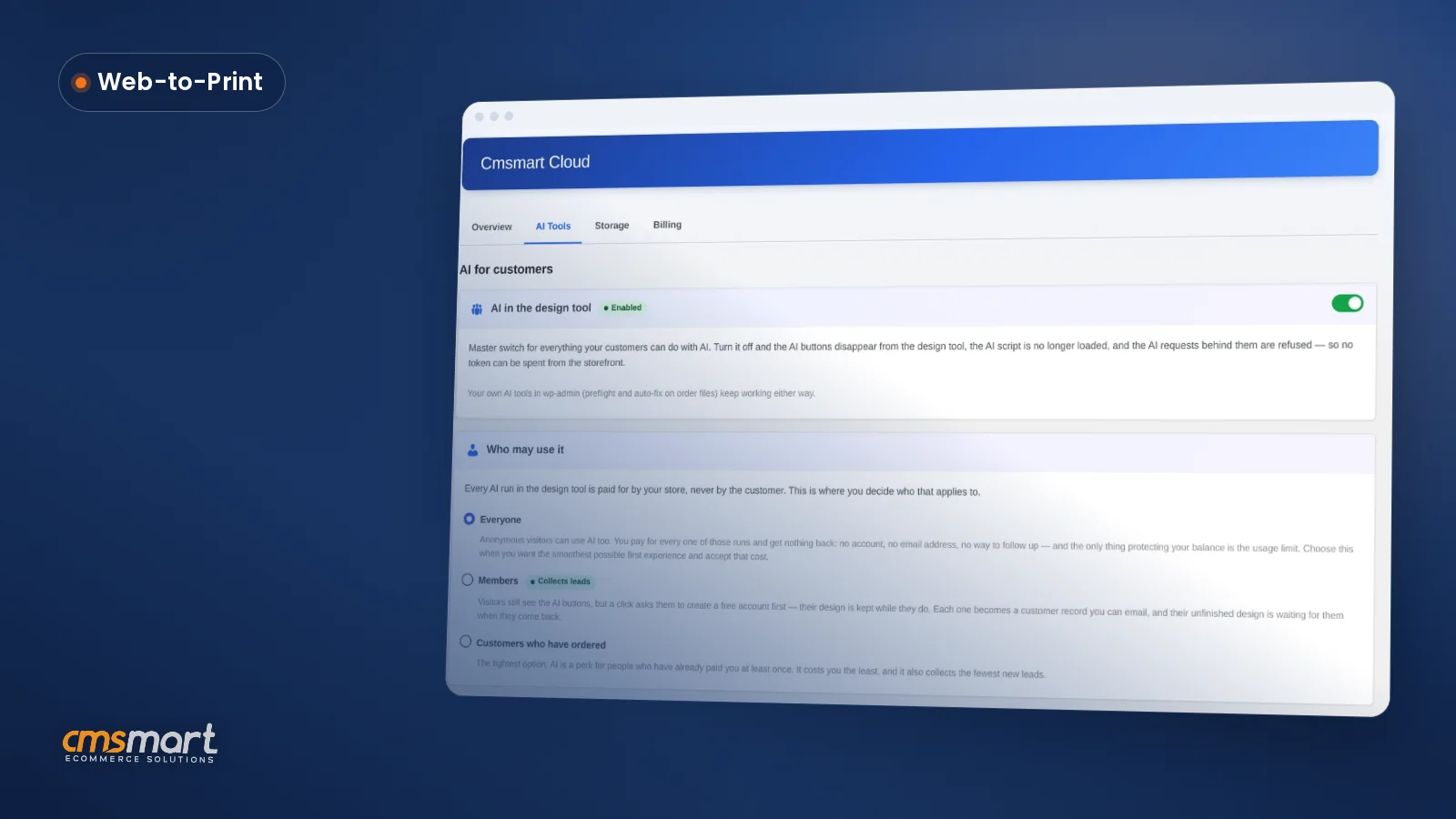
For WPML stores specifically: Cmsmart Product Designer's AI tools — AI preflight, upscale, background removal — run through Cmsmart Cloud rendering, and once failed with a license error under WPML's language-directory URLs because the license check used the wrong home URL for a translated page. That was fixed in version 2.12.0, so AI preflight and the other Cmsmart Cloud AI tools now recognize the license correctly on every language directory.
Going further: custom multilingual development from Cmsmart
Beyond string translation, Cmsmart builds merchant-specific multilingual work — automatic buyer-locale detection, translated print-ready output, and right-to-left language support — as custom development on top of the core plugin, scoped to what your store actually needs.
Translating the interface covers most stores. A few requests come up often enough that they are worth planning for as custom development rather than expecting them in the core plugin:
Cmsmart's delivery model for this kind of work runs discovery → solution design → sprints → QA → launch → support, the same process behind the custom ecommerce projects in our portfolio. See the product designer customization service for how this kind of engagement is scoped and priced.
Get a quote for multilingual designer development
Why work with Cmsmart for multilingual commerce?
Cmsmart has built WooCommerce product customization since 2012 as a Netbase JSC division, with 6,300+ client projects and a 4.2 Trustpilot rating, including stores that specifically asked for storefront and designer translation.
Cmsmart (Netbase JSC) has worked on web-to-print and product-customization projects since 2012, with 6,300+ client projects and 1,800+ live stores running today. Reviews on Trustpilot sit at 4.2 out of 5 across 404 reviews, and translation is a recurring theme in them — one reviewer wrote simply: "Thank you very much for my Web site translation." — antonissanchez, Trustpilot, Sep 2022. For a deeper look at the designer itself, see the Cmsmart Product Designer product page.
Frequently asked questions
Does Cmsmart Product Designer support multiple languages out of the box?
Yes. Every interface string on the Modern/Visual layout is a standard, translatable WordPress string, and the Classic layout has its own Frontend Translate screen. Neither requires custom code to add a language.
Which layout should I use for translation, Modern or Classic?
Use Modern or Visual with Loco Translate or WPML for any new work — it's the recommended, actively developed layout. Classic's Frontend Translate screen still functions in 2.17.0, but Cmsmart has stopped adding features to the Classic layout.
Do I need a separate plugin for storefront vs. designer strings?
No. Your theme, WooCommerce and Cmsmart Product Designer's Modern-layout strings all go through the same WordPress translation system, so one plugin like Loco Translate or WPML covers all of them.
Will translating the designer affect my checkout or order emails?
Translating the designer's own strings doesn't touch WooCommerce's checkout or email templates — those are translated separately, the same way you'd translate any WooCommerce store. One related fix in 2.17.0: the admin approval-notification email now checks the order status by its internal key rather than its translated subject line, so approval emails work correctly on translated stores.
Can buyers switch languages themselves on the storefront?
That depends on your language plugin, not the designer. WPML and Polylang both support a visible language switcher; the designer simply follows whatever language WordPress is currently serving.
How long does a full multilingual setup take?
Translating one language's worth of designer strings with Loco Translate typically takes under two hours for a focused pass, since you're working from the plugin's existing translation template rather than writing copy from scratch. Reviewing the result end to end on the storefront adds another short pass.
For more on configuring the designer's admin side, see How to use the WooCommerce product designer plugin in the backend and how to create a component in Product Builder.