
Guide · Web-to-print
Cmsmart Stores Setup Wizard: What's New, October 2026
The Cmsmart Stores Setup wizard installs niche, B2B and Marketplace stores with sample data live in minutes. See what changed and try it free.
Cmsmart's wedding invitation design software lets a WooCommerce stationery shop sell personalized save-the-dates and invitation suites online, with every order moving through an approval step before it reaches the press — so customers see exactly what they ordered, and you stop reprinting jobs because of an email that got missed.
Was this tutorial helpful?
Written by
Cmsmart Web-to-Print Solutions Consultant
Plans online print storefronts: product setup, pricing rules, proofing and print-ready files.
The team behind it
 Account Manager
 Project Manager
 Business Analyst
 Developers & QA
Guide · Web-to-print
The Cmsmart Stores Setup wizard installs niche, B2B and Marketplace stores with sample data live in minutes. See what changed and try it free.
Guide · Web-to-print
The NBDesigner plugin now gives stationery shoppers a curated background library so print-ready PDFs always match the preview. See how to set it up.
Guide · Web-to-print
See how t-shirt artwork approval and print-ready PDFs cut POD reprints on WooCommerce; get a free workflow review from Cmsmart today.
Browse more guides, tutorials and case studies from the Cmsmart community.
Run a custom tote bag printing business with Cmsmart Product Designer: live pricing, real print specs and a print-ready PDF. See how to set it up.
Read MoreBuild a car wrap ecommerce store on WooCommerce: panel pricing, approval and print-ready PDFs before you print. Plan your wrap store today.
Read MoreDiscover how the home décor industry is transforming with the rise of personalized products and the challenges retailers face. Learn how CMSmart's Product Builder offers a solution, improving customer engagement, reducing return rates, and increasing sales through real-time 3D previews and automated processes.
Read More
Cmsmart Ecommerce provides custom ecommerce and WooCommerce development services for web-to-print, product personalization, plugin support and API integration.
Cmsmart Web-to-Print Solutions Consultant
Plans online print storefronts: product setup, pricing rules, proofing and print-ready files.
Meet the team →





In short
Printing a wedding invitation used to mean emailing a PDF proof back and forth, hoping nobody misses a wrong date or a misspelled name before the job goes to press. Couples now expect to design, preview and pay for custom stationery the same evening they get engaged — on a phone, at 11pm, without calling a salesperson. This guide walks through the business case for running that experience on Cmsmart, from the buyer's first click to the file your press actually prints.
What Does Manual Invitation Proofing Really Cost Your Print Shop?
Cmsmart replaces email-based proofing with an online design tool and an in-order approval step, so a stationery shop stops losing hours to back-and-forth attachments and catches a wrong date or name before it is printed, not after.
Most stationery and invitation shops still run proofs the same way they did a decade ago, and it shows up as real, recurring cost:
As a rough formula: hours spent chasing proofs by email each week × your hourly staff rate is the hidden labor cost of the status quo; add your reprint rate × the cost of a reprint (paper, press time, rush shipping) for jobs where a mistake slipped through. Neither number needs to be large before an online approval step pays for itself.
What Would It Look Like If Couples Could Design and Approve Invitations Tonight?
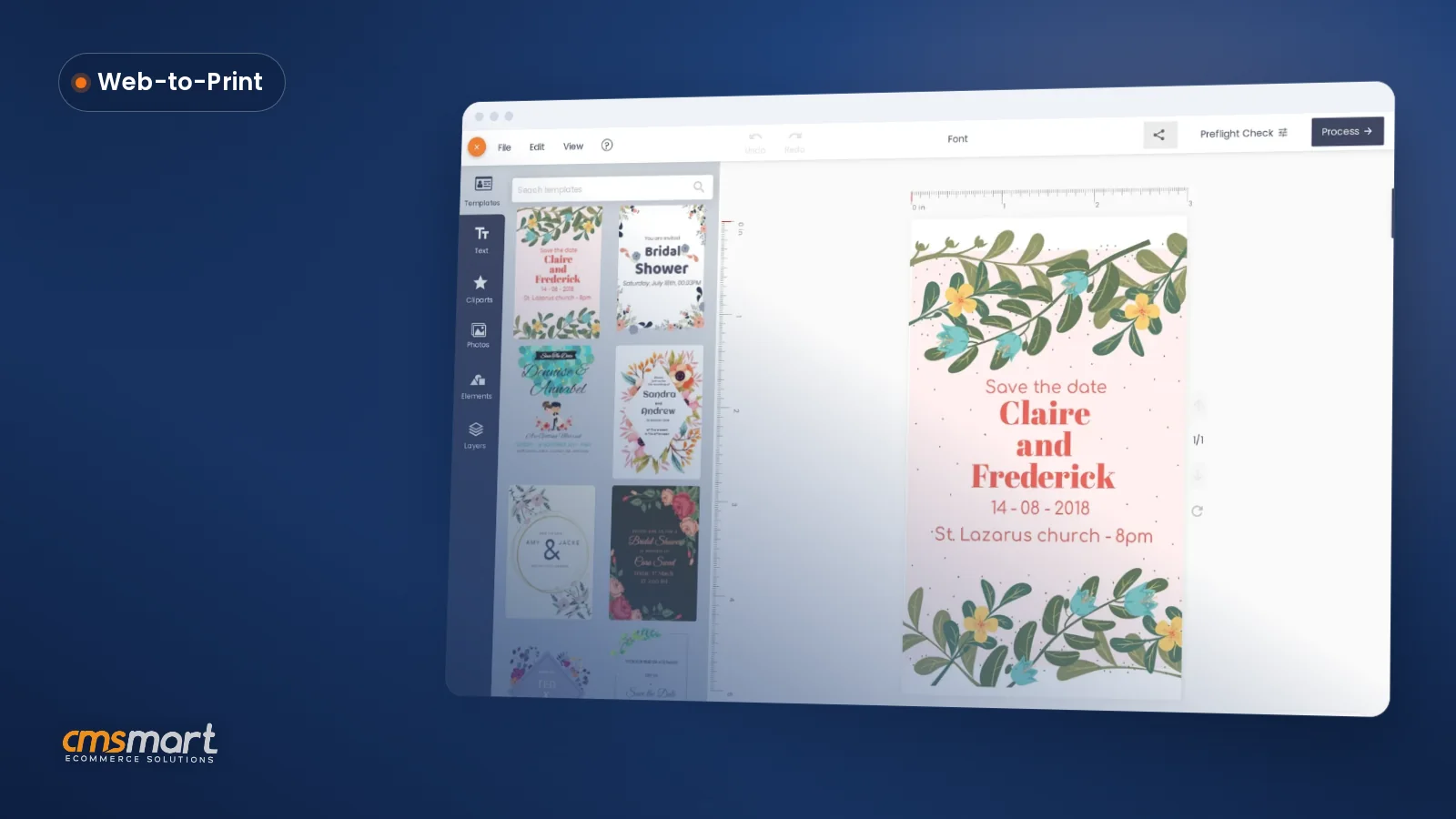
With Cmsmart, a couple opens your Invitation product, picks a template or starts from scratch, adds their names and date with the built-in text tools, and sees the finished artwork before they pay — no email, no waiting for a reply from your studio.
Example scenario: a couple sits down after dinner to pick their save-the-date. They open your Invitation product, choose "Design here online," pick a floral template from the gallery, swap in their own names and date, curve the headline text around the border the way they pictured it, and add it to cart. By the time they go to bed, the order is sitting in your queue with the exact artwork they approved — not a rough sketch you have to interpret.
That kind of on-demand customization is exactly where the category is heading: the wedding stationery services market is on track to roughly double, from about $0.97 billion toward $1.99 billion by 2035, an 8.5% compound annual growth rate, as more of that spending moves to shops that let couples design online instead of mailing in a form (Business Research Insights, 2025).
How Does Cmsmart's Wedding Invitation Design Software Work?
Cmsmart's wedding invitation design software connects a WooCommerce product to an online editor, an order-side approval box, and a print-ready PDF pipeline, so a template a couple customizes online becomes the exact file your press runs, with Cmsmart Cloud handling the render.
Six building blocks carry a stationery order from browse to press, and every one of them already exists in the plugin today:
Cmsmart insight: most of the reprint risk in invitation orders sits in the gap between a customer saying a design looks fine and someone in production actually checking the date, the spelling and the bleed. Routing every design through one approval screen before Create PDF closes that gap without adding a second round of emails.
The broader move to online design and ordering isn't unique to weddings: the web-to-print market is projected to grow from $36.13 billion in 2025 to $60.56 billion by 2035, a 5.3% compound annual rate, as more print shops put design, proofing and ordering online instead of behind a phone call (Expert Market Research, 2025). If you sell personalized products beyond stationery, the same online-design approach is covered from a broader angle in our guide to the WooCommerce product customizer.
What's the ROI of Selling Personalized Invitations Online?
Selling invitations through Cmsmart turns fewer proofing emails, fewer reprints and a mobile-friendly checkout into measurable KPIs — approval time, reprint rate and cart completion — that a stationery shop can track month over month.
ROI worksheet (use your own numbers): orders per month × minutes saved per order on proofing and file handling × your hourly staff rate = labor hours recovered. Separately, reprint rate × cost per reprint (paper, press time, rush shipping) is what an approval step and an artwork lock are protecting against. For scale: a typical wedding today has about 120 guests (median across more than 1,000 real 2025 weddings) (Carats & Cake, 2025), so a single invitation order can mean well over a hundred individually printed, personalized pieces riding on one approved design.
How Do You Set Up Cmsmart for an Invitation or Stationery Product?
Setting up Cmsmart for stationery means configuring one product for online design, a Printing Options set for your paper sizes, Upload and Output settings for your file types, and an approval habit on the order screen — all inside wp-admin, no developer required.
For a closer look at the Output tab specifically — watermarking, PDF passwords, bleed and sync options — see our guide to exporting a design online as a PDF.
What Can Cmsmart Build on Top of Your Invitation Designer?
Beyond the core designer, Cmsmart builds the extensions a growing stationery business actually asks for — RSVP and guest-list tools, bulk personalized mailings, ERP sync and multi-language storefronts — as custom development scoped to your workflow.
Delivery follows the same path for every custom project: discovery, solution design, build sprints, QA, launch and ongoing support — see how that plays out in our ecommerce project case studies. If your stationery line needs any of the above, or something specific to how your shop runs, talk to us about it directly.
Plan my invitation and stationery store
For the underlying plugin customization work itself — new tools, new panels, deeper product configuration — see our product designer customization service.
Why Work With Cmsmart on Your Stationery Store?
Cmsmart has built WooCommerce product design and print-shop tooling since 2012, with thousands of live client projects and a published Trustpilot track record, so a stationery shop is choosing a team that has already shipped this kind of workflow many times over.
Cmsmart has been building ecommerce and web-to-print solutions as a Netbase JSC division since 2012, across 6,300+ client projects, with a 4.2 rating from 404 reviews on Trustpilot. One recent review, from a developer who has run the plugin for three years, put it this way:
"It is wonderful to see their commitment to continuous development, with new features being added frequently to keep the software current and highly capable." — Web Developer, Trustpilot review, 2026
Browse related builds in our project case studies, or start with the Cmsmart Product Designer plugin page and our broader web-to-print solutions if you're scoping a full storefront rebuild rather than one product line.
Frequently Asked Questions
How long does it take to set up an invitation product in Cmsmart?
A single design-enabled product with a Printing Options set and Upload/Output settings configured is usually an afternoon's work in wp-admin; a full stationery catalogue with multiple sizes and price rules takes longer and is a good candidate for our setup support.
Can a couple design and approve an invitation from their phone?
The product page and the "how would you like to design" chooser are mobile-responsive, so a couple can start and preview a design on a phone; for detailed text and layer work, many still prefer a larger screen, but it isn't required.
What file do we actually get once an order is approved?
Once artwork is approved, Create PDF renders a print-ready PDF through Cmsmart Cloud using the order's real size, margins and bleed; the same design detail screen also offers SVG, high-resolution PNG and CMYK JPG with an ICC profile.
Does the approval step slow down small, simple orders?
No — accepting a design is one click from the Customer Design box on the order screen; it adds a checkpoint, not a queue, and it's the same screen whether the order is one card or a hundred.
Can Cmsmart connect our RSVP page or guest list to the store?
Not in the core plugin today — that kind of RSVP linking or guest-list mail merge is custom development Cmsmart builds on top of the existing designer and order flow for stationery shops that need it.
What happens if a customer needs a reprint after the artwork is approved?
Editing an approved design is blocked by the approved-artwork lock by default; your team can still open the saved design, make the correction and queue a fresh print-ready render, so there's a deliberate step rather than a silent overwrite of what was signed off.