

Guide · Web-to-print
Cmsmart Stores Setup Wizard: What's New, October 2026
The Cmsmart Stores Setup wizard installs niche, B2B and Marketplace stores with sample data live in minutes. See what changed and try it free.
Cmsmart's online product designer already lets WooCommerce buyers drop in shapes QR codes and drawing tools next to their text and templates, no separate app or designer required. That turns a blank product page into a finished order without a single email back and forth.
Was this tutorial helpful?
Written by
Cmsmart Product Designer Plugin Engineer
Builds and supports the Cmsmart Product Designer (NBDesigner) for WooCommerce.
The team behind it
 Account Manager
 Project Manager
 Business Analyst
 Developers & QA
Guide · Web-to-print
The Cmsmart Stores Setup wizard installs niche, B2B and Marketplace stores with sample data live in minutes. See what changed and try it free.
Guide · Web-to-print
The NBDesigner plugin now gives stationery shoppers a curated background library so print-ready PDFs always match the preview. See how to set it up.
Guide · Web-to-print
See how t-shirt artwork approval and print-ready PDFs cut POD reprints on WooCommerce; get a free workflow review from Cmsmart today.
Browse more guides, tutorials and case studies from the Cmsmart community.
Run a custom tote bag printing business with Cmsmart Product Designer: live pricing, real print specs and a print-ready PDF. See how to set it up.
Read MoreBuild a car wrap ecommerce store on WooCommerce: panel pricing, approval and print-ready PDFs before you print. Plan your wrap store today.
Read MoreDiscover how the home décor industry is transforming with the rise of personalized products and the challenges retailers face. Learn how CMSmart's Product Builder offers a solution, improving customer engagement, reducing return rates, and increasing sales through real-time 3D previews and automated processes.
Read More
Cmsmart Ecommerce provides custom ecommerce and WooCommerce development services for web-to-print, product personalization, plugin support and API integration.
Cmsmart Product Designer Plugin Engineer
Builds and supports the Cmsmart Product Designer (NBDesigner) for WooCommerce.
Meet the team →



In short
What does it cost your shop when a buyer has no artwork to upload?
Cmsmart Product Designer removes the "no artwork" dead end by giving buyers shapes, icons, a QR code generator and a free-hand pen on the same screen where they already pick colors and fonts, so a design finishes in one session instead of a support ticket.
Every print shop and personalization store has felt this pain:
Work out your own cost of the status quo: (abandoned sessions per week) × (average order value) + (staff minutes spent on manual artwork) × (your hourly rate). Even a handful of stalled orders a week adds up faster than a design tool costs to run.
Cmsmart insight: in our delivery work, the stores that lose the fewest custom orders are the ones that let buyers finish artwork in the same tab as checkout. Every extra app, upload portal or "email us your logo" step is a place a buyer quietly leaves.
What do shapes QR codes and drawing tools look like inside Cmsmart's product designer?
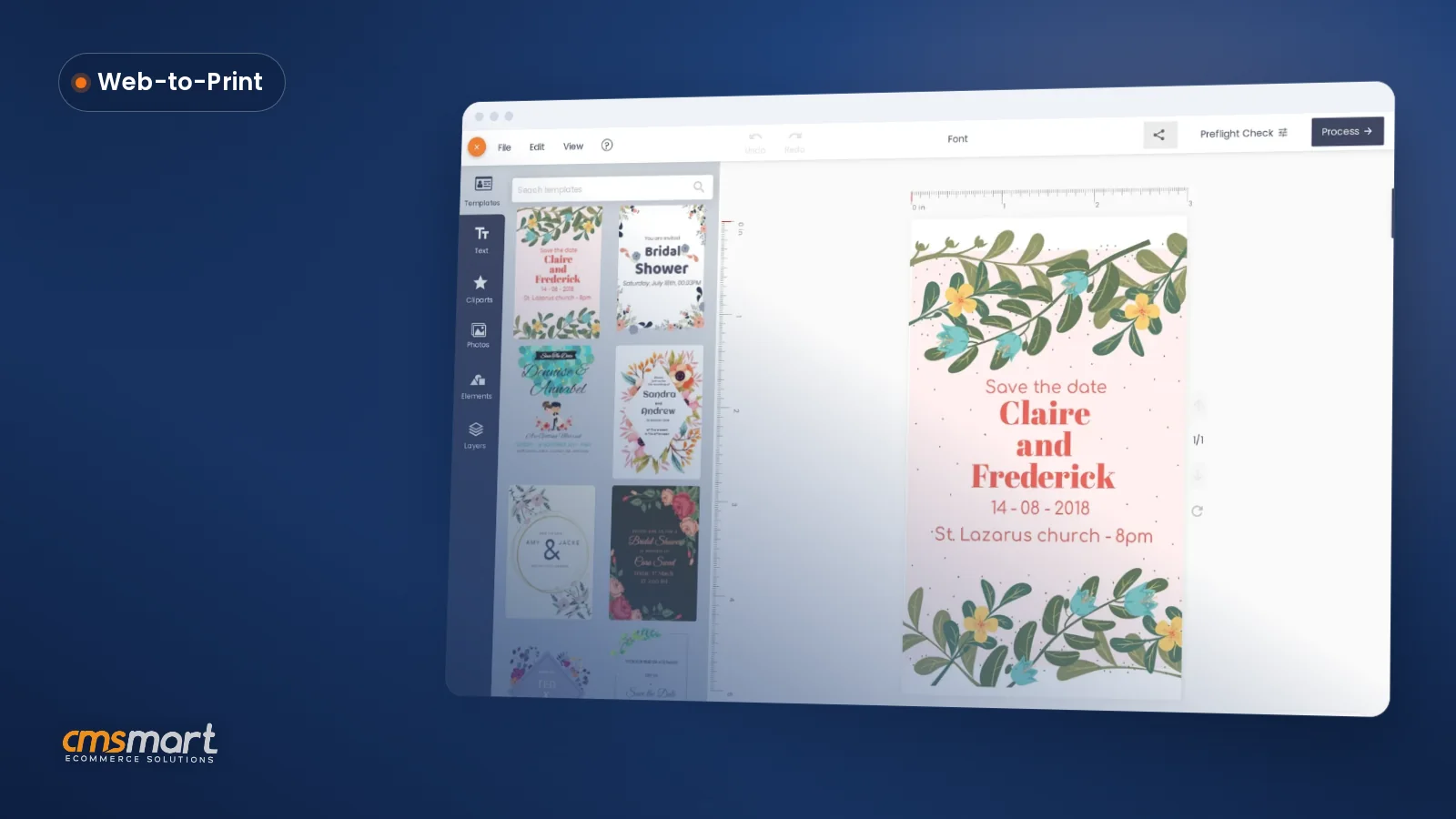
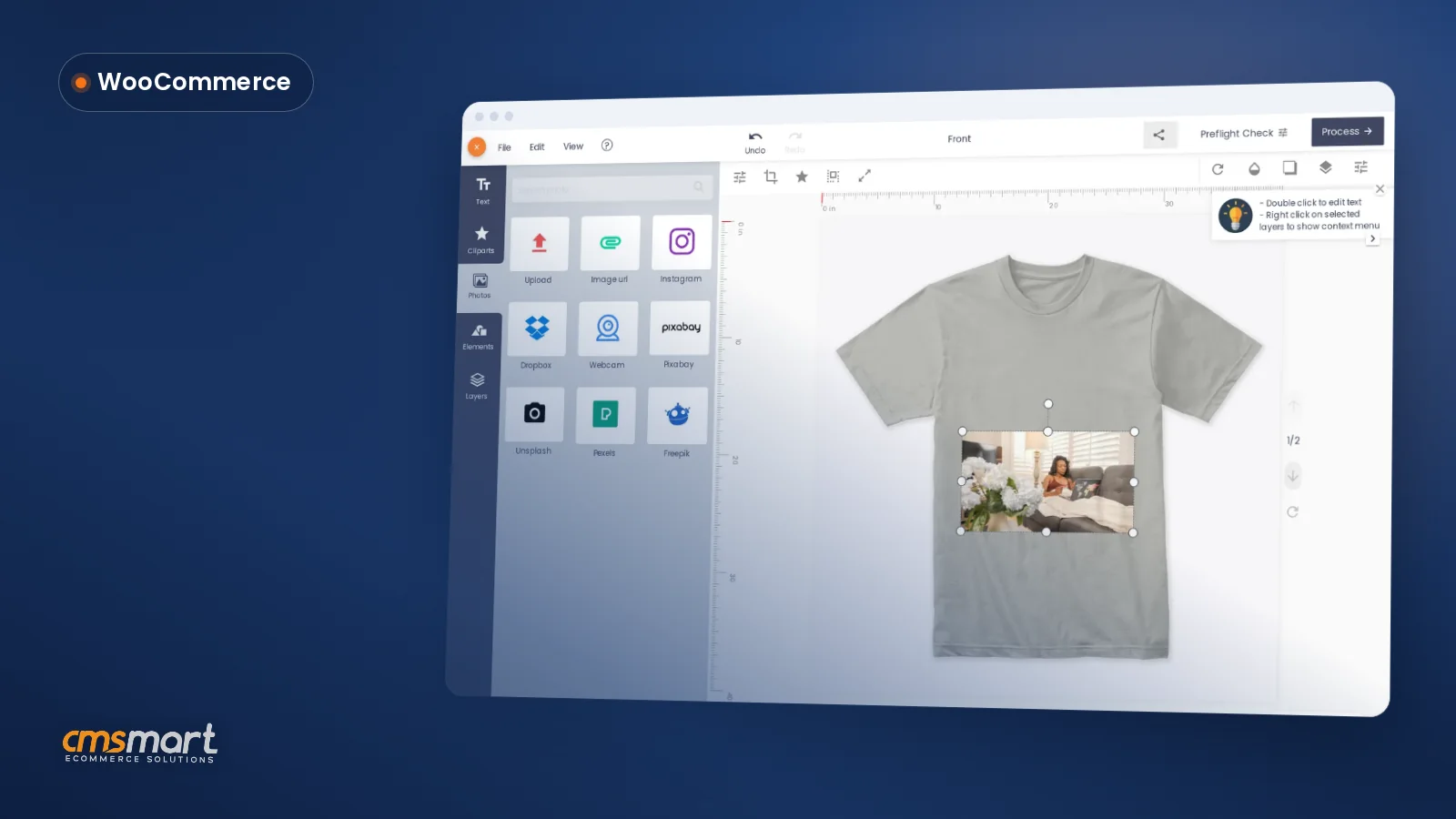
Cmsmart's Elements panel sits in the designer's left-hand toolbar next to Templates, Text, Cliparts and Photos, and it gives buyers shapes, an icon library, a QR code generator and a free-hand brush on the same canvas they already use for their design.
Example scenario: a buyer opens a wedding invitation product at 10 p.m., picks a template, adds a QR code linking to the couple's RSVP page, drops in a small heart shape, and signs the corner with the free-hand pen. They check out five minutes later, and the design that reaches your order queue already carries the QR code and the signature as real design layers, not a screenshot.
How does Cmsmart's online designer turn Elements into print-ready artwork?
Cmsmart connects the storefront, the online designer and the production side into one path: a buyer's shapes, QR code and drawing are saved as design layers, carried through the cart and order, and turned into a print-ready PDF that matches the order automatically.
The building blocks behind that one path:
What's the business value of letting buyers add their own shapes and QR codes?
Cmsmart turns self-serve shapes, QR codes and drawing into measurable business value: fewer stalled carts, less staff time spent recreating artwork, and fewer reprints because the approved design is locked before it reaches production.
Rough ROI worksheet: (orders per month with custom artwork) × (minutes your team currently spends redrawing or emailing about artwork) × (your fully-loaded hourly rate) = monthly cost of the manual path. Compare that to a one-time investment in setting up the Elements panel and a QR workflow for your products.
Buyers increasingly expect this kind of self-serve detail: GS1 US's 2024 Consumer Pulse Survey found 79% of consumers say they are more likely to buy a product with a scannable QR code that gives them more information, which is exactly what a buyer-generated QR code on a printed product can offer. The broader market backs the trend too: the print-on-demand market was valued at $10.8 billion in 2025 and is forecast to grow at a 23.6% CAGR through 2033, and the U.S. personalized gifting market alone was worth $9.69 billion in 2024, rising toward $14.56 billion by 2030.
How do you set up and use the Elements panel for shapes, QR codes and drawing?
You set up Cmsmart's Elements panel by enabling it on your design-ready products and checking your upload and output settings, so shapes, QR codes and free-hand drawing print at full quality alongside everything else in the order.
How far can Cmsmart take this with custom development?
Cmsmart builds the parts of a shapes-and-QR workflow that go beyond the standard Elements panel: dynamic QR destinations, brand-locked shape libraries and signature capture for legal paperwork, delivered as custom development for your store.
Plan my shapes and QR code workflow
See the full product designer customization service or browse the web-to-print solutions hub for related builds.
Why work with Cmsmart on your product designer?
Cmsmart has built and supported WooCommerce product designer stores since 2012, so the team that adds your QR, shape and drawing workflow already knows how it has to behave at checkout, in the cart and on the print floor.
Cmsmart is a Netbase JSC division running web-to-print and product customization projects since 2012, with 6,300+ client projects and a 4.2-out-of-5 Trustpilot rating from 404 reviews. Every custom-development engagement follows the same project delivery process: discovery, scoping, design, build, QA and launch, tracked on a shared dashboard so you always know where your QR or shape build stands.
Related reading: how to make your designs come alive with cliparts and how to work with layers in the product designer cover the other panels that sit alongside Elements. You can also see the designer itself on the Online Designer product page.
Frequently asked questions about shapes, QR codes and drawing in Cmsmart's product designer
Do I need a separate plugin for QR codes?
No. The QR code generator is part of the Elements panel inside Cmsmart Product Designer, on the same canvas as text, cliparts and photos.
Can buyers draw a real signature, not just type their name?
Yes, the free-hand drawing tool lets a buyer choose a brush width and color and draw directly on the design, which is how the original signature feature in this tutorial has worked for years.
Will a shape or QR code print as sharp as the rest of the design?
It's handled the same way as every other layer: the print-ready PDF Cmsmart renders for the order includes shapes, QR codes and drawn lines at the product's configured size and resolution, checked against your Output and Upload design settings.
Can we make the QR code point to a different page after the order ships?
Not out of the box — a QR code is fixed to whatever link the buyer enters at design time. A QR code that updates automatically (for example, always pointing at the live tracking page) is custom development Cmsmart builds for your store.
How long does it take to add a custom QR or shape workflow?
It depends on scope. A connector that generates dynamic QR destinations or a brand-locked shape library is scoped during discovery on your quote request, then delivered through Cmsmart's standard discovery-to-launch process.
Does this work on mobile?
Yes, the same online designer, including the Elements panel, loads on the mobile product page buyers use to start a design from their phone.