

Guide · WooCommerce
What's New in Cmsmart Stores: November 2026
See what is new in Cmsmart this November: 15 ready-made Cmsmart Stores, Cmsmart B2B 2.2.0 and Product Designer fixes. Try the Store Setup wizard today...
A WooCommerce store selling invitations, business cards or branded merchandise does not need a graphic designer on staff to keep every custom order on-brand. Cmsmart Product Designer's built-in shape and clipart library lets buyers insert pre-made icons, borders and graphics straight into their design, so your catalog stays consistent and every order reaches production print-ready.
Was this tutorial helpful?
See also: Cmsmart pricing and Cmsmart products.
Written by
Cmsmart Product Designer Plugin Engineer
Builds and supports the Cmsmart Product Designer (NBDesigner) for WooCommerce.
The team behind it
 Account Manager
 Project Manager
 Business Analyst
 Developers & QA
Guide · WooCommerce
See what is new in Cmsmart this November: 15 ready-made Cmsmart Stores, Cmsmart B2B 2.2.0 and Product Designer fixes. Try the Store Setup wizard today...
Guide · Web-to-print
The Cmsmart Stores Setup wizard installs niche, B2B and Marketplace stores with sample data live in minutes. See what changed and try it free.
Guide · Web-to-print
The NBDesigner plugin now gives stationery shoppers a curated background library so print-ready PDFs always match the preview. See how to set it up.
Browse more guides, tutorials and case studies from the Cmsmart community.
Run a custom tote bag printing business with Cmsmart Product Designer: live pricing, real print specs and a print-ready PDF. See how to set it up.
Read MoreBuild a car wrap ecommerce store on WooCommerce: panel pricing, approval and print-ready PDFs before you print. Plan your wrap store today.
Read MoreDiscover how the home décor industry is transforming with the rise of personalized products and the challenges retailers face. Learn how CMSmart's Product Builder offers a solution, improving customer engagement, reducing return rates, and increasing sales through real-time 3D previews and automated processes.
Read More
Cmsmart Ecommerce provides custom ecommerce and WooCommerce development services for web-to-print, product personalization, plugin support and API integration.
Cmsmart Product Designer Plugin Engineer
Builds and supports the Cmsmart Product Designer (NBDesigner) for WooCommerce.
Meet the team →



In short
Why is manual redrawing still your biggest hidden design cost?
Without a shared shape library, every custom order forces someone — the buyer or your staff — to recreate logos, icons and borders from scratch. Cmsmart's clipart library removes that manual step: buyers reuse the same vetted shapes your store provides, design time drops, and every print-ready file matches your brand standard.
The market rewards getting this right. The global print-on-demand and custom-product segment is projected to reach $13.1 billion in 2026, growing at roughly 23.6% a year (Grand View Research, 2026) — more stores chasing the same buyers makes a fast, consistent design experience a real differentiator, not a nice-to-have.
Open a custom product designer with no element library and you can predict what happens next. Buyers with no design skill either abandon the order or grab a random "free" icon from a search engine — one that is blurry, the wrong color mode, or someone else's intellectual property by the time it reaches your print queue. Multiply that across every SKU in your catalog and four costs stack up fast:
What would it look like if every design started on-brand?
Picture a holiday rush where fifty buyers design fifty different invitations in one afternoon. Cmsmart's shape library means every one of them pulls from the same vetted icon set, so ribbons, borders and seasonal graphics match your brand guide automatically — without you reviewing a single design by hand before it ships to production.
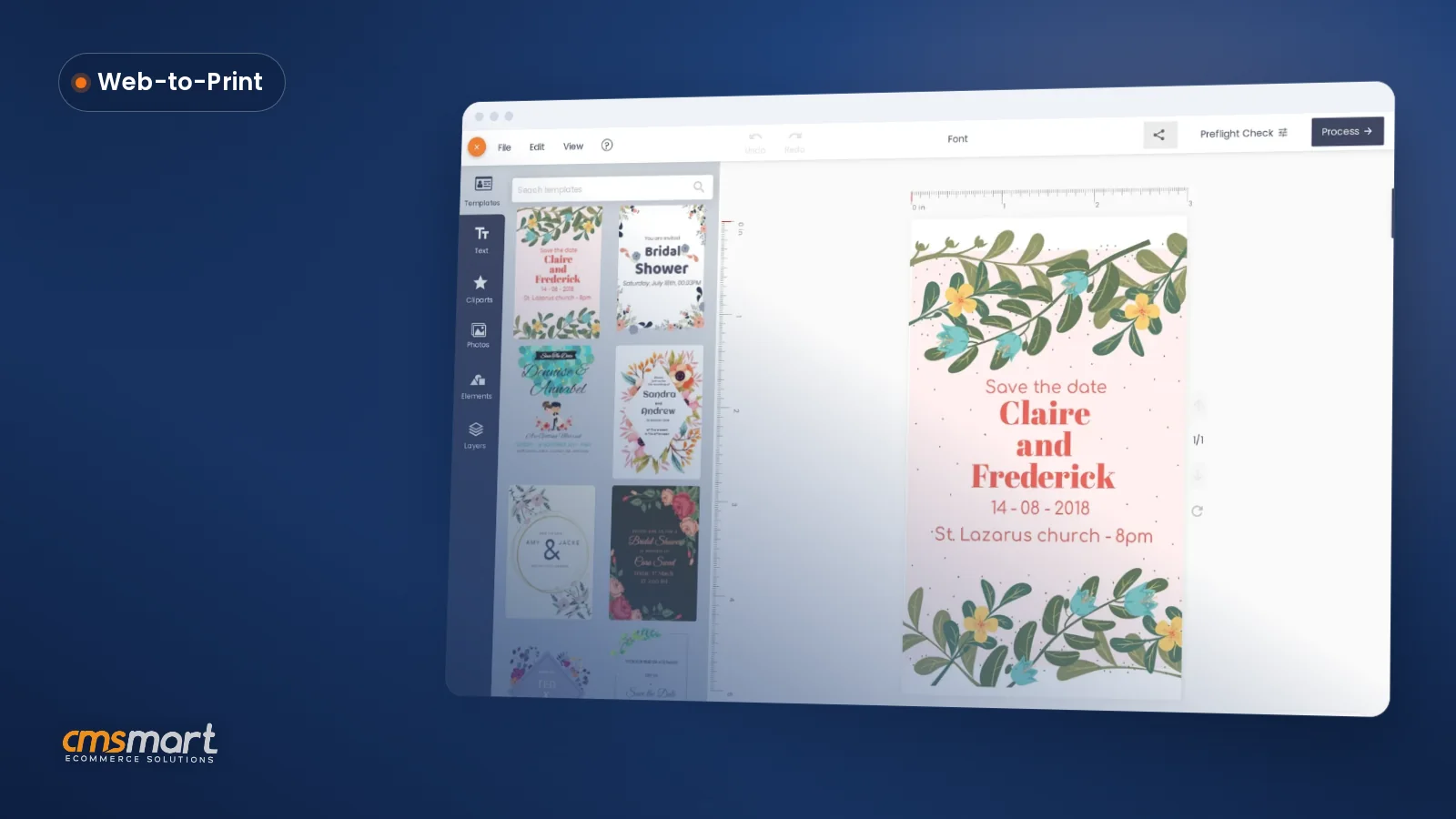
Example scenario. A stationery store turns on three clipart categories for its Invitation product: borders, seasonal icons and monogram frames. A buyer opens the designer, picks a template, drags in a border and a heart icon from Cliparts, types in their own names and date, and clicks Process. The saved design shows as "Your artwork" next to Add to cart — no email back-and-forth, and no one on staff has to check the clipart before the order reaches the print queue.
How does Cmsmart's shape and clipart library fit into the designer?
Cmsmart Product Designer puts Cliparts and Elements panels next to Templates, Text, Photos and Layers inside the same browser-based editor your buyers already use. Pick a category, drag a shape onto the canvas, resize it like any other layer, and it flows straight through to the print-ready PDF Cmsmart renders at checkout — no extra plugin, no separate app.
The shape library is one panel inside a bigger pipeline. From a buyer's first click to a print-ready file, five building blocks do the work:
Cmsmart insight: most "wrong color" complaints we see on print jobs trace back to a clipart layer dropped in as a web-optimized PNG, not a shape from the plugin's own library. Keep the global library as the default source, and restrict uploads to your own tested files if color accuracy matters more to you than sheer variety.
What's the business value of a built-in shape library?
A shared shape library turns design consistency into something you configure once instead of policing order by order. Cmsmart stores see fewer reprint-triggering mistakes, faster checkouts because buyers are not hunting for graphics elsewhere, and a catalog that reads as one brand across every design-enabled product.
Rough the math for your own store: multiply your custom orders per month by the minutes your team currently spends manually sourcing or redrawing a shape per order, then by your loaded hourly design rate. That total is the monthly labor cost the Cliparts panel removes once buyers source their own shapes from the library instead. Plug in your own order volume, minutes per order and hourly rate to see where you land.
Keeping that look consistent is worth more than the hours it saves. A 2019 survey of more than 200 brand teams found that consistent branding across channels was tied to as much as a 33% revenue lift (PR Newswire / Lucidpress "State of Brand Consistency," 2019). A shape library is one of the cheapest ways to keep that consistency automatic instead of manual, order after order.
How do you set up the shape and clipart library in Cmsmart Product Designer?
Turning on the shape library is a WooCommerce admin job, not a design project. You enable the global library, decide which categories each product can show, optionally add your own branded shapes, and the Cliparts panel is ready for buyers on every design-enabled product — no code and no separate design software.
Cmsmart insight: clipart and background management picked up real reliability work in 2.16 — deleting a background now removes its whole card instead of leaving an orphaned thumbnail, and category pickers stay pointed at the right item afterward. If your admin's clipart library has gotten untidy over the years, a current Cmsmart install is worth revisiting before you build a bigger shape set on top of it.
For the settings behind printing options and price matrices that react to size or material, see our guide to configuring printing options and price matrix rather than reconfiguring them here. If you also want buyers to add their own freehand artwork alongside library shapes, our tutorial on the drawing tool covers that companion workflow. Template collections that bundle shapes, text and layout together are configured separately — see how to build and assign a template.
Going further: what can Cmsmart build on top of the shape library?
The Cliparts panel covers shapes, icons and your own uploads out of the box. When a store needs more — a locked brand kit per wholesale account, shape-aware AI preflight, or a connector that pulls approved artwork straight from your brand portal — Cmsmart builds that as custom development on top of the same designer, not a separate product.
Plan a branded shape library for my store
Every custom build like this follows the same path: a short discovery call, a solution design we review with you, development in sprints, QA against your real catalog, launch, and ongoing support — the same process behind the case studies on our ecommerce projects page.
Why work with Cmsmart on your product designer?
Cmsmart has built web-to-print and product-customization storefronts since 2012 as part of Netbase JSC, with 6,300+ client projects delivered across 80+ countries and 1,800+ live stores running today. The same team that ships the Cliparts panel in the plugin also builds the custom shape, pricing and approval workflows stores need beyond it.
Cmsmart holds a 4.2-out-of-5 rating on Trustpilot across 404 reviews. Store owners call out the depth of the designer specifically: "The tool has so many options. We are very happy with it. Also the support team is very fast... We would recommend the NB Designer tool for printing personalized cards," wrote M. Idema, a Trustpilot reviewer from the Netherlands.
For the plugin itself, see the Cmsmart Product Designer (NBDesigner) product page, and for the wider storefront, pricing and production workflow it plugs into, our web-to-print solutions hub. If your shape library needs go beyond what the plugin covers today, our product designer customization service is where that work gets scoped.
Frequently asked questions
Does the shape library work on every product, or do I configure it per product?
It is available to any product with the online designer enabled. You can leave the global clipart library on for every product, or restrict individual products to specific categories from that product's Clipart settings in Product manager.
Can buyers upload their own shapes instead of using the library?
Yes. Upload design lets a buyer bring a finished file, and inside the online designer the Photos panel accepts their own images alongside the library's shapes. Settings → Upload design controls which file types and minimum DPI you accept.
Does a shape stay print-ready once it is on the canvas?
Yes. Whatever a buyer places — a library shape or their own upload — is part of the same design Cmsmart renders into the print-ready PDF on Process, matching the file your order screen's Create PDF button would generate.
Can we add more shapes than the built-in library has?
Add your own branded shapes in Media → Cliparts, or connect a Flaticon API key on Settings → General so buyers can search Flaticon's larger icon catalog from the same panel.
Will adding more clipart categories slow down the designer?
No. Each category loads its own page of cliparts on demand instead of pulling the whole library at once, so adding categories does not bloat the editor's initial load.
What if we need rules the plugin does not have, like locking a franchise to approved artwork only?
That is custom development. Cmsmart builds category and account-level restrictions, approval routing and connected brand portals on top of the existing Cliparts panel — see the Going further section above.