
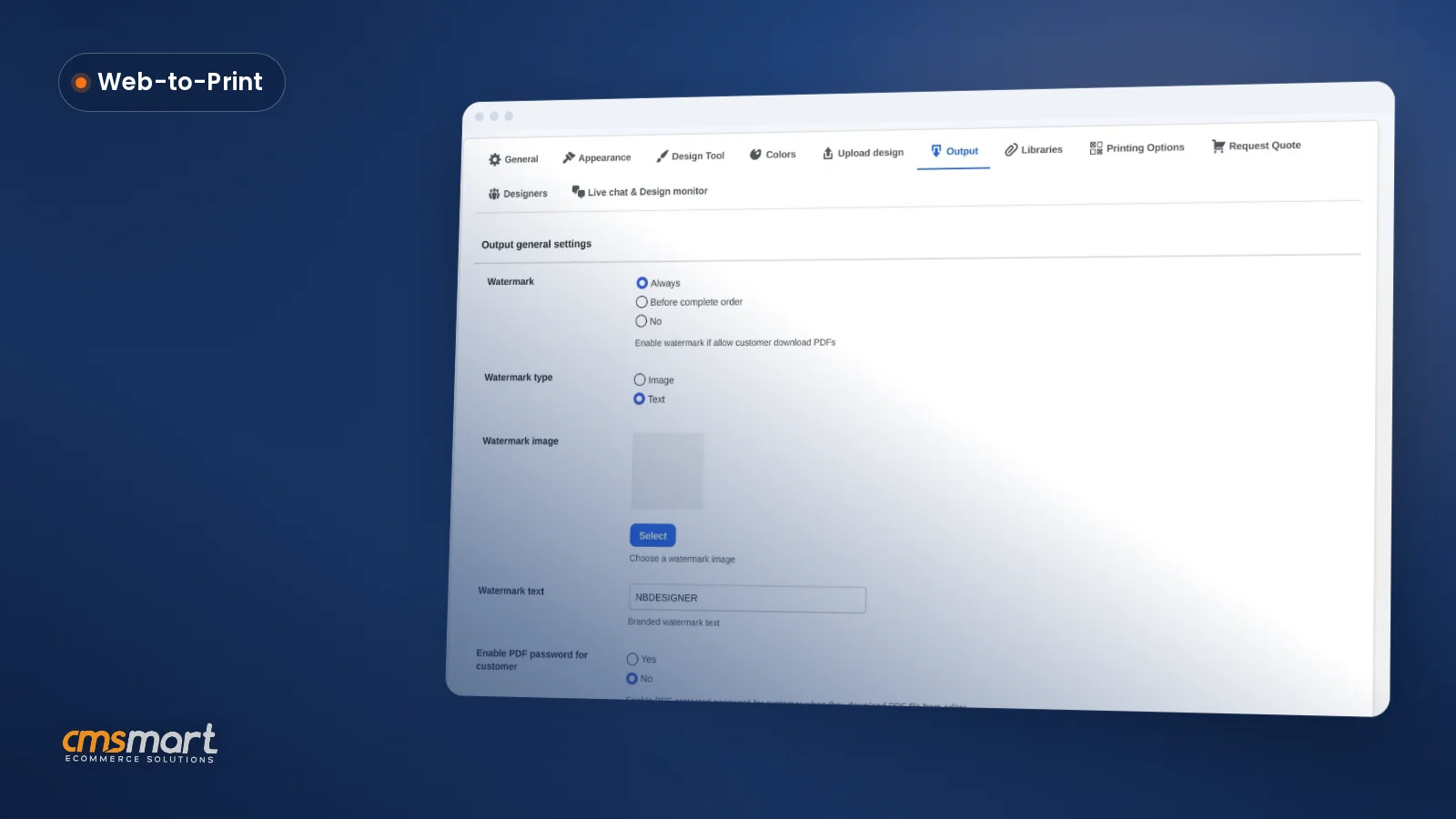
Guide · Web-to-print
Print Ready PDF Output Settings WooCommerce Setup
See what the print ready PDF output settings WooCommerce screen controls — watermark, password, bleed, FTP sync — and configure yours today.
Explore critical online marketplace trends shaping e-commerce in 2024. Gain insights into consumer behavior, technology integration, and market growth strategies. Stay ahead of your competition with actionable knowledge to enhance your business success.
Table of contents
Was this tutorial helpful?
Written by
Cmsmart Ecommerce Growth & Trends Analyst
Tracks ecommerce trends and turns them into practical moves for growing stores.
The team behind it
 Account Manager
 Project Manager
 Business Analyst
 Developers & QA
Guide · Web-to-print
See what the print ready PDF output settings WooCommerce screen controls — watermark, password, bleed, FTP sync — and configure yours today.
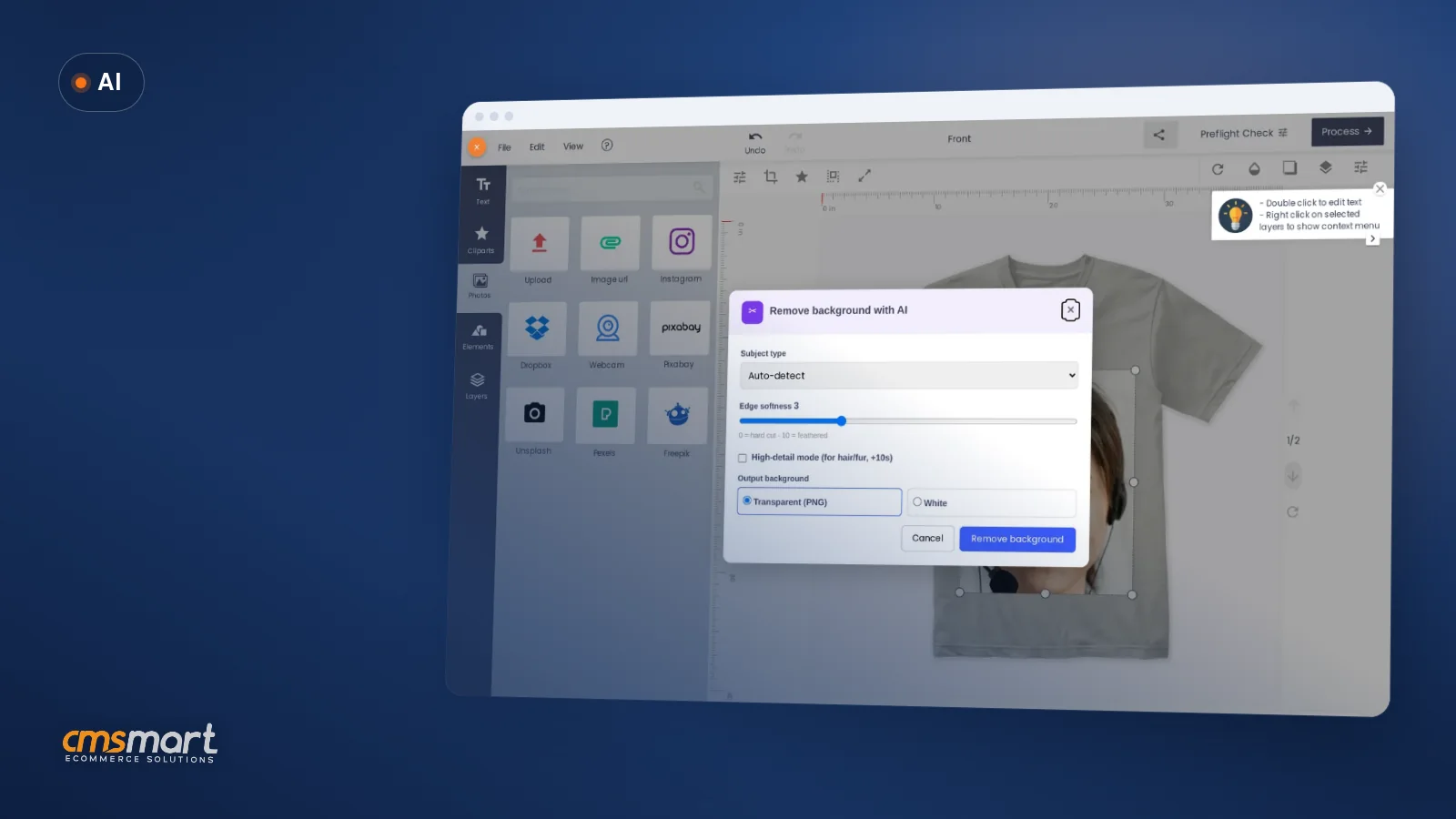
Case study · AI
Add an AI background remover for WooCommerce to your product designer so buyers get a clean cutout instantly, and see how Cmsmart builds the rest for...
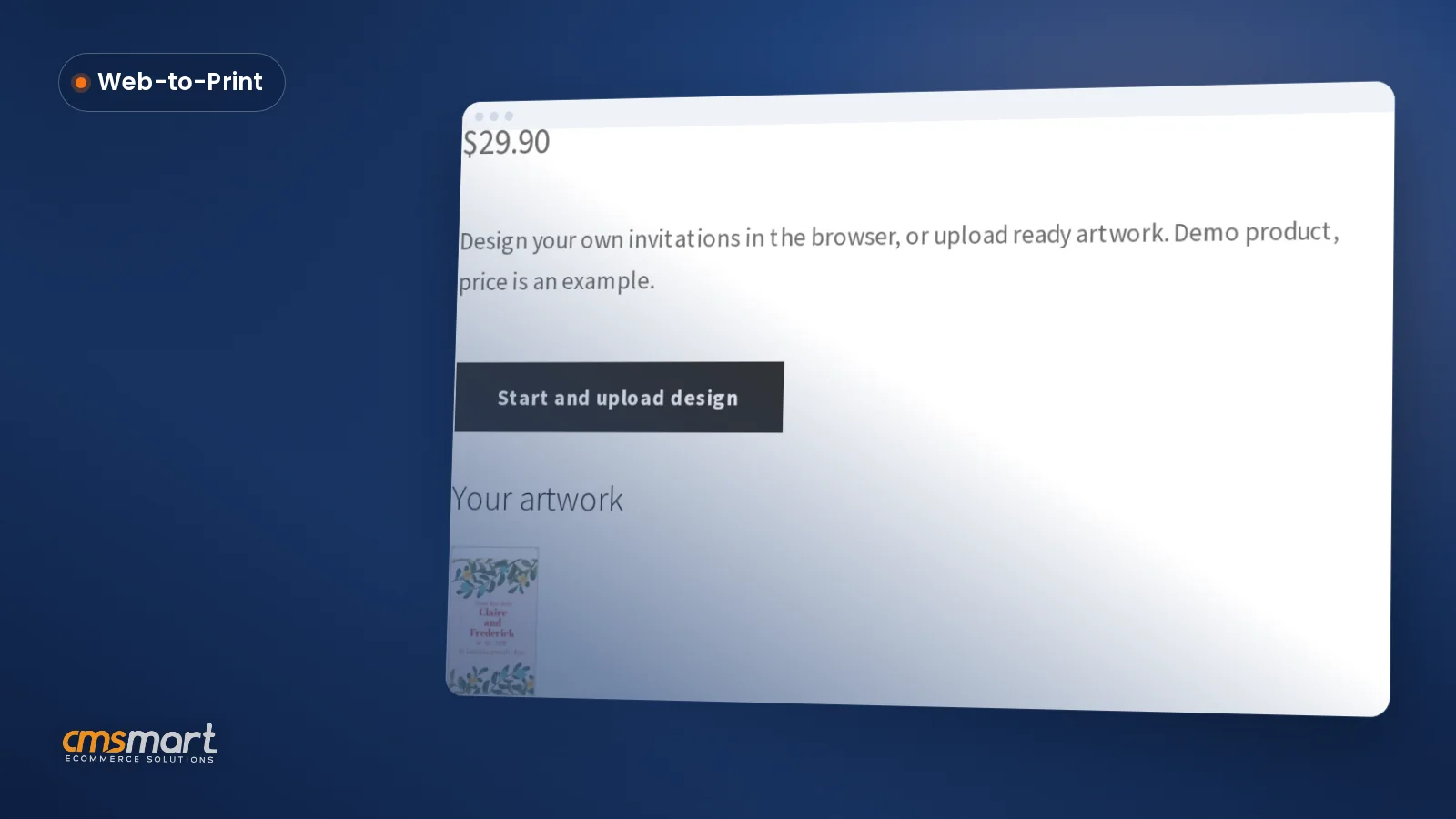
Case study · Web-to-print
Save design and reorder WooCommerce orders in one click, with a fresh print-ready PDF every time. See how Cmsmart builds it.
Browse more guides, tutorials and case studies from the Cmsmart community.
Unlock the Power of Mobile Commerce: Propel Your Business Forward
Read MoreDiscover how to harness mobile commerce to enhance your business growth. Learn strategies for optimizing the mobile shopping experience and increasing consumer engagement.
Read MoreDiscover the benefits of mobile commerce and how it can transform your business. Learn effective strategies for maximizing sales and customer engagement through mobile-optimized shopping experiences.
Read More
Cmsmart Ecommerce provides custom ecommerce and WooCommerce development services for web-to-print, product personalization, plugin support and API integration.
Cmsmart Ecommerce Growth & Trends Analyst
Tracks ecommerce trends and turns them into practical moves for growing stores.
Meet the team →




As we delve into 2024, the e-commerce landscape is poised for remarkable transformation. With a staggering 24.5% growth projection in global retail sales attributed to e-commerce by 2025, businesses are under pressure to innovate and adapt their strategies. Consider our client, Globecart, based in Germany, a thriving online marketplace specializing in eco-friendly products. Facing challenges in integrating their online and offline shopping channels seamlessly, they sought our expertise. Through tailored solutions, including augmented reality for product visualization and enhanced mobile checkout processes, we helped them not only improve their customer engagement but also boost their sales significantly amidst evolving consumer preferences.
In today’s fast-paced digital era, mastering the latest online marketplace trends is crucial for staying ahead of competitors and fostering substantial growth. As businesses pivot towards innovative solutions to meet customer expectations, the potential for personalized experiences and seamless integrations cannot be underestimated. For instance, by optimizing user journeys and adopting voice search functionalities, companies can create a more intuitive shopping experience that resonates well with tech-savvy consumers. In this tutorial, we’ll explore actionable insights into the latest trends that will shape the online marketplace landscape in 2024, ensuring you are well-prepared for the exciting challenges ahead.
Thriving on The Digital Wave
Need to integrate online and offline shopping seamlessly? You’re not alone.Many businesses struggle with complexity in ensuring smooth mobile checkout experiences and providing accurate information for offline purchases.
Thriving on The Digital Wave: Decoding the Future of E-Commerce
What if you could stay ahead of the curve by leveraging the latest online marketplace trends for your business? The rapidly evolving digital shopping landscape offers numerous opportunities for organizations willing to adapt their strategies to meet modern consumer behavior.Actionable E-Commerce Trends for Your Business
To gain a competitive edge, consider the following strategies:Case Study: Turn Challenges into Opportunities
Customers today expect convenience and personalization. An esteemed e-commerce brand reported a 30% increase in sales after integrating AR technology, enabling users to visualize products before purchasing. This adaptation responded directly to customer pain points, enhancing overall satisfaction and driving revenue.Looking Ahead: Collectively Shaping User Experiences
As we move toward more integrated shopping experiences, businesses must remain agile in their strategies. Leveraging advancements such as AR, voice search, and personalized marketing could significantly enhance consumer experiences, positioning you ahead in this competitive marketplace. In summary: By adopting these actionable insights and strategies, youll not only keep pace with digital shopping trends but also thrive on them. In our next section, we will explore the importance of integration in enhancing the shopping experience by bridging online and offline interactions effectively.Decoding Brick and Click Policy
Need to integrate online and offline shopping seamlessly? Youre not alone.Many businesses struggle with the complexity of ensuring smooth mobile checkout experiences, providing accurate online information for offline purchases, and adapting to the rise of voice-activated shopping.
Defining Brick and Click Policy
The Brick and Click Policy refers to the strategy of combining traditional retail (brick-and-mortar) with online operations (click-and-mortar). This approach enables businesses to offer a seamless shopping experience, allowing consumers to shop in-store or online with ease, ultimately enhancing user engagement and customer satisfaction.Understanding the Significance of Brick and Click Policy in E-commerce
With the ongoing shift in shopping habits, many brands are investing in this hybrid model. Here are some key benefits:How to Integrate Online and Offline Shopping Seamlessly
To effectively bridge your online and offline shopping experiences, consider the following actionable strategies:- Utilize an integrated inventory management system to ensure product availability online and in-store.
- Implement user-friendly design features in mobile apps for streamlined checkout processes.
- Incorporate AR technology to enhance visual shopping experiences, making it easier for customers to visualize products.
- Optimize your e-commerce platform for voice search to capture the growing market of voice-activated shopping.
- Employ image search functionalities for intuitive shopping experiences that resonate with younger consumers.
In summary: The Brick and Click policy is an essential strategy for modern e-commerce businesses. By effectively integrating both online and offline shopping experiences and staying ahead of digital trends, brands can transform challenges into opportunities. Next, let’s explore the impact of optimizing e-commerce for voice search and using image search for intuitive shopping.Excelling in Mobile Checkout Processes
Need to provide a seamless mobile checkout experience for your customers? You’re not alone.In today’s fast-paced shopping landscape, businesses face the challenge of ensuring that mobile checkout processes are not only effective but user-friendly. A cumbersome mobile checkout experience can lead to abandoned carts and lost revenue.
Recognizing the Importance of Mobile Checkout
Understanding mobile checkout is crucial in catering to tech-savvy consumers who expect convenience. Here are a few points to consider:Enabling a Streamlined Mobile Checkout Experience
To create a smooth mobile checkout, consider implementing the following strategies:Overcoming Challenges in Mobile Checkout
Businesses often encounter obstacles in mobile checkout. To tackle these issues, keep the following in mind:- Ensure accurate product information is available to prevent confusion and returns.
- Implement chat support to assist customers in real-time.
- Regularly analyze checkout metrics to understand where users drop off.
For deeper insights on integrating online and offline shopping experiences, take a look at our guide on streamlined mobile checkout processes and how research products online before buying in stores can enhance user engagement. In summary: Enhancing the mobile checkout process is pivotal for driving sales and improving consumer experiences. As we move forward, let’s delve into effective strategies for better user engagement through innovative technologies.Embracing the ROPO Method
Need to integrate online and offline shopping seamlessly? Youre not alone.Many businesses are grappling with the complexities of ensuring smooth mobile checkout experiences and providing accurate online information for offline purchases.
Unveiling the ROPO Method
The ROPO method, which stands for Research Online, Purchase Offline, is a powerful strategy that blends the digital and physical shopping experiences. It allows tech-savvy consumers to leverage online resources while engaging in traditional retail.Exploring the Role of the ROPO Method in the Modern Shopping Landscape
The integration of online and offline shopping experiences has become essential in todays retail environment. Adapting to e-commerce trends ensures your business meets the needs of consumers who expect convenience and accessibility.Delivering Accurate Online Information for Offline Purchases
Providing reliable information online plays a critical role in the ROPO method. It reduces return rates by equipping consumers with the necessary tools for informed decision-making. The key steps include:- Ensure all product information is up-to-date and accessible.
- Engage customers through reviews and FAQs to build trust.
- Enhance product descriptions with high-quality images and videos.
In summary: The ROPO method is not just a passing trend; it’s a pivotal strategy for modern retailers aiming to connect effectively with consumers. Next, lets explore the integration of online and offline shopping experiences and how you can effectively leverage these strategies to enhance your business.Augmented Reality Transforming Online Shopping
Need to adapt to evolving shopping habits and enhance customer experiences? You’re not alone.Many businesses struggle with integrating online and offline shopping, ensuring smooth mobile checkout experiences, and providing accurate product information to reduce return rates.
Introduction to Augmented Reality in E-commerce
As technology advances, Augmented Reality (AR) is at the forefront of transforming the online shopping landscape. This innovative tool enhances consumer experiences by allowing them to visualize products in their real-world environment before making a purchase. AR fosters a user-friendly design that appeals to tech-savvy consumers, making shopping both convenient and engaging.Boosting Decision-Making and Reducing Return Rates with AR
AR significantly aids customers in making informed choices, thereby decreasing the likelihood of returns. By digitally overlaying real-time data onto their shopping environments, customers can assess how products look and feel. Here are some actionable tips for businesses looking to leverage AR:Case Studies: Successful Utilization of AR in Online Shopping
Many brands have effectively integrated AR to enhance their shopping experiences. For instance, IKEA’s Place app allows users to visualize furniture in their homes, resulting in a significant reduction in return rates. Another example is Warby Parker, which offers virtual try-ons for glasses, simplifying the selection process for customers. In summary: Utilizing AR in your e-commerce strategy can bridge the gap between online and offline shopping experiences, streamline mobile checkout processes, and improve product visualization for consumers. As we transition to the next section, we’ll explore more on optimizing e-commerce for voice search and using image search for intuitive shopping.Voice Search and Image Search in E-commerce
Need to adapt your e-commerce strategy to the evolving shopping landscape? You’re not alone.As technology advances, businesses face the challenge of seamlessly integrating online and offline shopping experiences. Todays consumers demand convenience, and optimizing for voice-activated and image search functionalities is key to enhancing user engagement and reducing return rates.
Adapting to Voice-Activated Shopping
Voice-activated shopping is rapidly growing, with around 55% of households expected to own a smart speaker by 2025. This shift in consumer behavior emphasizes the need for e-commerce platforms to optimize for voice searches. Here are some actionable tips to consider:Leveraging Image Search for a Visually-Oriented Shopping Experience
As tech-savvy consumers increasingly rely on visual inputs, integrating image search features can enhance product visualization and boost conversion rates. Consider the following strategies:Best Practices for Optimizing E-commerce Platforms for Voice and Image Searches
To ensure your e-commerce platform is equipped for the latest shopping trends, implement these best practices:- Conduct regular keyword research with a focus on long-tail keywords commonly used in voice searches.
- Ensure your website is mobile-friendly to accommodate on-the-go shoppers.
- Utilize analytics to track user behavior and refine your optimization strategies.
In summary: Optimizing for voice and image searches is crucial for staying competitive in the e-commerce space. As we move forward, well explore the integration of online and offline shopping experiences, and how to streamline mobile checkout processes for a seamless consumer experience.Personalized Recommendation - Key to Consumer Engagement
Need to enhance customer engagement and drive sales? Youre not alone.Many businesses struggle with integrating personalized recommendations into their marketing strategies, especially in the rapidly evolving online shopping landscape. With tech-savvy consumers expecting tailored experiences, its crucial to adapt and meet these demands.
Underlining the Importance of Personalized Recommendations
Personalized recommendations are central to providing a compelling shopping experience. They help businesses connect with consumers on a deeper level by offering tailored product suggestions based on their preferences and behaviors. Here are a few actionable insights:Using Consumer Data for Personalized Marketing
Data is at the heart of personalized marketing strategies. By leveraging insights from consumer interactions, businesses can create tailored campaigns. Here’s how to effectively use this data:How Personalized Suggestions Improve User Engagement and Sales
Personalized suggestions not only enhance user engagement but also significantly boost sales. Here’s how:- Greater customer satisfaction through relevant product offers.
- Increased chances of upselling and cross-selling opportunities.
- Lower return rates due to better-informed purchasing decisions.
In summary: Embracing personalized recommendations is vital for businesses seeking to enhance consumer experiences and drive sales. As we move forward, the next section will explore the integration of online and offline shopping experiences, providing further insights into creating a seamless customer journey.Upcoming Online Marketplace Trends
Need to integrate online and offline shopping seamlessly?Many businesses are grappling with the complexities of ensuring smooth mobile checkout experiences and providing accurate online information to support offline purchases. Adapting to the digital shopping landscape is crucial for meeting the evolving expectations of tech-savvy consumers.
Exploring Current E-commerce Trends
In todays competitive market, understanding current e-commerce trends is essential. Here are some key insights:Predicted Online Retail Trends
As we look forward, these predicted online retail trends can help shape your business strategies:Preparing Your Business for Future Digital Shopping Trends
To succeed in the evolving marketplace, here are actionable strategies to prepare your business:- Analyze consumer behavior through data analytics to refine your product suggestions.
- Implement streamlined mobile checkout processes that reduce cart abandonment rates—54% of all online transactions are conducted on mobile devices.
- Offer customers options to research products online before buying them in stores, improving decision-making tools to reduce return rates.
In summary: Staying ahead in the e-commerce game requires understanding both current and upcoming trends. With the integration of online and offline shopping experiences, businesses can create a more user-friendly design that meets consumer demands. Next, we will explore how to optimize your e-commerce site for voice search and other advanced functionalities.Frequently Asked Questions
Need to integrate online and offline shopping seamlessly? Youre not alone.Many businesses struggle with ensuring a smooth transition for customers between digital purchases and in-person transactions while also enhancing user engagement across platforms.
Frequently Asked Questions About Online Marketplace Trends
What Are the Current Trends in Online Marketplaces?
Current trends focus on convenience and enhanced consumer experiences. Notable areas include:How Can Businesses Reduce Return Rates?
Reducing returns is crucial for profitability. Strategies include:What Should Be Done About Voice and Visual Search?
Voice-activated shopping is on the rise, and adapting to this can enhance user experience. Consider:How Can Customer Data Enhance Marketing Strategies?
Using consumer data effectively allows for tailored marketing strategies. Any successful approach should include:In Summary
Staying ahead in the evolving online retail landscape requires understanding shifting consumer preferences and employing strategies that integrate technology with user convenience. For a comprehensive exploration of optimizing your e-commerce strategy, including the integration of online and offline shopping experiences, streamlined mobile checkout processes, and utilizing AR tech, continue to our next section.FAQ Section: Troubleshooting and Pro Tips
How can I integrate online and offline shopping experiences?
Utilize omni-channel approaches to create seamless transitions between digital and physical stores.
What are the best strategies for ensuring smooth mobile checkout?
Implement one-click payments and mobile-optimized design to streamline checkout on mobile devices.
How can I provide accurate information for offline purchases?
Incorporate real-time inventory updates and comprehensive product details to bridge online and offline shopping.
What tools can help reduce return rates?
Utilize detailed product descriptions and size guides to improve buyer decision-making and reduce returns.
How should I adapt to the rise of voice-activated shopping?
Optimize your online store for voice search and enhance product listings to improve visibility through voice queries.
How can I improve search functionalities with visual inputs?
Integrate visual search technologies that allow users to upload images for product discovery.
What is the best way to use consumer data for personalized marketing?
Leverage AI and analytics to create personalized shopping experiences based on user behavior and preferences.
Further Reading
Congratulations on taking a deep dive into the latest online marketplace trends for 2024! By focusing on optimizing mobile checkouts, leveraging AR for product visualization, and personalizing marketing efforts, you can position your business at the forefront of the e-commerce revolution. Staying ahead in this dynamic landscape isn't just beneficial—it's essential for survival and growth. Let’s discuss how we can assist you in implementing these strategies effectively.
Contact David, our CEO, directly via WhatsApp at this link, or reach out to our Ecommerce Project Consultant at [email protected]. Additionally, if you require more personalized assistance, you can request a quotation today. Join me in transforming your store to thrive on the digital wave!