

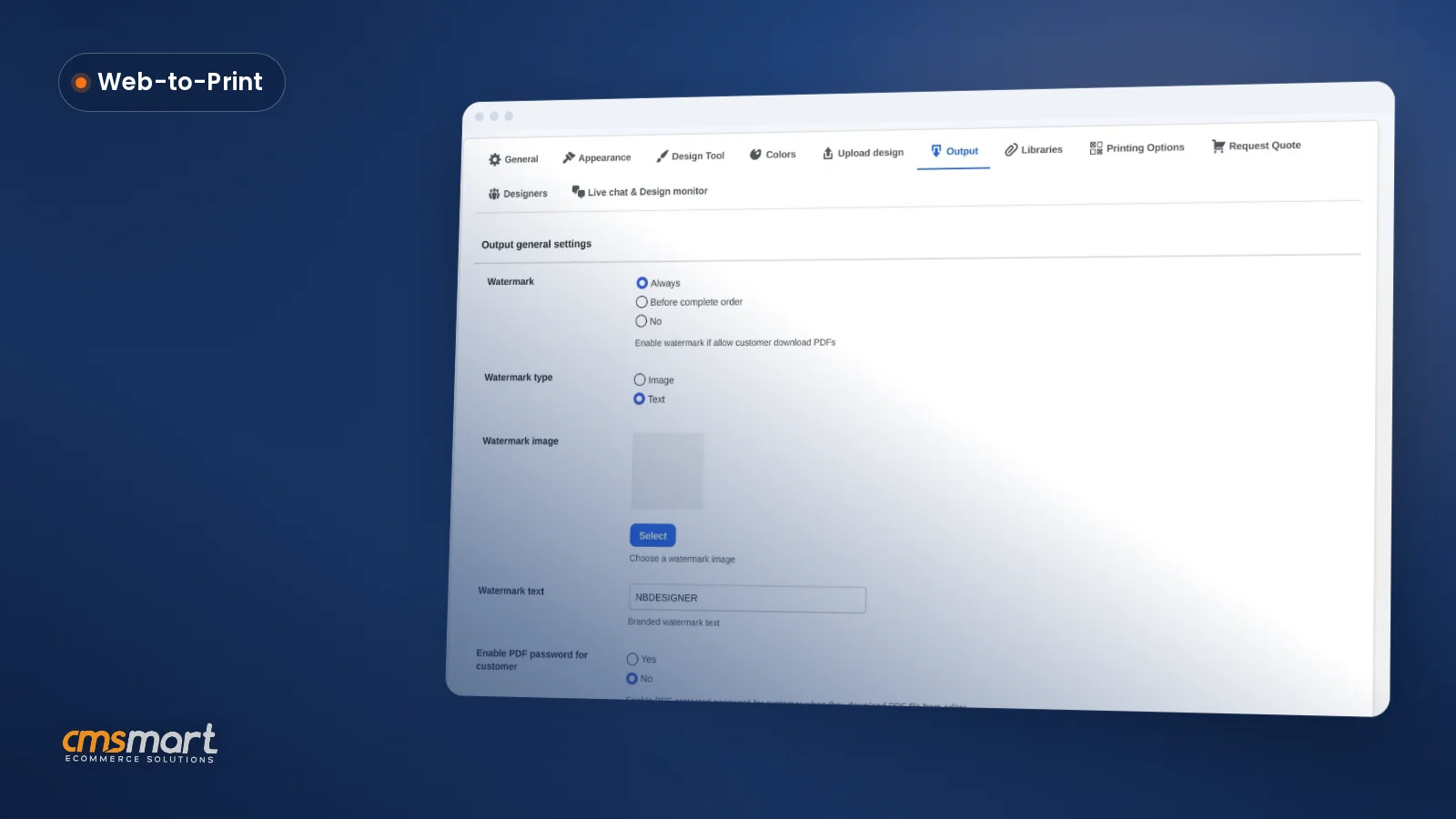
Guide · Web-to-print
Print Ready PDF Output Settings WooCommerce Setup
See what the print ready PDF output settings WooCommerce screen controls — watermark, password, bleed, FTP sync — and configure yours today.
Explore emerging eCommerce trends to harness cutting-edge strategies for growth. Learn how to leverage advanced tools, optimize your platform, and stay ahead in the competitive online marketplace.
Table of contents
Was this tutorial helpful?
Written by
Cmsmart WooCommerce Development Lead
Leads custom WooCommerce builds: architecture, checkout, performance and integrations.
The team behind it
 Account Manager
 Project Manager
 Business Analyst
 Developers & QA
Guide · Web-to-print
See what the print ready PDF output settings WooCommerce screen controls — watermark, password, bleed, FTP sync — and configure yours today.
Case study · AI
Add an AI background remover for WooCommerce to your product designer so buyers get a clean cutout instantly, and see how Cmsmart builds the rest for...
Case study · Web-to-print
Save design and reorder WooCommerce orders in one click, with a fresh print-ready PDF every time. See how Cmsmart builds it.
Browse more guides, tutorials and case studies from the Cmsmart community.
Unlock the Power of Mobile Commerce: Propel Your Business Forward
Read MoreDiscover how to harness mobile commerce to enhance your business growth. Learn strategies for optimizing the mobile shopping experience and increasing consumer engagement.
Read MoreDiscover the benefits of mobile commerce and how it can transform your business. Learn effective strategies for maximizing sales and customer engagement through mobile-optimized shopping experiences.
Read More
Cmsmart Ecommerce provides custom ecommerce and WooCommerce development services for web-to-print, product personalization, plugin support and API integration.
Cmsmart WooCommerce Development Lead
Leads custom WooCommerce builds: architecture, checkout, performance and integrations.
Meet the team →






Is your online retail strategy keeping pace with the explosive growth of digital commerce? As the global digital commerce market is set to skyrocket to an astonishing $6.54 trillion, businesses must adapt or risk falling behind in this competitive landscape. One such business, GreenEarth Supplies from Australia, faced a daunting challenge. After noticing a decline in sales due to cumbersome payment methods and a lackluster user experience, they turned to Cmsmart. Through our tailored solutions, GreenEarth transformed their online store, integrating multiple versatile payment options and enhancing website usability, leading to a remarkable 45% increase in sales within just three months.
Digital transformation is no longer just a strategy; it’s a mandate for survival in eCommerce. By aligning your operations with the fast-evolving preferences of online shoppers, you can foster trust and transparency while ensuring that your brand remains relevant. In this guide, we’ll explore the latest eCommerce trends that are unlocking new opportunities for entrepreneurs and businesses alike. Whether you're looking to enhance customer satisfaction with flexible payment solutions or adopt cutting-edge strategies to streamline the shopping experience, we’ve got you covered. To learn more about leveraging these trends for your success, check out our resources on global eCommerce market trends and strategies for sustained growth. In this tutorial, we will dive deep into how you can navigate digital transformation and capitalize on emerging trends.
Digital Transformation in eCommerce
Building trust and transparency with consumers while adapting to market changes such as ensuring website usability and offering versatile payment methods is pivotal in the dynamic world of digital commerce. In this transformative digital era, aligning your online store with evolving shopper preferences is not just beneficial—its crucial.Embrace the Future of Digital Commerce
Imagine harnessing the power of technology to transform your online store and capture the evolving preferences of digital shoppers. Digital transformation in eCommerce is about embedding smart strategies and innovative solutions into your business model to meet modern demands.
Strategies for Digital Transformation
To successfully transform, focus on strategies that foster trust and streamline the shoppers journey:
Highlighting your websites user-friendly attributes and emphasizing the importance of social proof can profoundly influence consumer trust and drive decision-making.
In summary: Digital transformation in eCommerce isnt just a trend; its a necessity that equips businesses with the tools to thrive in today’s highly competitive landscape. Next, well delve into understanding the importance of social proof in eCommerce and how it influences buyer decisions.Navigating through eCommerce Trends
Building trust and transparency with consumers is essential in todays competitive eCommerce landscape. Businesses often face challenges like ensuring website usability, providing competitive pricing, convenient delivery options, implementing easy return policies, and offering versatile payment methods.Overview of eCommerce Trends
The digital commerce sphere is rapidly evolving, with an increasing emphasis on mobile shopping, personalization, and social commerce integration. The convenience and flexibility of online shopping are driving significant shifts in consumer behavior.
Significance & Impact of Online Shopping Trends
Understanding and leveraging online shopping trends is crucial for businesses aiming to boost their online presence. These trends not only shape consumer expectations but also influence purchasing decisions significantly.
Online Retail Trends: A Close Look at the Digital Commerce Sphere
Online retail has seen various trends shaping the future of digital commerce, including:
For deeper insights, explore resources on successful eCommerce features.
In summary: Staying ahead of eCommerce trends is key to maintaining competitiveness in the digital marketplace. Stay tuned for our next section on the importance of social proof in eCommerce , which will delve into enhancing customer trust and influencing buyer decisions effectively.Understanding Consumer Research Behavior in Online Shopping
Building trust and transparency with consumers while ensuring seamless website usability.As online shopping continues to grow, understanding consumer behavior in the digital space has never been more crucial. Businesses today face the key challenges of enhancing user experience and maintaining competitive pricing. Let’s dive into the essentials of consumer research behavior to drive e-commerce success.
What is Consumer Research Behavior?
Consumer research behavior refers to the analysis of how customers gather information and make purchasing decisions online. It encompasses their interaction with online reviews, product research, and usability of e-commerce platforms. Understanding these patterns helps businesses tailor their strategies to meet consumer needs effectively.
Roles and Importance of Consumer Research Behavior in Online Shopping
Understanding these behaviors plays a pivotal role in optimizing product offerings, enhancing customer service, and crafting targeted marketing campaigns. It translates into better engagement, higher conversion rates, and customer loyalty.
Real Life Cases: Consumer Research Behavior in Action
Successful e-commerce businesses often leverage consumer behavior insights to refine their strategies. For example, implementing AI-driven analytics can help track consumer habits and preferences in real-time, facilitating adjustments to marketing and product strategies.
- Utilizing AI tools for real-time data analytics
- Employing AR for enhanced online product visualization
- Integrating feedback loops for continuous user experience improvements
In summary: By decoding consumer research behavior, businesses can significantly enhance their digital strategies and customer satisfaction. Next, let’s explore the importance of social proof in eCommerce , and how it influences buyer decisions . This journey also involves creating user-friendly website experiences and flexible payment options for online shoppers .Deciphering Buying Decision Factors
Building trust and transparency with consumers, Ensuring website usability and user experience, Providing competitive pricing and convenient delivery options, Implementing easy return policies, Offering versatile payment methodsUnderstanding Purchase Decision Drivers
In the evolving landscape of online shopping, understanding the key drivers behind purchase decisions is essential for any eCommerce business. Consumers today are increasingly aware and opt for convenience, trust, and seamless shopping experiences as key factors influencing their buying choices.
How Trust & Transparency Impact Buying Decisions in eCommerce
Trust and transparency are pivotal in the digital commerce space. Businesses need to foster trust by delivering on promises and maintaining transparency about processes and policies.
The Effect of User-Friendly Website on Buying Decision
User experience (UX) is a significant factor impacting purchasing decisions. A smooth, intuitive website can lead to higher conversions and customer retention.
- Ensure fast loading times and navigation.
- Use compelling call-to-action buttons to guide the customer journey.
- Conduct regular UX audits to identify and fix pain points.
In summary: Decoding and aligning your eCommerce strategies with purchase decision drivers can vastly improve customer acquisition and retention. Next, let’s delve into the importance of social proof in eCommerce.The Role of Social Proof in Online Sales
Are you struggling to establish trust and transparency with your online customers?Building consumer confidence is crucial, especially with trends shifting towards increased transparency and customer-centric policies in online shopping.
Introduction to Social Proof in eCommerce
Social proof plays a pivotal role in building trust among potential buyers in the realm of eCommerce. The concept refers to the influence that the actions and opinions of others have on our own behavior. Think about it: how many times have you decided on a purchase based on positive reviews or the number of likes a product has received? This behavioral tendency is harnessed powerfully in online retail settings.
Importance of Social Proof in Online Sales
Social proof is not just about testimonials or reviews. It’s about creating a community of satisfied customers whose positive experiences serve as a reliable reference for others. According to HubSpot, 81% of consumers trust the recommendations of friends and family over those from businesses.
Leveraging Social Proof to Boost eCommerce Sales
Implementing social proof effectively can significantly boost your conversion rates and enhance your brand’s reputation. Here are some strategies:
Trust and transparency achieved through effective social proof can reduce barriers to purchase by alleviating concerns over website usability, pricing competitiveness, and return policies. For further reading on enhancing user-friendly website experiences and trends in digital consumer behavior, visit our community site.
In conclusion: Embracing social proof not only strengthens trust but also acts as a bridge to improved customer relationships. In the next section, we will explore how social proof influences buyer decisions in-depth.Website Usability and User Experience
Building trust and transparency with consumers is crucial in todays competitive e-commerce landscape.Ensuring website usability and enhancing user experience can significantly influence customer satisfaction and loyalty.
The Imperative of a User-Friendly Website
A user-friendly website is not just about aesthetics; its about functionality and performance. An easy-to-navigate site can dramatically reduce bounce rates and encourage longer visits. Consider these key aspects:Optimizing Website Usability for Better User Experience
Website usability is a critical component of user experience. By optimizing usability, you ensure that users can interact with your website intuitively and efficiently. Here are some actionable tips:Case Studies: Successful User-Friendly eCommerce Websites
Learning from successful examples can provide inspiration and practical insights. Consider Shopify, which has simplified the e-commerce process by offering intuitive design and exceptional customer support.Website usability directly ties into critical e-commerce success factors such as the importance of social proof in eCommerce, factors influencing buyer decisions, and enhancing user-friendly website experiences. Keeping abreast of trends in digital consumer behavior and offering flexible payment options for online shoppers is also vital.
In summary: Enhancing website usability is essential for a positive user experience and business growth. Next, we will delve into advanced strategies for leveraging customer feedback to further optimize e-commerce operations.Strategies for Competitive Pricing and Convenient Delivery
Struggling to maintain competitive edge in eCommerce with affordable pricing and convenient delivery?Many businesses face challenges in building trust and offering pricing strategies that align with consumer expectations, while ensuring efficient delivery systems.
Incorporating Affordable Pricing in eCommerce
Setting competitive prices in your eCommerce store is crucial to stand out in the crowded market. But how do you balance affordability with profitability?
Offering Convenient Delivery for Enhanced Customer Satisfaction
Convenience in delivery options significantly enhances customer satisfaction and can lead to increased customer loyalty.
Effective Practices for Pricing and Delivery in eCommerce
Combining strategic pricing with efficient delivery options is essential for dominating in digital commerce.
- Consider automated pricing calculators to streamline pricing and billing processes.
- Leverage partnerships with reliable logistics providers to ensure timely deliveries, reducing pressure on your internal logistics.
In summary: Establishing a balance between competitive pricing and convenient delivery not only serves to attract more customers but also helps in building long-term trust and loyalty. By following these strategies, you can effectively enhance your eCommerce platform. Up next, lets delve into the importance of social proof in eCommerce and explore how it can influence buyer decisions.Simplified Return Policies and Versatile Payment Options
Building trust and transparency with consumers is at the heart of every successful e-commerce platform. Ensuring website usability and user experience, coupled with competitive pricing and convenient delivery options, is key to retaining and attracting new customers. Offering simplified return policies and versatile payment methods is another cornerstone of this strategy.Importance of Easy Return Policies for Customer Retention
The hassle of returning items can deter online shoppers from completing purchases. Simplified return policies not only enhance customer satisfaction but also build loyalty and encourage repeat business. In todays competitive online retail environment, a return policy can significantly influence consumer trust and buying decisions.
Adoption of Flexible Payment Methods in eCommerce
Versatile payment options are crucial for capturing a broader audience, particularly in a global market. Whether through traditional means or emerging technologies, flexibility in payment can greatly enhance the user experience.
Actionable Strategies for Simplified Returns and Flexible Payments
Embracing these strategies can drive customer loyalty and conversion rates, setting a strong foundation for your eCommerce success. As we look forward, it is crucial to understand the importance of social proof in eCommerce, factors influencing buyer decisions, and enhancing user-friendly website experiences. Consider exploring trends in digital consumer behavior and flexible payment options for online shoppers.
In summary: Implementing straightforward return policies alongside diverse payment options is a strategy that enhances customer satisfaction and retention, essential for sustaining competitive edge in todays digital commerce landscape. Next, let’s delve into advanced approaches to leveraging social proof in eCommerce.Future Projections of eCommerce Trends
Building trust and transparency with consumers, Ensuring website usability and user experience, Providing competitive pricing and convenient delivery options, Implementing easy return policies, Offering versatile payment methods are pivotal to thriving in the ever-evolving eCommerce landscape.Current Transformations in eCommerce
As the digital world continues to expand, keeping up with online shopping trends is crucial for success. Businesses are swiftly adapting to integrate digital commerce trends like mobile-first shopping experiences and voice search optimization, reflecting significant advances in website usability. Modern consumers expect flexible payment methods and seamless, user-friendly interactions.
Predicted eCommerce Trends for the Upcoming Years
Looking ahead, several online retail trends are poised to shape the future. Innovations such as AI-driven personalization and augmented reality shopping experiences will become commonplace. Moreover, eco-friendly business practices and sustainable logistics solutions are expected to gain momentum.
Preparing Your eCommerce Business for the Future
To remain competitive, integrating consumer trust factors like online reviews and robust privacy policies is essential. Ensuring content with E-E-A-T (Experience, Expertise, Authoritativeness, and Trustworthiness) elevates brand credibility and consumer confidence.
For deeper insights into how these trends influence digital consumer behavior, explore our in-depth content on trends in digital consumer behavior, importance of social proof in eCommerce, and factors influencing buyer decisions.
In conclusion: Embracing these emerging trends and strategies is not just an option but a necessity for businesses aiming to lead in the digital commerce environment. Up next, lets explore enhancing user-friendly website experiences and flexible payment options for online shoppers.Frequently Asked Questions
Building trust and transparency with consumers can seem challenging at first. But ensuring website usability and offering versatile payment methods can make a significant difference.Round Up of Common Queries Related to eCommerce Trends
Keeping up with online shopping trends is crucial as the eCommerce market is projected to reach astounding heights in coming years.
Ensuring your website offers an intuitive user experience is key for customer retention.
Yes, offering a variety of payment options can significantly enhance consumer satisfaction and conversion rates.
Competitive pricing strategies ensure that your offerings are appealing without compromising your profit margins.
Streamlined delivery enhances customer satisfaction and encourages repeat purchases.
Having easy return policies can increase consumer trust and result in higher customer retention.
Enhancing User-Friendly Website Experiences
For further guidance on designing intuitive interfaces, visit our in-depth guide on enhancing user-friendly website experiences .In summary: Prioritizing customer-centric strategies is vital in today’s competitive eCommerce landscape. Next, dive into the importance of social proof in eCommerce to understand how external validation can influence buyer decisions and bolster trust.
FAQ Section: Troubleshooting and Pro Tips
What are the emerging eCommerce trends in 2025?
AI personalization, augmented reality for product visualization, and voice search optimization are key trends.
How can online retailers build trust with consumers?
Transparency in pricing and comprehensive product information build customer trust.
What measures ensure better website usability?
Intuitive navigation, quick load times, and mobile responsiveness enhance usability.
How to offer competitive pricing and delivery options?
Analyzing market trends and leveraging efficient logistics improves pricing and delivery.
Why is an easy return policy important?
It increases customer confidence and encourages purchase decisions.
What are the benefits of offering versatile payment methods?
It caters to broader demographics and reduces cart abandonment rates.
How does a subscription model benefit businesses?
It ensures recurring revenue and strengthens customer loyalty.
Further Reading
As you embark on your journey to unlock new opportunities in online retail, remember that adapting to digital commerce trends is key to thriving in this dynamic landscape. By building trust and embracing innovative strategies, you can transform your online store to meet the evolving needs of digital shoppers. Don't miss out on the chance to enhance customer satisfaction with flexible payment options and exceptional website usability. Let’s discuss how we can help you implement these essential transformations. Reach out to David at WhatsApp: David CEO WhatsApp, or contact our Ecommerce Project Consultant at [email protected]. For personalized solutions tailored to your business, don't hesitate to Request a Quotation. Join me in shaping the future of your online retail experience!