
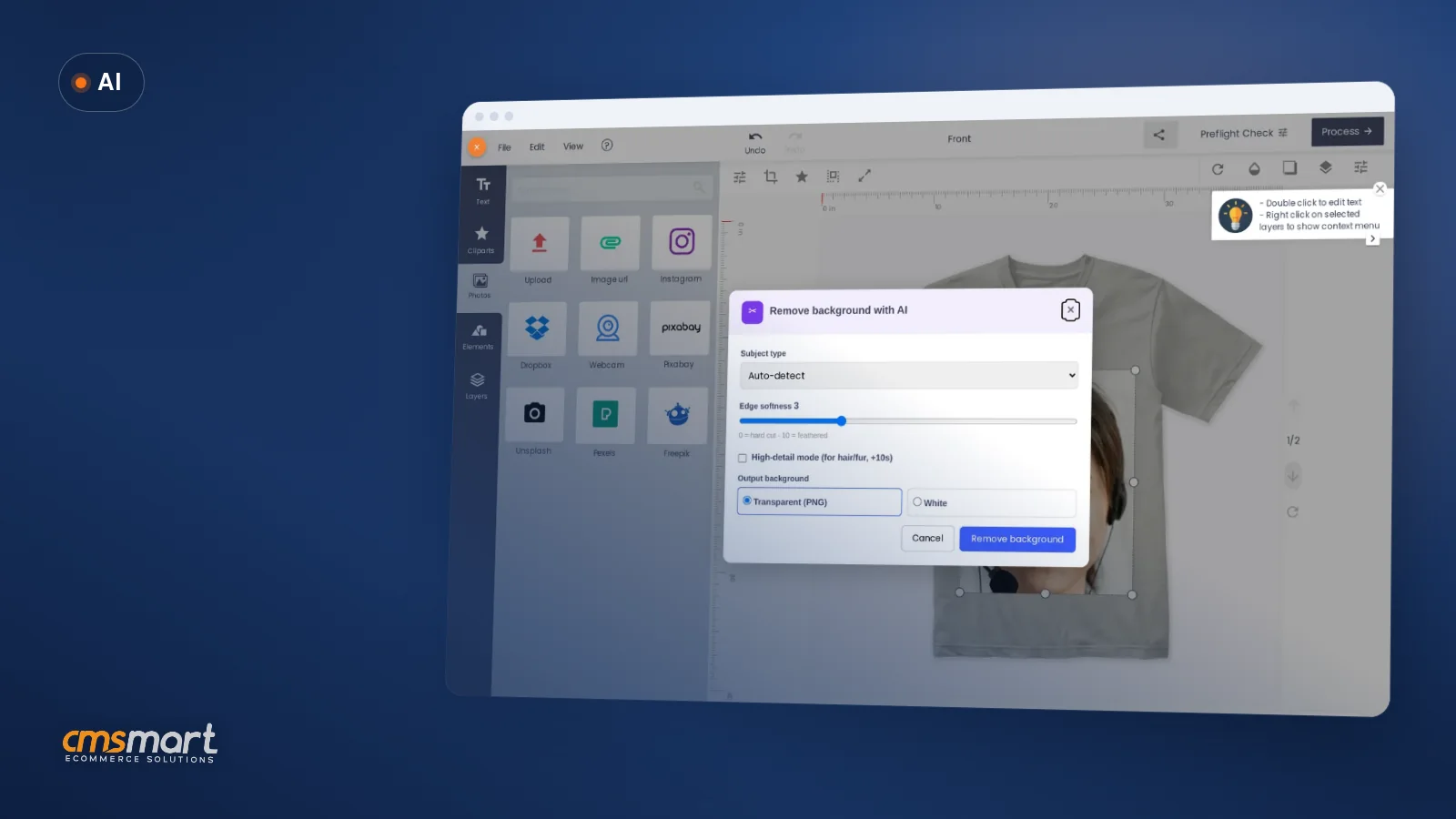
Case study · AI
AI Background Remover for WooCommerce Product Designer
Add an AI background remover for WooCommerce to your product designer so buyers get a clean cutout instantly, and see how Cmsmart builds the rest for...
Discover top-tier e-commerce solutions with Cmsmart. From personalized product design to multi-vendor stores, streamline operations while boosting sales with scalable WooCommerce integrations.
Table of contents
Was this tutorial helpful?
Written by
Cmsmart Ecommerce Growth & Trends Analyst
Tracks ecommerce trends and turns them into practical moves for growing stores.
The team behind it
 Account Manager
 Project Manager
 Business Analyst
 Developers & QA
Case study · AI
Add an AI background remover for WooCommerce to your product designer so buyers get a clean cutout instantly, and see how Cmsmart builds the rest for...
Case study · Web-to-print
Save design and reorder WooCommerce orders in one click, with a fresh print-ready PDF every time. See how Cmsmart builds it.
Guide · Web-to-print
Custom size printing WooCommerce shoppers configure themselves: Cmsmart prices it live and matches the print-ready PDF to the order. Get a quote.
Browse more guides, tutorials and case studies from the Cmsmart community.
Unlock the Power of Mobile Commerce: Propel Your Business Forward
Read MoreDiscover how to harness mobile commerce to enhance your business growth. Learn strategies for optimizing the mobile shopping experience and increasing consumer engagement.
Read MoreDiscover the benefits of mobile commerce and how it can transform your business. Learn effective strategies for maximizing sales and customer engagement through mobile-optimized shopping experiences.
Read More
Cmsmart Ecommerce provides custom ecommerce and WooCommerce development services for web-to-print, product personalization, plugin support and API integration.
Cmsmart Ecommerce Growth & Trends Analyst
Tracks ecommerce trends and turns them into practical moves for growing stores.
Meet the team →




In a rapidly evolving digital landscape, businesses are experiencing a seismic shift as over 80% of consumers now prefer shopping online. This trend has encouraged companies worldwide to embrace e-commerce as a critical strategy for growth. Take, for instance, GreenLeaf Designs from Canada, a small business specializing in eco-friendly home decor. Faced with stiff competition from larger retailers, they turned to Cmsmart's innovative e-commerce solutions. By implementing our multi-vendor marketplace model, GreenLeaf not only expanded its product offerings but also tapped into a community of vendors who share a commitment to sustainability. As a result, their sales skyrocketed by 150% within six months, showcasing how strategic e-commerce solutions can reshape business outcomes.
In today’s digital age, the question isn’t if you should take your business online, but rather how to maximize it effectively. With various e-commerce models such as B2C, B2B, and C2C, understanding the right fit for your business goals is crucial. According to recent market insights, businesses that leverage tailored e-commerce solutions have reported a remarkable 30% increase in customer retention rates. By harnessing the power of Cmsmart’s tools, like our mobile commerce solutions, you too can elevate your online presence and thrive in competitive markets. In this tutorial, we will explore cutting-edge e-commerce solutions powered by Cmsmart that can help you unleash your business's full potential.
Taking your Business Online
Imagine a world where your business can reach millions of customers without even opening a physical store.The realm of online commerce makes this possible, enabling you to transform your traditional business into a digital powerhouse with the help of e-commerce platforms. Whether you are a budding entrepreneur or an established enterprise, taking your business online is more accessible than ever. But understanding different e-commerce models is crucial to harness this opportunity effectively.
Explore E-commerce Models
To create a successful online business, you need to comprehend various e-commerce models that align with your business objectives:
- Business to Consumer (B2C): This model focuses on selling products directly to consumers. It helps improve user experience and branding.
- Business to Business (B2B): Ideal for companies selling products or services to other businesses. Managing longer sales cycles and developing relationships are key to driving sales here.
- Consumer to Consumer (C2C): Platforms where individuals can sell to one another, such as through marketplaces.
For more detailed insights, explore our resources on business to consumer e-commerce and business to business transactions .Benefits of Taking Your Business Online
Venturing into e-business provides myriad advantages:
- Broader Audience Reach: Access a global market, transcending geographical boundaries.
- Cost Efficiency: Reduced overheads compared to traditional retail.
- Scalability: Easily expand product ranges or services without significant investments in physical infrastructure.
Learn more about the advantages of e-commerce in our guide to e-commerce benefits .Preparing for an Online Launch
Before you proceed, consider these actionable steps:
- Choose the right e-commerce platform that supports your business model.
- Invest in a user-friendly website design to enhance the customer shopping experience.
- Employ a reliable payment gateway to ensure secure transactions.
Get inspired by successful e-commerce business examples. In summary: Transitioning to an online platform can exponentially grow your business reach and customer base. Optimize your strategy by choosing the right e-commerce models and leveraging comprehensive digital tools. In our next section, well delve deeper into the e-commerce system and necessary resources to get started.Demystifying E-commerce
Struggling to navigate the evolving landscape of e-commerce? Youre not alone.Many businesses grapple with understanding e-commerce models, enhancing user experience in B2C markets, managing lengthy B2B sales cycles, and nurturing relationships to drive B2B sales. This comprehensive guide aims to demystify the world of e-commerce, offering insights and strategies for success.
Definition of E-commerce
E-commerce, a term that has redefined modern commerce, refers to the buying and selling of goods and services over the Internet. This digital revolution has enabled businesses to reach global audiences, streamline operations, and offer unparalleled convenience to customers.
The Rise and Significance of E-commerce in the Digital Age
The past decade has seen a meteoric rise in e-commerce, driven by technological advancements and shifting consumer preferences. Market Insight: Its estimated that global e-commerce sales will reach a staggering $6.5 trillion by 2023, capturing 22% of total retail sales. This growth underscores the critical importance of embracing online commerce to capitalize on digital sales opportunities.
Terminology Unpacked: E-commerce, Online Commerce, Digital Sales, E-business
Understanding the jargon is key to mastering e-commerce. Terms like online commerce, digital sales, and e-business often overlap but generally refer to varied aspects of the e-commerce ecosystem:
For an in-depth look into the meaning and required resources of e-commerce systems, explore our detailed community posts.
In summary: Understanding the intricacies of e-commerce, from models to terminology, is pivotal for any business aiming to thrive in the digital age. Up next, we will delve into the different types of e-commerce models and explore business-to-consumer and business-to-business transactions.Exploring the E-commerce Universe: B2C, B2B, and C2C
Unlock the Potential of Your E-commerce Business with the Right ModelUnderstanding the dynamics of different E-commerce models is crucial for optimizing your online strategy and enhancing your brands reach. Managing longer sales cycles in B2B, improving user experience and branding in B2C, and developing relationships to drive C2C sales are some of the key pain points businesses face today.
What are B2C, B2B, and C2C E-commerce Models?
E-commerce platforms come in various forms, chiefly Business-to-Consumer (B2C), Business-to-Business (B2B), and Consumer-to-Consumer (C2C). Each model serves a unique role in the digital marketplace.
Advantages of Each E-commerce Model for Different Businesses
Choosing the right E-commerce strategy can significantly impact your growth.
Real-life Examples of B2C, B2B, and C2C E-commerce
Exploring successful examples helps to understand the application of these models:
For more on the types of B2B and B2C interactions, you can explore our content on types of E-commerce models and business to consumer E-commerce.
In summary: Understanding these E-commerce models is vital for tailoring your digital strategy effectively. Each model offers distinct benefits and caters to specific business needs, whether enhancing user-experience in B2C or streamlining processes in B2B. Up next, we delve into innovative strategies to leverage emerging trends in E-commerce.
Deep Dive Into E-commerce Platforms
Struggling to unlock the full potential of e-commerce platforms for your business growth? Youre not alone.Many entrepreneurs face the challenge of navigating the complexities of digital commerce, enhancing user experience, and managing intricate sales cycles in both B2C and B2B environments.
Understanding the E-commerce Platforms
E-commerce platforms are integral to establishing a successful online presence, serving as the backbone for businesses to showcase their products and services. Platforms like WooCommerce, Shopify, and Magento provide robust solutions tailored for various business needs.
The Role of E-commerce Platforms in Online Retailing
The digital transformation of retailing hinges significantly on e-commerce platforms. These platforms are not only about listing products online but about leveraging data analytics, optimizing digital marketing, and enhancing customer experiences.
Impact of E-commerce Platforms on Traditional Retail
Traditional retail has been significantly impacted by the rise of e-commerce platforms. Retailers are now required to adapt quickly, integrating online strategies to complement their physical stores.
- Adapt omni-channel models to offer a cohesive shopping experience
- Utilize platforms that support both B2B and B2C models
- Transform in-store experiences using digital tools for better customer engagement
In summary: Understanding and effectively leveraging e-commerce platforms can significantly transform your business landscape, driving sales growth and enhancing customer experiences. As we continue, let’s explore the types of e-commerce models and how they cater to different businesses.Mastering the Art of User Experience in E-commerce
Struggling to boost your e-commerce sales? You’re not alone.Many businesses face challenges like understanding different E-commerce models, improving user experience and branding in B2C, and managing longer sales cycles in B2B. Lets delve into how mastering user experience can pivot your online commerce performance.
Importance of User Experience in E-commerce Websites
A superior user experience in e-commerce is vital for increasing customer retention and conversion rates. Websites that are difficult to navigate can drive potential customers away, resulting in lost sales. By optimizing user experience, businesses can create a seamless shopping journey that encourages more purchases.
Key Elements of a Superior User Experience for Online Shoppers
To craft a memorable and efficient shopping experience, focus on these key elements:
How to Choose an E-commerce Platform with User-friendly Interface
Selecting the right e-commerce platform is crucial for a user-friendly interface. Platforms like WooCommerce offer flexibility and a variety of plugins to enhance user experience. Here are some pointers when choosing an e-commerce platform:
The market offers numerous options, each with its unique features. A comprehensive evaluation can help you select the best-suited platform to meet your business needs and customer expectations.
In summary: Focusing on user experience not only improves customer satisfaction but also drives sales. Next, we will explore various types of E-commerce models and how they impact your strategy . Stay tuned as we dive deeper into transforming your online business.
Blending E-commerce and Digital Marketing
Unlock the synergy between e-commerce and digital marketing for unparalleled growth.Understanding new e-commerce models can greatly improve user experience in B2C settings, manage longer B2B sales cycles, and develop crucial relationships to drive B2B sales.
Overview of Digital Marketing in E-commerce
Engaging in digital marketing is vital for online commerce success. It encompasses strategies like SEO, social media marketing, and content marketing — all aimed at boosting your online retail presence.
The Connection between E-commerce and Digital Marketing
Digital marketing and e-commerce are intertwined, leveraging the internet to drive sales. Effective campaigns enhance product visibility, cater to customer queries, and influence purchasing decisions.
Pros and Cons of Digital Marketing in E-commerce
While digital marketing can significantly enhance e-commerce growth, it also comes with challenges.
- Pros: Global reach, measurable results, cost-effectiveness.
- Cons: High competition, constant algorithm changes, requires ongoing strategy optimization.
For real-world examples of these strategies in action, consider exploring types of e-commerce models , business-to-consumer e-commerce , and business-to-business transactions .In summary: Harnessing digital marketing strategies not only propels your e-commerce business forward but also aligns it with broader market trends and customer expectations. Up next, delve into detailed analyses of e-commerce models and their categorization to understand their influence on digital marketing efforts.
Strategies for Handling B2B and B2C Sales Cycles in E-commerce
Understanding different E-commerce models? Let’s dive deep to improve your user experience in B2C and manage longer sales cycles in B2B, ultimately developing stronger B2B relationships.Planning for Improving Sales Cycles
In the world of online commerce, catering to both B2B and B2C requires strategic planning. Start by analyzing your sales data to understand customer buying patterns and preferences. Evaluate what works for your existing audience and what doesnt.
Key Steps in Managing B2B and B2C Sales Cycles
One key difference between B2B and B2C e-commerce is the length and complexity of the sales cycle. Here’s how you can manage these effectively:
Effective Techniques for Improving E-commerce Sales
Boosting sales in online retail involves several effective strategies:
To explore more about building robust e-commerce platforms, take a look at our guides on business-to-business e-commerce transactions, business to consumer e-commerce, and types of e-commerce models.
In summary: Implementing these strategies can drive your sales cycles toward success. Next, delve into optimizing conversion rates for better ROI.Future Trends in E-commerce
Understanding different E-commerce models, Improving user experience and branding in B2C, Managing longer sales cycles in B2B, Developing relationships to drive B2B salesCurrent Trends in E-commerce
The world of online commerce is constantly evolving, with digital sales reaching new heights as consumers increasingly turn to e-business platforms. In recent years, we have seen significant growth in business to consumer (B2C) E-commerce and business to business (B2B) transactions, each presenting unique challenges and opportunities.
For instance, enhancing user experience on B2C platforms has become crucial for sustaining consumer interest and boosting sales. Personalization and seamless mobile experiences are at the forefront. Meanwhile, B2B transactions require strategic focus on relationship management and longer sales cycles. Integrating Customer Relationship Management (CRM) systems with e-commerce platforms is proving essential for B2B success.
Predicted Future Developments in E-commerce
Looking ahead, the future of e-commerce is set to be shaped by cutting-edge technology and changing consumer behaviors. Key trends include:
How to Future-Proof Your Business with E-commerce
To navigate the future trends in e-commerce, businesses must strategically position themselves for success:
- Invest in robust business to consumer E-commerce solutions to enhance user engagement.
- Focus on data-driven strategies for B2B transactions to manage longer sales cycles efficiently.
- Ensure a flexible and scalable e-commerce platform to accommodate evolving market demands.
In summary: Adapting to the dynamic landscape of e-commerce by embracing innovative technologies and evolving consumer expectations is imperative. With strategic initiatives, businesses can harness the potential of future trends to secure a competitive edge. Next, lets delve into the elements that constitute successful C2C E-commerce marketplaces.Frequently Asked Questions
Frequently Asked Questions: Unlocking E-commerce SuccessUnderstanding different E-commerce models, improving user experience and branding in B2C, managing longer sales cycles in B2B, and developing relationships to drive B2B sales can dramatically enhance your digital commerce success. Lets address some common questions in the E-commerce realm.
What is E-commerce?
E-commerce, short for electronic commerce, involves buying and selling goods or services using the internet. It encompasses a variety of business types, including Business-to-Consumer (B2C) and Business-to-Business (B2B) transactions.
Why Choose WooCommerce for E-commerce Development?
WooCommerce is a powerful platform used by over 3.8 million websites to power their online stores globally. Its flexibility and wide range of customizable features make it a top choice for E-businesses.
What Are the Different Types of E-commerce Models?
How Can I Improve User Experience in My E-commerce Store?
Which Payment Methods Should I Offer on My E-commerce Platform?
Providing multiple payment options can enhance user experience and reduce cart abandonment. Consider integrating Credit Card, PayPal, and Bank Transfers. Explore alternative methods like cryptocurrency for tech-savvy customers.
What Are Best Practices for B2B E-commerce Transactions?
How Can I Implement Multi-Vendor Functionality?
Multi-vendor platforms can significantly expand your business scope. Using tools like Dokan Multivendor Marketplace helps you streamline vendor management, commissions, and product listings.
In summary: Addressing these FAQs can set the foundation for a thriving e-commerce business. Next, well dive into advanced strategies for leveraging different types of e-commerce models to maximize your market reach .FAQ Section: Troubleshooting and Pro Tips
What are the primary e-commerce models I can choose from?
Single vendor stores, multi-vendor marketplaces, and subscription-based services.
How can B2C businesses improve user experience and branding?
Utilize custom themes and personalized product recommendations to enhance engagement.
What strategies can manage longer sales cycles in B2B?
Implement automation tools and CRM systems for efficient lead nurturing and tracking.
How can I develop strong relationships to drive B2B sales?
Regular communication and personalized solutions tailored to client needs foster trust.
What are the benefits of customizing my e-commerce storefront?
Custom branding and advanced UI features can significantly boost user engagement.
How can Cmsmart help in scaling my e-commerce business?
Cmsmart offers scalable solutions and integrations to manage growing business demands.
Further Reading
As you've uncovered in this tutorial, launching your online business with Cmsmart’s cutting-edge e-commerce solutions is not just a possibility—it’s an opportunity well within your reach. By understanding the distinct e-commerce models like B2C, B2B, and C2C, you are equipped to cater to diverse markets and optimize your operations. Now is the time to elevate your business into the digital landscape and maximize your potential. Let’s discuss how we can help you implement these strategies effectively! Reach out to David, our CEO, for personalized support via WhatsApp at https://wa.me/84937869689, or email our Ecommerce Project Consultant at [email protected]. For a tailored quote, request a quotation here. Your business transformation begins today!