
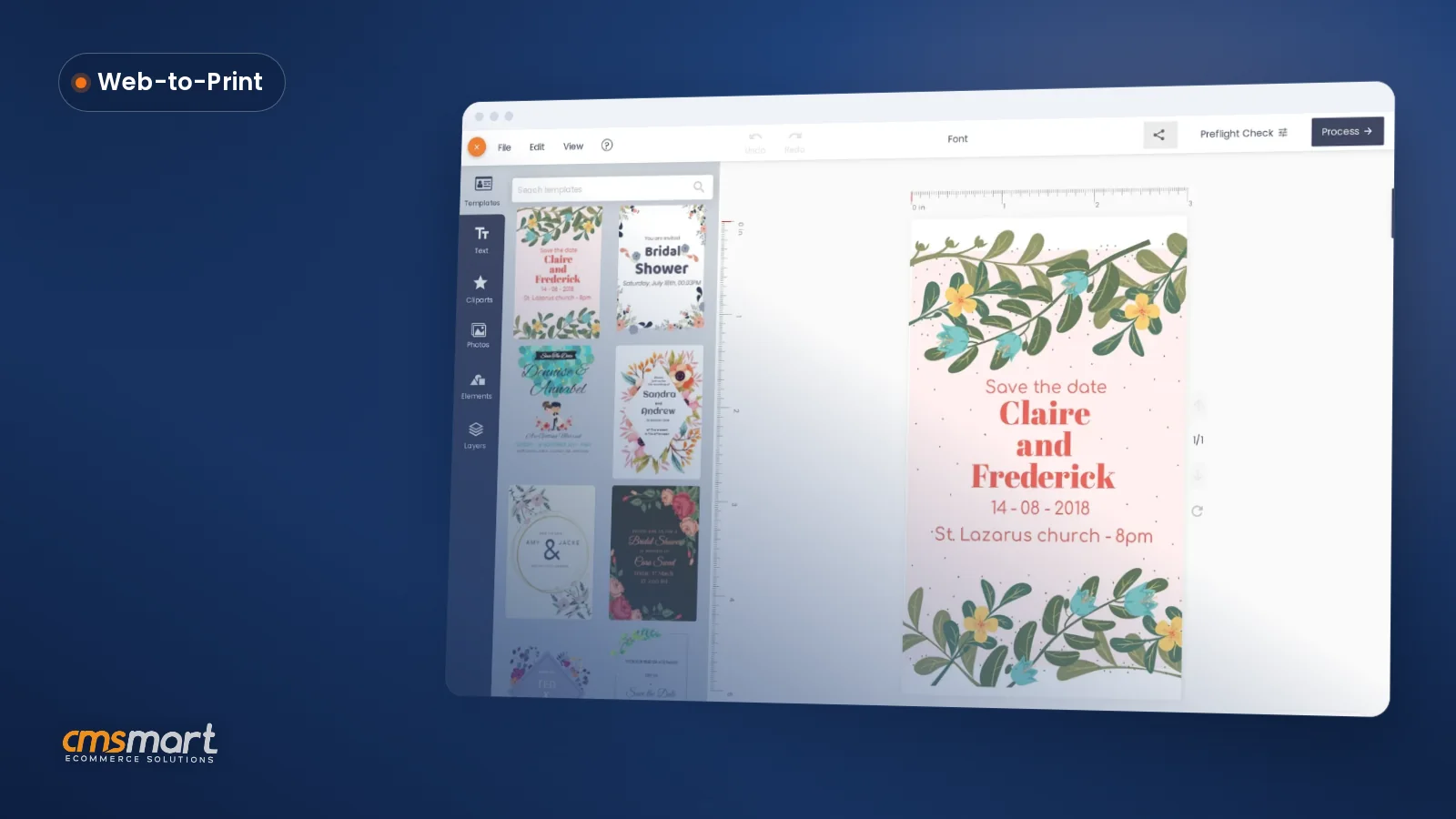
Guide · Web-to-print
NBDesigner Plugin Backgrounds: Fewer Reprints for Shops
The NBDesigner plugin now gives stationery shoppers a curated background library so print-ready PDFs always match the preview. See how to set it up.
Discover the transformative potential of 3D printing in your business. Enhance product customization, streamline production, and stay ahead in the competitive market with our expert solutions tailored for seamless integration.
Was this tutorial helpful?
Written by
Cmsmart Web-to-Print Solutions Consultant
Plans online print storefronts: product setup, pricing rules, proofing and print-ready files.
The team behind it
 Account Manager
 Project Manager
 Business Analyst
 Developers & QA
Guide · Web-to-print
The NBDesigner plugin now gives stationery shoppers a curated background library so print-ready PDFs always match the preview. See how to set it up.
Guide · Web-to-print
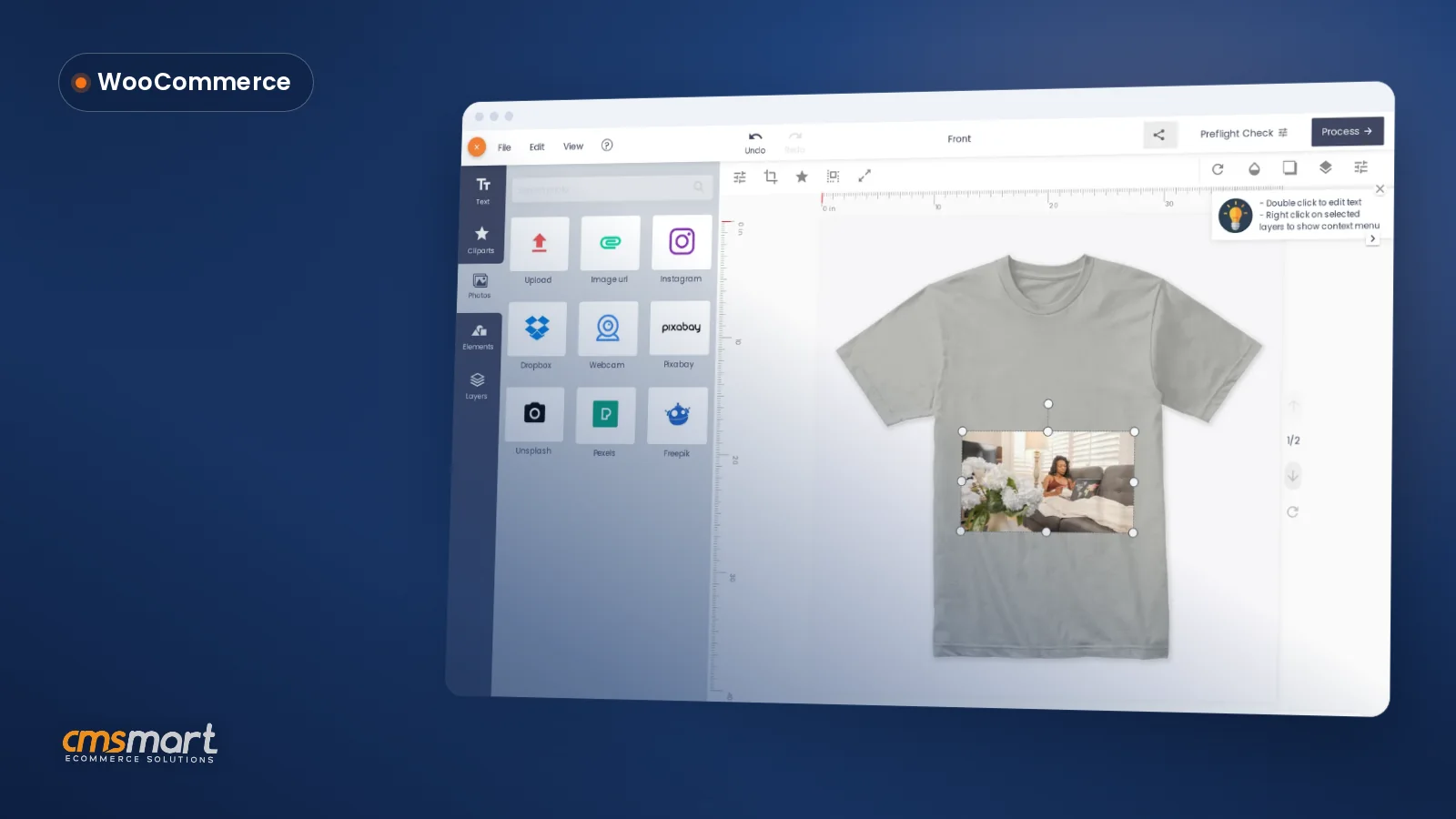
See how t-shirt artwork approval and print-ready PDFs cut POD reprints on WooCommerce; get a free workflow review from Cmsmart today.
Guide · Web-to-print
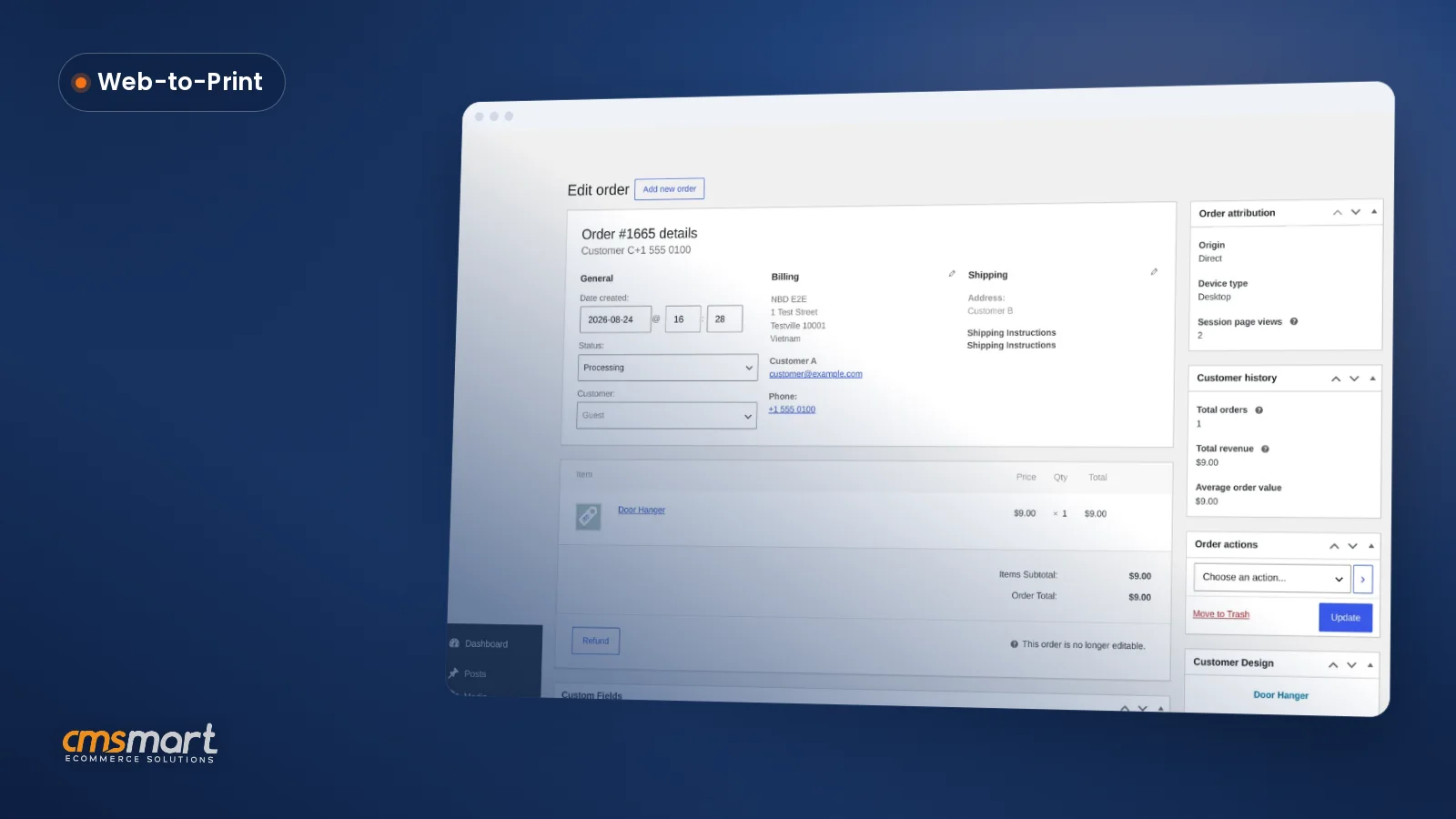
See how WooCommerce Online Product Designer turns a checkout into an approved, print-ready order on the screen you already use. Get started today.
Browse more guides, tutorials and case studies from the Cmsmart community.
Unlock the Power of Mobile Commerce: Propel Your Business Forward
Read MoreDiscover how to harness mobile commerce to enhance your business growth. Learn strategies for optimizing the mobile shopping experience and increasing consumer engagement.
Read MoreDiscover the benefits of mobile commerce and how it can transform your business. Learn effective strategies for maximizing sales and customer engagement through mobile-optimized shopping experiences.
Read More
Cmsmart Ecommerce provides custom ecommerce and WooCommerce development services for web-to-print, product personalization, plugin support and API integration.
Cmsmart Web-to-Print Solutions Consultant
Plans online print storefronts: product setup, pricing rules, proofing and print-ready files.
Meet the team →




Did you know that the 3D printing market is expected to reach a staggering $32.78 billion by 2023? Many businesses, however, are still grappling with how to harness this innovative technology effectively. For instance, consider our client, Innovate Tech Solutions, based in Germany. They started as a small design firm struggling to offer tailored products to their clients. With the integration of Cmsmart's 3D printing solutions, they not only enhanced their product development through precision 3D scanning but also significantly reduced lead times and production costs. This transformation allowed them to turn their complex ideas into reality, positioning them as an industry leader in customization.
In today's fast-paced eCommerce landscape, the power of 3D printing can revolutionize how businesses interact with their customers and streamline operations. By overcoming the challenges of educating your audience on 3D applications and creating accurate 3D models, you can unlock new levels of customization and growth.
To dive deeper into the world of 3D printing and explore resources geared towards enhancing your eCommerce strategy, check out our guide on eCommerce infographics and learn how to strategically transform your business. In this tutorial, we will explore the essential steps to leverage cutting-edge customization solutions that 3D printing offers.
Breaking Down 3D Printing
Imagine transforming your eCommerce content and services through the power of 3D printing!Many businesses struggle with educating audiences on 3D printing applications and creating accurate 3D models for printing. Lets dive into how additive manufacturing and 3D fabrication can revolutionize your business.
The Impact of 3D Printing Technology
Adopting 3D Printing in Your Business
To further explore 3D printing, consider checking our resources on educating B2B clients about 3D printing and utilizing our impactful infographics in 3D printing for effective communication.In summary: By understanding and adopting modern 3D printing scope, your business can stay ahead of the curve and deliver innovative solutions to clients—next, lets delve into the future trends and potentials of 3D technologies.
Additive Manufacturing: An Introduction
Struggling to harness the full potential of 3D printing for business growth? You’re not alone.Navigating the complexities of creating accurate 3D models and understanding 3D printing applications can be daunting for many businesses today.
Defining 3D Printing and Its Key Components
3D printing, often synonymous with additive manufacturing and 3D fabrication, transforms digital models into tangible objects. Key components include the digital 3D model, materials typically used like plastics and metals, and the printer itself, which constructs the object layer by layer.The Evolution and Significance of 3D Printing in Todays Industry
Originally developed in the 1980s, 3D printing has evolved remarkably, from rapid prototyping to being a cornerstone in industries ranging from automotive to healthcare. This innovation is not just about creating prototypes but fully functional products, reducing waste, and offering endless customization possibilities.Unpacking the Terminologies: 3D Printing, Additive Manufacturing, and 3D Fabrication
While often used interchangeably, these terms have nuanced differences. Additive manufacturing refers to the technology and processes used, while 3D fabrication could be seen more broadly or culturally interpreted based on regional manufacturing norms.Enhancing Business Operations with 3D Printing
For a deeper understanding of how 3D printing can redefine your business approach, explore our comprehensive visual guide to 3D printing. This resource will navigate you through impactful infographics and the modern scope of 3D printing solutions for B2B clients.In summary: Embracing 3D printing technologies can propel your business to new heights. Next, let’s delve into practical applications and case studies that showcase the versatility and power of 3D printing.
Exploring 3D Printing Technologies and Applications
Unlocking the Potential of 3D Printing in BusinessEducating audiences about the expansive world of 3D printing can seem daunting, but understanding its diverse applications and revolutionary benefits unlocks significant growth opportunities for businesses.
What is 3D Printing Technology?
3D printing, also known as additive manufacturing, is a process that creates a physical object from a digital design by layering materials. Unlike traditional manufacturing, 3D printing offers more flexibility and the ability to produce complex structures with incredible precision.
Understanding Various 3D Printing Applications
The versatility of 3D printing extends across multiple industries, enabling businesses to produce everything from intricate jewelry designs to large-scale architectural models. Companies are also pioneering in the medical sector with 3D-printed prosthetics and in aerospace with lightweight components.
How Businesses are Leveraging 3D Printing for Growth and Development
3D printing empowers businesses to enhance product development cycles, reduce waste, and lower production costs. This transformative technology is particularly beneficial for startups and SMEs, driving innovation and competitiveness without heavy upfront investments.
- Increases design flexibility and innovation
- Reduces manufacturing waste and costs
- Simplifies supply chains by enabling local production
In conclusion: Embracing 3D printing technology can be a game-changer for businesses aiming to innovate and compete on a global scale. To delve deeper, explore our comprehensive visual guide to 3D printing that provides further insights into educating B2B clients and leveraging impactful infographics . Next, we will examine modern 3D printing scope and its implications for various industries.Creating Accurate 3D Models for Printing
Unlock the full potential of your product development with 3D printing accuracy.Creating precise 3D models is essential for harnessing the power of additive manufacturing in transforming ideas into tangible realities. Here’s how you can navigate the complexities with ease and expertise.
Navigating the 3D Modeling Process for Printing
Embarking on a 3D modeling journey involves several pivotal steps that lead to successful prints. From conceptualization to final adjustments, understanding each stage helps in achieving exact replicas of your designs:
Understanding the Role of CAD in 3D Model Creation
Computer-Aided Design (CAD) is instrumental in creating high-fidelity 3D models. It allows designers to draft detailed models which are essential for complex structures and rapid prototyping.
Common Challenges and Solutions in Creating Accurate 3D Models
Accuracy in 3D modeling isnt without its hurdles. Here are some common challenges and ways to overcome them:
For further insights into the 3D printing process and its applications, consider exploring our comprehensive visual guide to 3D printing and understand its potential impact on business growth.
In summary: By mastering 3D modeling techniques, businesses can reduce errors, minimize material waste, and improve the overall quality of their products. Next, we will delve into educating B2B clients about the transformative capabilities of 3D printing, along with creating impactful infographics to illustrate modern 3D printing scopes effectively. .The Power of 3D Scanning in Product Development
Harness the Power of 3D Scanning to Elevate Your Product DevelopmentIn todays competitive market, educating audiences about the applications of 3D printing and creating accurate 3D models is paramount for businesses looking to grow. Leveraging 3D scanning, a crucial aspect of additive manufacturing, can dramatically improve the efficiency and precision of your product development process.
Defining 3D Scanning and its Use in Various Industries
3D scanning, a cornerstone in 3D fabrication and technology, involves capturing the shape of an object using laser or structured light to create its digital 3D model. This technology is revolutionizing industries such as:
Overcoming Product Development Challenges with 3D Scanning
3D scanning addresses numerous business pain points by offering precise measurement and reducing the time and cost associated with traditional methods. Here’s how it can benefit your operations:
Effective 3D Scanning Techniques for Accurate Product Replication
To achieve precise product replication, consider these techniques:
- Use high-resolution scanners for detailed surface capture.
- Implement structured light scanning for complex geometries.
- Adopt photogrammetry for cost-effective and versatile scanning.
In summary: 3D scanning is transformative in product development, offering significant advantages from design to final production. As we advance, explore how impactful infographics and modern 3D printing techniques can continue to drive your business growth. Dive into our resources on educating B2B clients about 3D printing and understanding the modern 3D printing scope for comprehensive knowledge.Impactful Infographics in 3D Printing
Unlock the Power of Educative Visuals in 3D PrintingEducating audiences on 3D printing applications and creating accurate 3D models is paramount for leveraging this technology for business growth.
Understanding the Impact of Infographics in 3D Printing
Infographics serve as a bridge to understanding complex concepts in 3D printing, such as Additive Manufacturing and 3D Fabrication. By simplifying technical details, they make 3D printing applications accessible to a wider audience.
How Infographics Facilitate Better Understanding of 3D Printing
Creating Impactful and Educational 3D Printing Infographics
To craft effective infographics for 3D printing:
For more insights, explore our comprehensive visual guide to 3D printing, which provides an in-depth look into educating B2B clients about this transformative technology.
In summary: Effective infographics can dramatically enhance understanding and engagement in the 3D printing industry. Next, delve into our section on "educating B2B clients about 3D printing" to further enhance your business strategies.Enhancing eCommerce Content Creation with 3D Printing
Are you ready to transform your eCommerce content creation through 3D printing?3D printing, also known as additive manufacturing or 3D fabrication, is revolutionizing how businesses approach content creation for online stores, allowing for detailed, custom product modeling that enhances the shopping experience.
Innovative Uses of 3D Printing for eCommerce Content Creation
3D printing technology offers numerous applications in eCommerce. By creating precise 3D models, businesses can:
With 3D printing, products come to life on screen, captivating potential buyers and driving engagement.
Fusing 3D Printing And eCommerce for Profitable Business Growth
Integrating 3D printing within your eCommerce strategy can lead to business growth through:
Case Studies Highlighting Success through 3D Printing Integration
For more detailed insights and descriptions of 3D printing applications in your eCommerce venture, explore our comprehensive visual guide to 3D printing and our articles on educating B2B clients about 3D printing, as well as our impactful infographics on modern 3D printing scope.
In summary: The fusion of 3D printing with eCommerce is an exciting frontier for product innovation and customer engagement. As we move on, lets delve into specific techniques to enhance your eCommerce platform using advanced 3D tools and automation features.Future Trends in 3D Printing And Its Scope
Are you trying to understand the evolving landscape of 3D printing and its immense potential for business growth?As industries continue to innovate, the need for insightful knowledge on 3D printing applications, accurate 3D model creation, and the advantages of 3D scanning becomes crucial for leveraging business opportunities.
Current Developments in the 3D Printing Industry
The 3D printing industry, also known as Additive Manufacturing, is rapidly evolving with advancements in 3D Fabrication techniques. This technology is increasingly being used in sectors such as healthcare, automotive, and aerospace to produce highly customized and complex products that would be impossible to create with traditional methods.
Predicted Future Trends and Potentials
Future trends predict that 3D printing will expand its scope, offering new potentials:
Strategies to Future-Proof Your Business with 3D Printing
For businesses aiming to capitalize on these advancements, adopting strategic approaches is key:
For comprehensive insights, explore our comprehensive visual guide to 3D printing, designed to educate B2B clients about this transformative technology.
In summary: By understanding and integrating these future trends, your business can innovate and thrive. Next, let’s delve into a comprehensive visual guide to 3D printing, offering insights into its educational impact and market scope .Frequently Asked Questions
Facing challenges in mastering 3D printing?Educating audiences on 3D printing applications and creating accurate 3D models can be daunting, yet indispensable, for harnessing the full potential of this technology.
Essential Knowledge in 3D Printing
Actionable Tips for Effective 3D Printing
- Choose the right materials for your specific needs—ranging from plastics to advanced composites.
- Optimize designs for additive manufacturing to improve efficiency and reduce waste.
For further in-depth understanding, consider exploring our comprehensive visual guide to 3D printing and see how impactful infographics can educate B2B clients about the modern 3D printing scope . In summary: By leveraging these insights, youre well positioned to not only tackle existing challenges but also to explore new growth opportunities using 3D printing. Next, lets delve deeper into the technical aspects with our upcoming section focused on educating B2B clients about 3D printing.FAQ Section: Troubleshooting and Pro Tips
What are some common applications of 3D printing in modern industries?
3D printing is widely used in industries for prototyping, custom manufacturing, healthcare, and architectural modeling.
How can businesses educate audiences about 3D printing applications?
Businesses can conduct workshops, publish case studies, and provide hands-on demos to educate about 3D printing applications.
What is crucial to creating accurate 3D models for printing?
Precision in design and understanding of material properties are crucial for creating accurate 3D models for printing.
What are the advantages of using 3D scanning in product development?
3D scanning enhances accuracy, speeds up the design process, and allows for easy modifications in product development.
How can leveraging 3D printing contribute to business growth?
3D printing can reduce production costs, allow for rapid prototyping, and enable customized product offerings, leading to business growth.
Further Reading
Now that you’ve discovered the transformative potential of 3D printing, it’s time to take action and elevate your business to new heights! With the ability to enhance product development, reduce lead times, and empower your brand as a thought leader, leveraging 3D printing can significantly impact your market presence. Don’t navigate this journey alone; let’s collaborate to implement these cutting-edge solutions effectively. Contact David, our CEO, directly via WhatsApp at this link or reach out for tailored guidance at project@cmsmart.net. Ready to transform your vision into reality? Request a quotation here. Join me in harnessing the power of 3D printing to revolutionize your business!