

Case study · Web-to-print
Web-to-Label Printing: Sell Custom Product Labels Online
Set up web-to-label printing for product labels with Cmsmart Product Designer: upload, proofing and print-ready PDFs. Get a quote today.
Cmsmart Product Designer lets shoppers recolor icons from its built-in clipart library to match a brand's exact shade directly on the product canvas, instead of emailing a logo and waiting on a mockup. The chosen color is saved with the order and carried through approval into a bleed-ready, CMYK print file.
Was this tutorial helpful?
See also: Cmsmart pricing and Cmsmart products.
← Icon Library for Custom Labels in WooCommerce · Clipart Library Plugin for WooCommerce Product Design →
Written by
Cmsmart Product Designer Plugin Engineer
Builds and supports the Cmsmart Product Designer (NBDesigner) for WooCommerce.
The team behind it
 Account Manager
 Project Manager
 Business Analyst
 Developers & QA
Case study · Web-to-print
Set up web-to-label printing for product labels with Cmsmart Product Designer: upload, proofing and print-ready PDFs. Get a quote today.
Guide · Web-to-print
See a sourced WooCommerce product designer plugin comparison: pricing, features and print-ready files, then request a free migration quote today.
Guide · Web-to-print
Translate WooCommerce product designer screens with Loco Translate or Frontend Translate: see every setting, its default, and how to set it up.
Browse more guides, tutorials and case studies from the Cmsmart community.
Run a custom tote bag printing business with Cmsmart Product Designer: live pricing, real print specs and a print-ready PDF. See how to set it up.
Read MoreBuild a car wrap ecommerce store on WooCommerce: panel pricing, approval and print-ready PDFs before you print. Plan your wrap store today.
Read MoreDiscover how the home décor industry is transforming with the rise of personalized products and the challenges retailers face. Learn how CMSmart's Product Builder offers a solution, improving customer engagement, reducing return rates, and increasing sales through real-time 3D previews and automated processes.
Read More
Cmsmart Ecommerce provides custom ecommerce and WooCommerce development services for web-to-print, product personalization, plugin support and API integration.
Cmsmart Product Designer Plugin Engineer
Builds and supports the Cmsmart Product Designer (NBDesigner) for WooCommerce.
Meet the team →


In short
A corporate buyer wants your tote bag, mug or apparel in their own brand color, not whatever shade ships in your icon pack. Cmsmart Product Designer's icon color customization lets them pick an icon, set its exact color, and see it on the product before they pay — no more email screenshots back and forth over a shade that still might miss on press.
What's the real cost of manual icon color matching?
Cmsmart Product Designer puts the color picker in the buyer's hands at the point of design, so the shade that's approved is the shade that prints — removing the email-and-guess loop that causes most color-related reprints on personalized orders.
If you sell personalized merchandise to businesses, schools, sports teams or event organizers, matching the buyer's brand color is one of the most common and most expensive requests you get:
Cmsmart insight: The highest-risk order is rarely the one with no color instruction at all — it's the one where a brand-color match was agreed by email with no documented hex value. Capture the exact color inside the online designer and attach it to the approved artwork, instead of leaving it in an inbox.
What does buyer-driven brand-color matching look like in practice?
With Cmsmart Product Designer, a buyer picks a product, opens the online designer, drags an icon onto the canvas and recolors it to their brand shade themselves — the design is saved as part of the order, so what they approved is what goes to print, with no separate proofing round trip.
Example scenario. A promotional-products store sells branded tote bags to small businesses and nonprofits. A buyer opens a tote bag product, clicks Start and upload design, and picks Design online. In the Cliparts panel they search for a courier or leaf icon that fits their logo mark, drop it on the bag, select it and pick their brand's exact color from the toolbar color picker. The bag preview updates instantly. They add their org name in matching type, save, and the design appears as Your artwork next to Add to cart. They check out. On the shop's end, the order lands in Cmsmart > Orders with the design attached, ready for approval and a print-ready PDF — no email thread, no guessing at a Pantone-adjacent shade from a phone photo.
That loop — pick, recolor, preview, buy — is what turns a merchandise request into a self-serve order instead of a quote-and-wait process.
How does Cmsmart's product designer turn a picked color into a print-ready file?
Cmsmart Product Designer combines a storefront product page, an online editor with a Cliparts and color-picker panel, an admin approval step and a cloud PDF renderer, so a buyer's color choice becomes a certified, CMYK-converted print file without anyone re-typing it.
The building blocks, and what's built into the plugin today versus what Cmsmart adds as custom development:
What's the business value of letting buyers match their own brand color?
Buyer-driven color matching in Cmsmart Product Designer cuts the proofing emails, staff recoloring time and reprint risk that come with manual custom-color orders, while giving the buyer the confidence to pay without a separate mockup.
Web-to-print software itself is a growing category to build on: Mordor Intelligence sizes the global web-to-print market at USD 26.59 billion in 2025, growing to USD 36.38 billion by 2031 (CAGR 5.43%), which is the demand a self-serve, brand-accurate design tool is built to capture.
Quick ROI check. If your team currently hand-recolors icons for custom orders, estimate the monthly cost with your own numbers: (custom-color orders per month) × (minutes of manual recoloring and proofing per order) ÷ 60 × (fully loaded hourly rate) = monthly cost of the manual workflow. Add (reprint rate on custom-color orders) × (average cost per reprint) to see what color mismatches alone are costing before you even count the staff time.
Promotional merchandise is not a niche line item: PPAI's 2025 US Distributor Sales Volume Estimate puts the promotional products channel at $27.1 billion in sales, up 1.3% on the previous year — and every one of those orders is a brand that wants its own color on the product. On the buying side, Deloitte Digital's 2026 consumer research found that 52% of consumers say they're more likely to buy from brands that personalize their experience, and they spend 30% more with those brands — a self-serve color match is a small piece of that personalization, directly inside the product page.
How do you set up icon color customization in Cmsmart Product Designer?
Setting up brand-color icon customization means confirming a design-enabled product, walking the buyer flow once yourself, and knowing where the admin approval and print-ready PDF steps sit — all inside the plugin you likely already have active.
For the admin-side library that feeds this panel — organizing cliparts, fonts and backgrounds so buyers only see curated, on-brand assets — see how to make your designs come alive with cliparts.
What can Cmsmart build on top of icon color matching for your store?
Beyond the standard color picker, Cmsmart builds brand-palette locks, ERP-fed brand kits and automated color-match preflight as custom development, so larger B2B and franchise accounts get brand control the core plugin doesn't ship with.
Delivery runs the same way for every custom build: discovery call, solution design, development sprints, QA, launch and ongoing support — see the Cmsmart project delivery model for real examples, or the Product Designer Customization service this work falls under.
Get a brand-color customization quote
Why work with Cmsmart on brand-color product customization?
Cmsmart has built and supported the Product Designer plugin since 2012 as a Netbase JSC division, with thousands of live stores using it and a published Trustpilot rating buyers can check before they commit to a custom build.
Cmsmart is a Netbase JSC division running web-to-print and WooCommerce customization projects since 2012, with 6,300+ client projects and 1,800+ live stores running today across 80+ countries, rated 4.2 on Trustpilot (404 reviews). A plugin user summed up the customization fit directly in a Trustpilot review: the designer works exceptionally well across all devices and allows them to create the exact customisations required to perfectly fit their products and business model — Web Developer, GB. The plugin behind all of this is the Cmsmart Product Designer (NBDesigner) for WooCommerce.
Frequently asked questions
Will the color a buyer picks on screen match what prints?
The screen color is RGB; the production files include a CMYK JPG with an embedded ICC profile alongside the vector and PDF, so the color that reaches the press is converted for print rather than copied straight from the screen.
Can we restrict buyers to our own brand colors only, instead of any color?
Not out of the box — the standard color picker is open to any color. A palette lock tied to an account's approved brand colors is something Cmsmart builds as custom development.
Who approves the artwork before it goes to print?
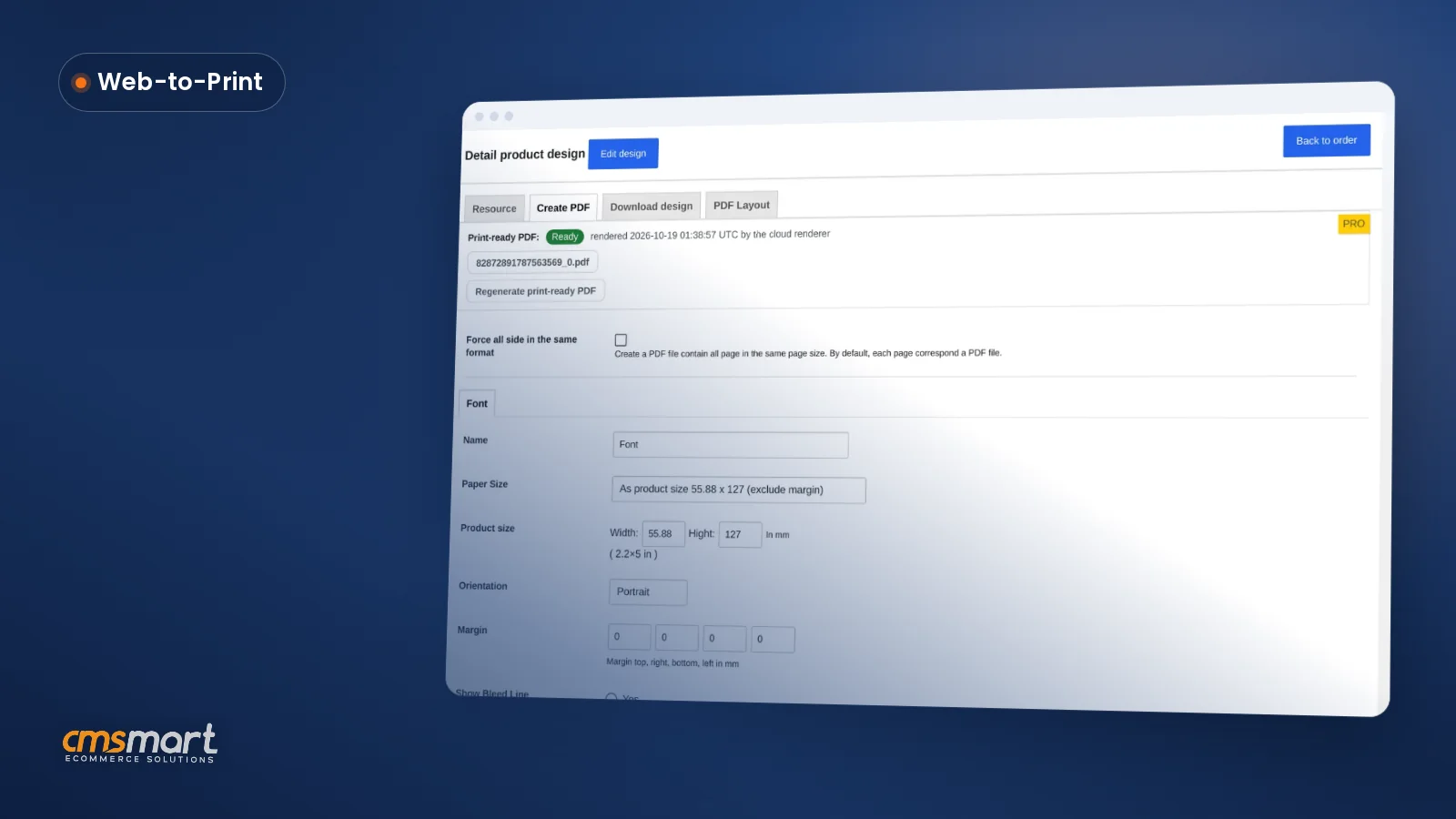
Your staff, using the Customer Design box on the WooCommerce order screen, where the exact design the buyer saved can be accepted or declined before Create PDF runs.
Does this work for B2B accounts that order for multiple brands or locations?
The core plugin treats every order independently. Syncing a brand kit per account or per location, and tracking brand compliance across reorders, is custom development Cmsmart builds for B2B and franchise stores.
What plugin version do I need?
The flow in this guide — Cliparts panel, color picker, Customer Design approval, Create PDF and CMYK/ICC downloads — is current as of Cmsmart Product Designer 2.17.0; check your version on the WordPress Plugins screen.
How does print resolution affect a recolored icon's quality?
Recoloring an icon doesn't change its resolution — a low-DPI icon will still print soft. See how DPI affects print quality for how upload rules and AI preflight catch that before an order ships.
Where do I manage which icons are available to recolor?
That's the admin-side Cliparts, Fonts and Backgrounds setup under Cmsmart's Media menu — see how to make your designs come alive with cliparts for curating that library.
Does a buyer need separate design software to recolor an icon?
No. Recoloring happens inside the browser-based online designer: a buyer opens the Cliparts panel, drags an icon onto the canvas, selects it, and sets its color with the toolbar color picker, all without leaving the product page or uploading a separate file.
What does a buyer see on the product page after saving a recolored icon?
The saved design appears as Your artwork next to Add to cart, so the buyer can confirm the exact color before paying, and that same preview carries through to the cart line item and the checkout review before the order is placed.
What kind of store is given as an example of this feature in use?
A promotional-products store selling branded tote bags to small businesses and nonprofits: a buyer drops a courier or leaf icon onto a tote, recolors it to their brand's shade from the toolbar, adds matching text, and checks out with the design attached.
Where are the other Cmsmart Fullstore Quickstart Package tutorials?
Every Cmsmart Fullstore Quickstart Package tutorial is listed on the Cmsmart Fullstore Quickstart Package tutorials page. Customers with a licence can open a support ticket from the Cmsmart dashboard when a step does not match their install.
What if a step in this Cmsmart Fullstore Quickstart Package tutorial does not match my store?
This tutorial describes the release that was current when it was written (it was published on 13 October 2018), so a menu or setting may have moved since. Customers with a licence open a support ticket from the Cmsmart dashboard, naming the step and adding a screenshot, and the team answers there.
Where is the Cmsmart Fullstore Quickstart Package product page?
The Cmsmart Fullstore Quickstart Package product page shows the product as it is sold today, so you can check what this tutorial covers against the current release.
How do I pay securely?
Contracts and payments go to the company, Netbase JSC: plans are paid through PayPal; services are invoiced by Netbase JSC under a written proposal and paid by bank transfer to Netbase JSC's company account or by PayPal Business. Cmsmart (Cmsmart Ecommerce) is the ecommerce brand of Netbase JSC, a company based in Hanoi, Vietnam.
How do I contact Cmsmart or get a quote?
Message the Cmsmart team on WhatsApp at +84 937 869 689 or email project@cmsmart.net; the contact page at cmsmart.net/contact lists every channel, and Request a quote (cmsmart.net/project-proposal) sends a project brief. Customers with a licence open a ticket from the dashboard.
Further reading