
Guide · Web-to-print
The Print Ready PDF WooCommerce Orders Need
See how Cmsmart generates a print ready pdf woocommerce orders can send to production: bleed, CMYK, watermark off, automatically. Get a quote.
Restaurant menu printing online: launch a WooCommerce menu designer with print specs, live pricing and print-ready PDFs. Plan your menu store today.
Table of contents
Was this tutorial helpful?
Written by
Cmsmart Web-to-Print Solutions Consultant
Plans online print storefronts: product setup, pricing rules, proofing and print-ready files.
The team behind it
 Account Manager
 Project Manager
 Business Analyst
 Developers & QA
Guide · Web-to-print
See how Cmsmart generates a print ready pdf woocommerce orders can send to production: bleed, CMYK, watermark off, automatically. Get a quote.
Guide · Web-to-print
Set up a WooCommerce file upload print shop that takes print-ready PDF, AI and PSD files with file-type, size and DPI checks built in.
Guide · Web-to-print
Install and configure NBDesigner on WooCommerce: license it, set print-ready output and pricing, then launch. Get a setup quote today.

Cmsmart Ecommerce provides custom ecommerce and WooCommerce development services for web-to-print, product personalization, plugin support and API integration.
Cmsmart Web-to-Print Solutions Consultant
Plans online print storefronts: product setup, pricing rules, proofing and print-ready files.
Meet the team →

In short
Restaurant menu printing online means a diner-facing WooCommerce store where an owner or manager builds a trifold, single-page or laminated menu in a browser, sees a real price, and gets a print-ready file the moment the order is placed, instead of a week of PDF edits over email.
A price goes up on the seafood special, or a chain needs the same menu reprinted at 12 locations with one phone number swapped — and the request lands with whoever answers email that day, who opens the old file, hopes it's current, edits it by hand, and emails a proof back. Multiply that by every price change and every new location, and menu reprints quietly become one of the most repetitive jobs in a print shop's back office.
This guide shows what a WooCommerce menu store looks like end to end: the storefront, the print specs a laminated or trifold menu needs, how Cmsmart Product Designer handles the designer-to-print-file path today, and what Cmsmart builds on top as custom development.
What's the real cost of printing restaurant menus the old way?
Cmsmart sees the same five pains on every menu-printing account: manual price edits, versions that drift, no live quote, proofing by email, and reprints that start from scratch. A WooCommerce menu designer removes the hand-editing step and keeps one current file per menu.
The pressure on this process is not slowing down: the web-to-print software market is forecast to grow from $26.59 billion in 2025 to $36.38 billion by 2031 (Mordor Intelligence, accessed 2026-10-08), and restaurant menu prices were still 3.4% higher year over year as of August 2025 (National Restaurant Association, accessed 2026-10-08) — every price cycle is another round of reprints for a shop still working from email.
Put a rough number on it with your own variables: menu reprints per month × minutes spent re-editing and emailing × your hourly staff cost is the monthly cost of the status quo, before counting a single wasted laminate sheet from a price that changed mid-run.
What would it look like if your menus updated themselves?
Cmsmart lets a diner-facing restaurant or a print shop's menu customer open a template, edit the price list themselves, and see the finished layout and price before paying — no round trip through a designer's inbox for a routine update.
Example scenario. A multi-location fast-casual group needs the lunch menu reprinted at every store because one dish price changed. The operations manager opens the saved design, edits the one price field, checks the trifold panels still line up, and reorders. The print-ready PDF is waiting before the laminator is even warmed up.
That is the promise of a WooCommerce menu store: the same storefront a customer already orders from becomes the place they design, price and reorder.
Own production or outsource: when does a WooCommerce menu store pay off?
Cmsmart doesn't push every print shop to the same model: a WooCommerce menu designer pays off once you print often enough that staff time on manual quoting and re-editing outweighs the setup work, whichever way you produce the menus.
Either way, the storefront, designer and print-ready file stay the same — only what happens after Process changes.
What are the print specs for a restaurant menu?
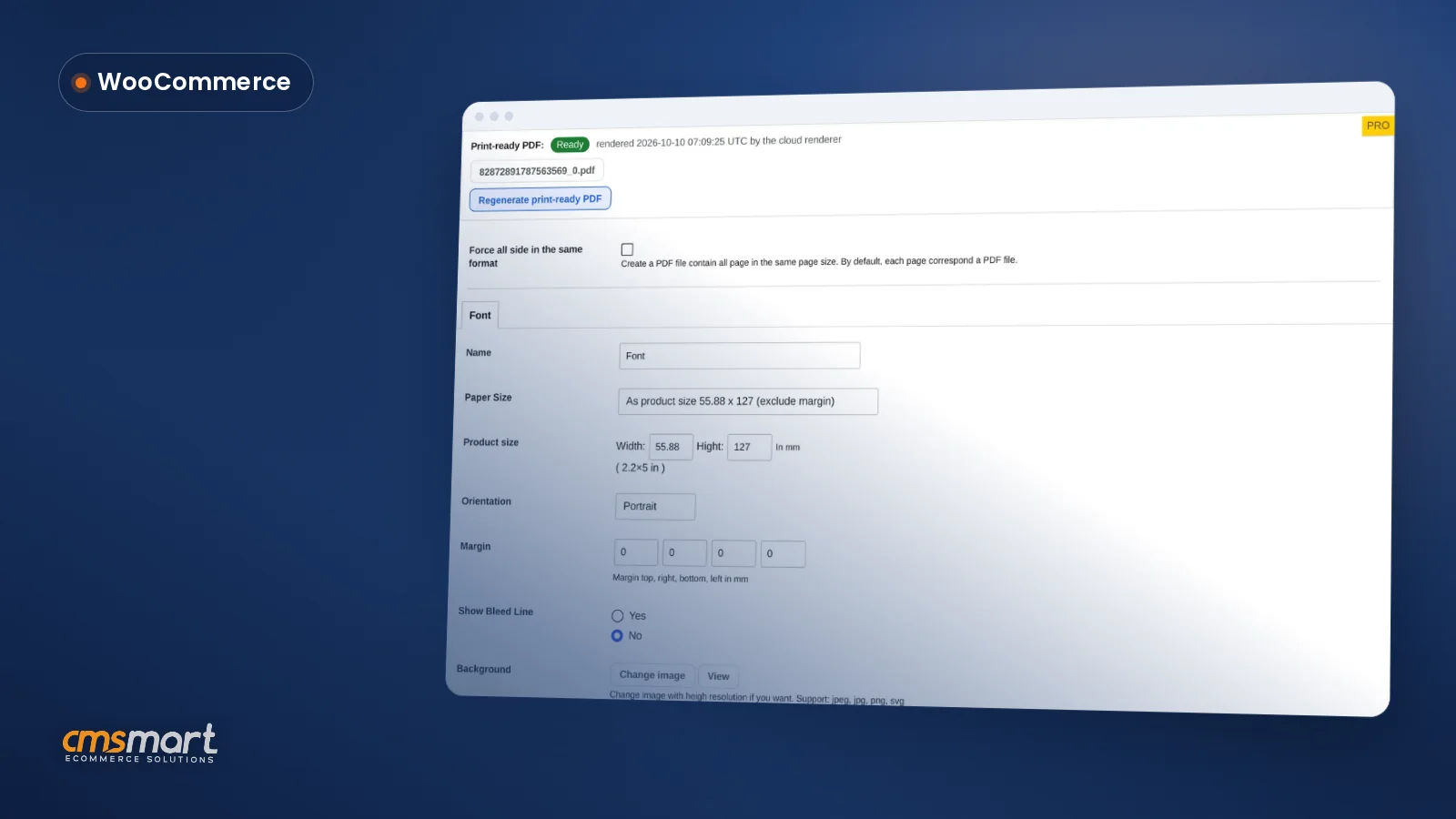
Cmsmart Product Designer lets you set the design area, bleed line and output format per product, so a menu's print specs are enforced in the browser instead of caught after the file reaches the press.
Cmsmart insight: most menu reprints trace back to one changed price, not a full redesign. Build your template so prices sit in editable text fields rather than being baked into a background image, and a reorder becomes a one-field edit instead of a new layout.
What to configure in Cmsmart Product Designer:
How does Cmsmart handle restaurant menu printing online?
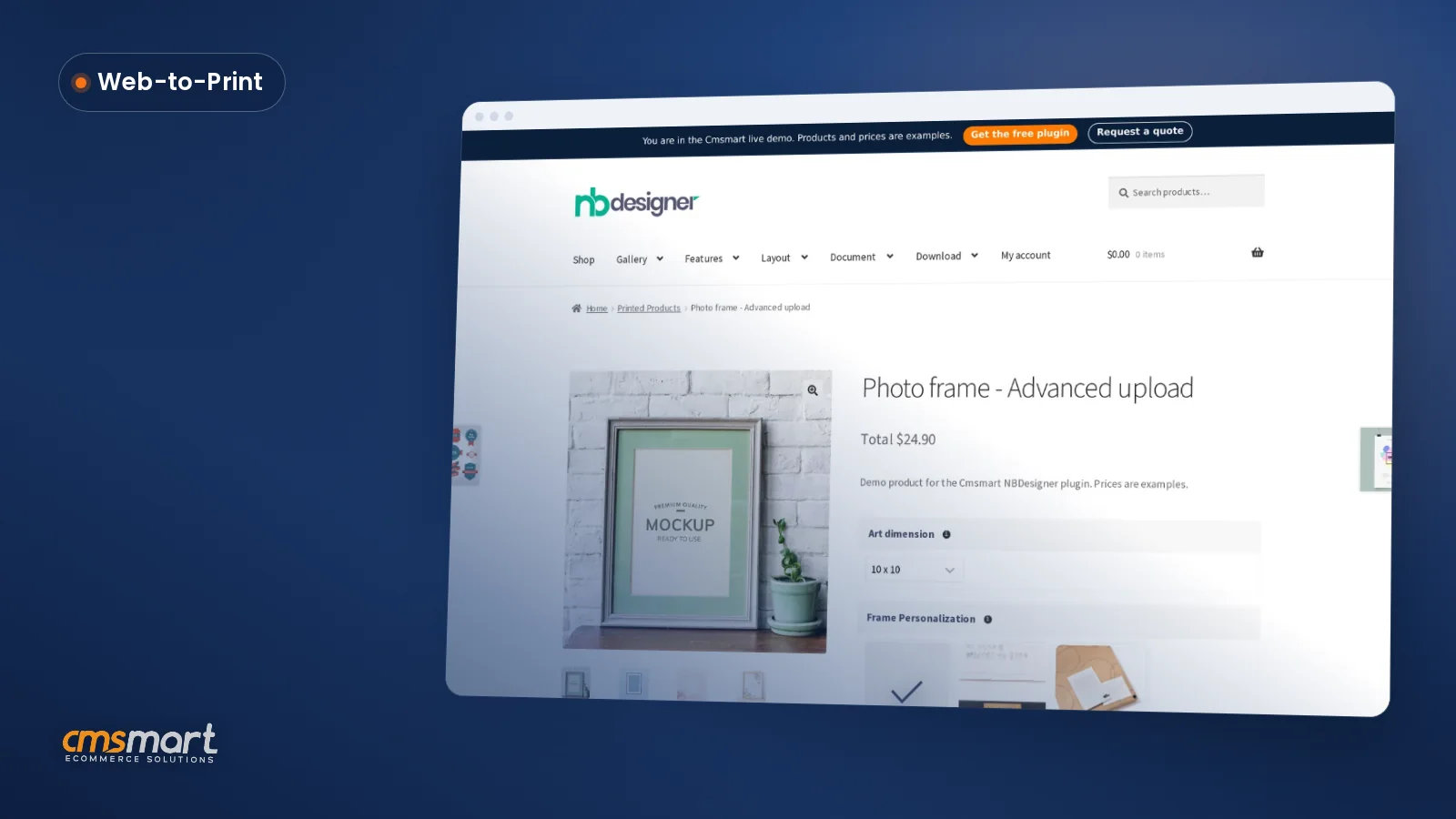
Cmsmart Product Designer (NBDesigner) puts the design area, templates, pricing and print-ready output on your existing WooCommerce product page, so restaurant menu printing online runs through the same storefront a customer already checks out on.
The building blocks, as captured on the live demo menu product, all run on Cmsmart Product Designer (NBDesigner):
What is in the plugin today versus what Cmsmart builds as custom development:
Multi-panel trifold templates with fold guides are not in the box on every demo product yet — Cmsmart builds the specific template set your menu range needs as custom development.
Can AI catch a bad menu file before it prints?
Cmsmart's AI Preflight checks a menu design's resolution before it goes to production, so a blurry logo or a low-resolution photo gets flagged in the admin order screen instead of discovered after 200 laminated menus are printed.
AI Preflight runs from the order screen in wp-admin and reports on the artwork already attached to that order — a quality check, not an automatic rewrite. For background removal, upscaling and the rest of Cmsmart's AI toolset, see Cmsmart AI for ecommerce.
How do you price custom restaurant menus?
Cmsmart's Printing Options module lets you price a menu by panel count, paper stock or lamination with a price matrix, so the number on the product page already matches what the order will actually cost to produce.
Pricing drivers for a menu range: panel count, paper weight, lamination, and quantity breaks for a multi-location reorder. See Cmsmart's pricing engine development and the Printing Options and quotes page.
ROI worksheet: (menu reorders per month × minutes saved per reorder × your hourly staff cost) + (reprints avoided per month × your cost per wasted laminate sheet) — plug in your own numbers to see what a self-service reorder flow is worth to your business.
What's the business value of selling menus online?
Cmsmart turns a manual, email-driven menu order into a self-service flow, which shows up as fewer staff hours per order, a lower reprint rate, and orders your team can accept outside business hours.
How do you set up menu printing in Cmsmart Product Designer?
Setting up a restaurant menu store means turning the designer on for your menu product, matching its design area to your print specs, and testing the full buyer flow before you take a real order. Cmsmart Product Designer handles every step inside WooCommerce.
Try the live demo first: the Menu product on nbdesigner.cmsmart.net.
What can Cmsmart build beyond the plugin for your menu program?
Cmsmart builds the parts a menu program needs that go past a single product's designer settings — multi-location template rollout, POS or kitchen-system sync, and approval workflows — as custom development on top of Cmsmart Product Designer.
Delivery runs through Cmsmart's standard model: discovery, a written proposal, milestone builds, QA and launch. See how Cmsmart runs ecommerce projects, or talk to an ecommerce expert first.
Plan my menu ordering store
Why work with Cmsmart for your menu storefront?
Cmsmart has run WooCommerce and web-to-print projects since 2012 as a Netbase JSC division, with 6,300+ client projects and a 4.2 rating on Trustpilot — the same team that builds your product designer also builds the custom pieces around it.
The same company that builds Cmsmart Product Designer (NBDesigner) takes on the custom menu-program work above. See Cmsmart's web-to-print solutions, or read how other print businesses automated their order-to-print flow in Web to Print API Integration for Print Shops.
Frequently asked questions
Can a customer reorder the same menu after a price change?
Yes. A saved design sits in My designs with an Order again action that puts it straight back in the cart, so only the changed field needs editing.
Do I need separate print files for a trifold menu?
A trifold menu is set up as a multi-side product, with one design area per panel, so Create PDF produces the file geometry your printer expects.
What paper or lamination should I offer?
That depends on your printer's stock list; see the spec table above for typical weights and finishes, and match your designer's bleed setting to what your printer requires.
Can AI catch a blurry logo before 200 menus print?
Within limits, yes: AI Preflight checks the resolution of the artwork attached to an order, so a low-resolution logo gets flagged before the print-ready PDF goes to the press.
Can Cmsmart connect menu reorders to our POS or kitchen system?
Cmsmart builds that connection as custom development — a POS price change can flag the matching menu design instead of relying on staff to remember every location.
How long does it take to launch a menu ordering store?
It depends on your template count and pricing rules; see how Cmsmart runs ecommerce projects for the delivery process, or how to configure print pricing options on NBDesigner for the pricing side.