

Guide · Web-to-print
Cmsmart Stores Setup Wizard: What's New, October 2026
The Cmsmart Stores Setup wizard installs niche, B2B and Marketplace stores with sample data live in minutes. See what changed and try it free.
Running a custom embroidered hats online store means proving, before checkout, that a buyer's logo will survive being stitched onto a curved cap panel — not just emailing files back and forth and hoping. Cmsmart Product Designer inside WooCommerce does that proving, pricing and file hand-off for you, from logo upload to a production-ready embroidery file.
Was this tutorial helpful?
Written by
Cmsmart Print-on-Demand & Apparel Specialist
Helps T-shirt, apparel and print-on-demand brands sell personalised products online.
The team behind it
 Account Manager
 Project Manager
 Business Analyst
 Developers & QA
Guide · Web-to-print
The Cmsmart Stores Setup wizard installs niche, B2B and Marketplace stores with sample data live in minutes. See what changed and try it free.
Guide · Web-to-print
The NBDesigner plugin now gives stationery shoppers a curated background library so print-ready PDFs always match the preview. See how to set it up.
Guide · Web-to-print
See how t-shirt artwork approval and print-ready PDFs cut POD reprints on WooCommerce; get a free workflow review from Cmsmart today.

Cmsmart Ecommerce provides custom ecommerce and WooCommerce development services for web-to-print, product personalization, plugin support and API integration.
Cmsmart Print-on-Demand & Apparel Specialist
Helps T-shirt, apparel and print-on-demand brands sell personalised products online.
Meet the team →

In short
What's the Real Cost of Running a Custom Embroidered Hats Online Store the Manual Way?
Cmsmart Product Designer replaces the email-and-spreadsheet hat order with a browser flow: a buyer places a logo inside a bleed-safe embroidery area, watches the price update live, and your team gets a checked, print-ready file instead of a loose photo attachment.
Hat orders are small-ticket and detail-heavy, which punishes a manual process:
Put your own numbers on it: (minutes per manual quote × hat orders a month ÷ 60) × your loaded hourly rate, plus (reprint rate × cost per reprint). A shop quoting 40 orders a month at 15 minutes each loses roughly 10 staff hours before a single cap reaches the embroidery machine — before counting a single reprint.
Cmsmart insight: the most common hat-order mistake we see in client projects is sizing the logo to the flat mockup image instead of the embroidery area. A design that looks centered on a photo can run into the seam once it's digitized onto a curved panel. Set the design area's bleed and safe zone to match your digitizer's limits, and that mistake never reaches production.
What Would a Custom Hat Store Look Like With Cmsmart?
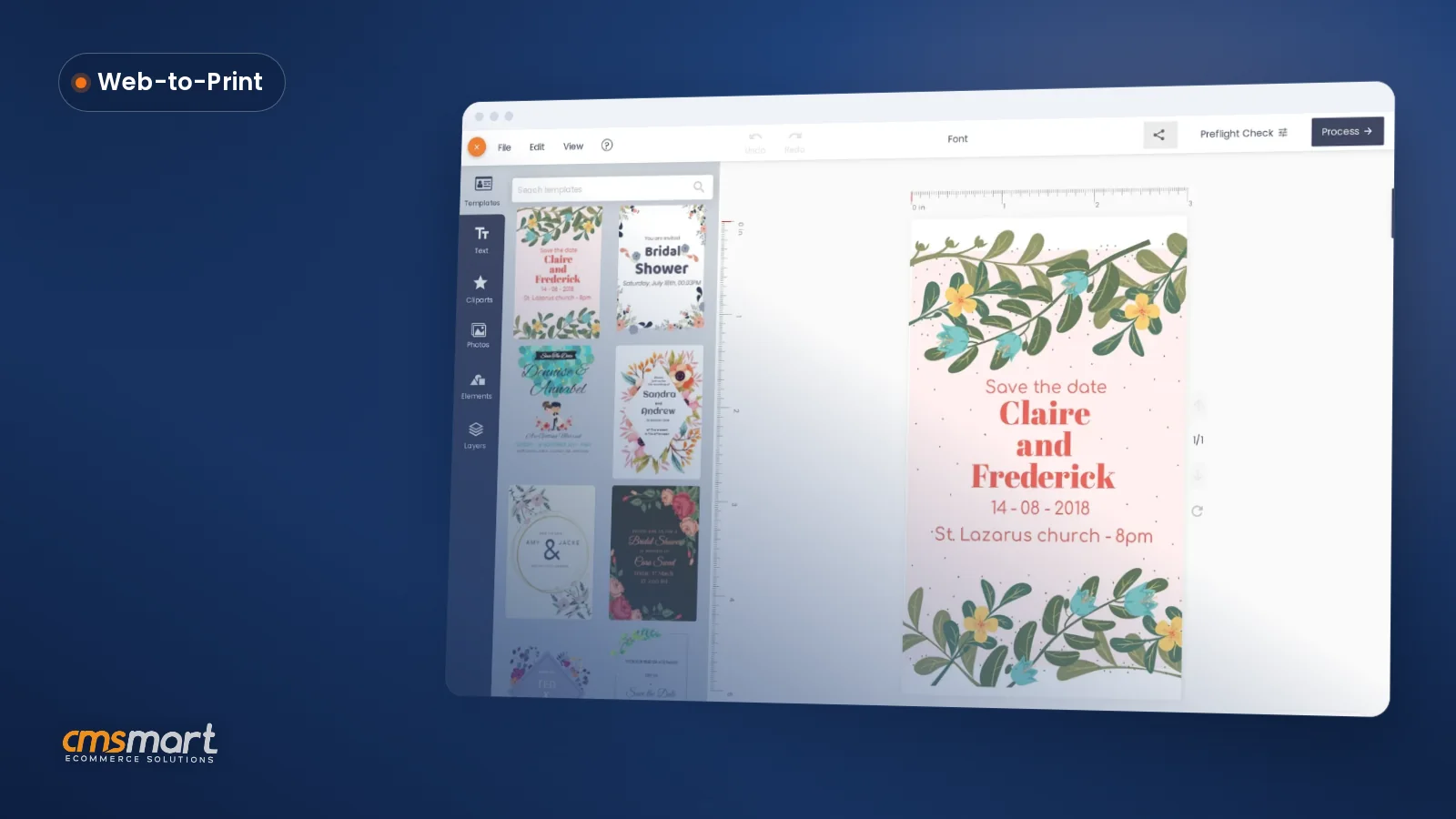
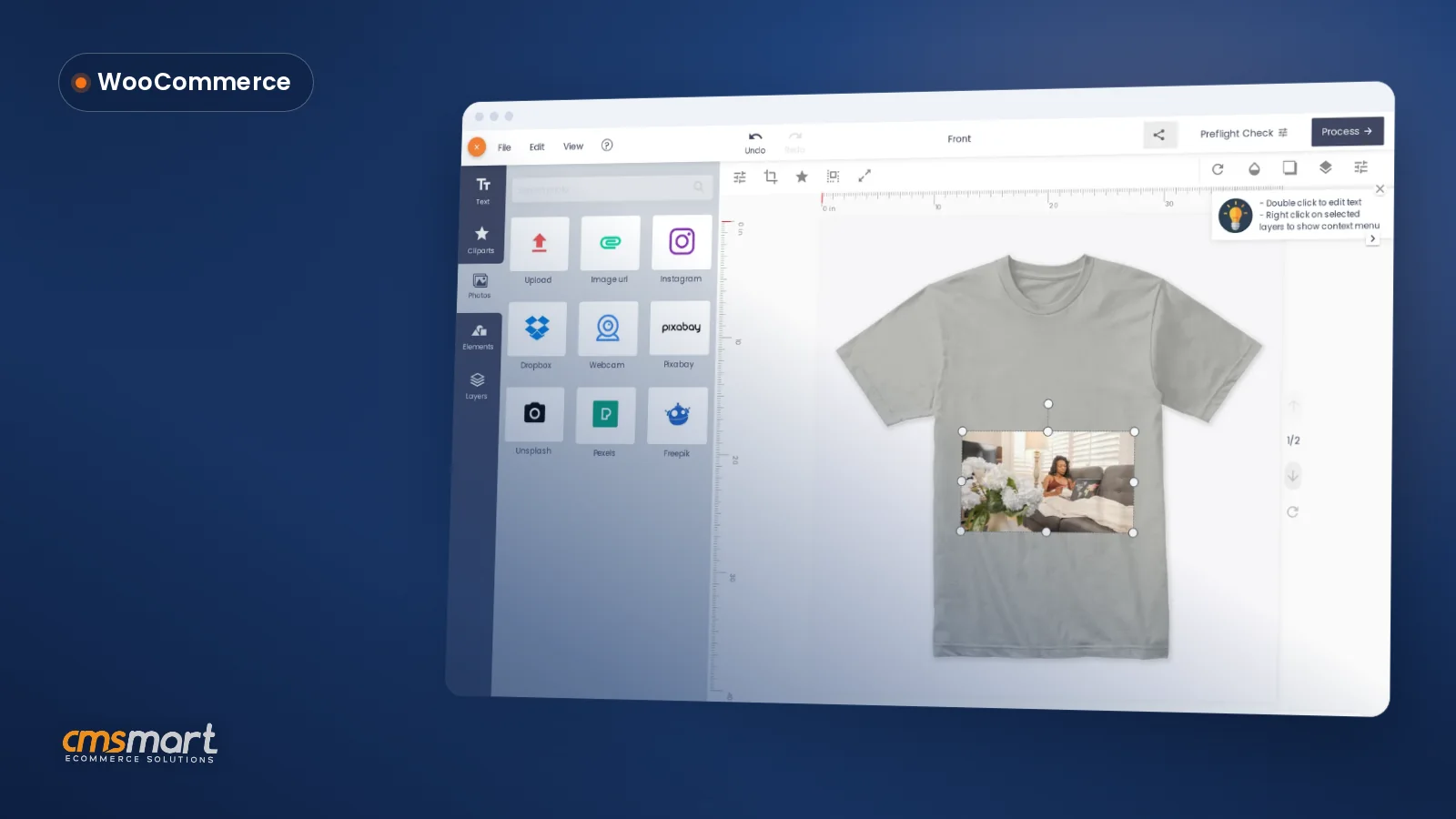
With Cmsmart Product Designer, a shopper builds a cap entirely on your WooCommerce store: picks the blank, drops a logo or monogram inside a guided embroidery area, watches the price update, and checks out — while your team receives a print-ready file instead of a design to track down.
Example scenario. A youth sports league's team parent opens your store at 9pm, the night before uniform orders close. She uploads the club crest; the designer centers it inside the front-panel embroidery area and the artwork passes the upload check. She picks 24 caps in two colorways, the price updates with the quantity break, and she pays. By morning, production has one checked, print-ready file for the whole order — no screenshot, no follow-up email.
How Does Cmsmart Turn a Cap Order Into a Print-Ready Embroidery File?
Cmsmart Product Designer runs the whole flow inside WooCommerce — a guided design area with an embroidery-safe bleed, a canvas for logos and text, automatic pricing, and a print-ready file the moment the order is placed — while Cmsmart's team builds the pieces that sit outside the plugin, like stitch-file digitizing or a team-order portal.
Picture the order as five connected stages, each one a real part of the Cmsmart web-to-print platform:
What's in the plugin today and what Cmsmart builds on top for a hat-specific launch:
Saving over an approved design is refused on the server rather than just hidden behind a button — Cmsmart calls this the approved-artwork lock (2.17): once a hat order's artwork is approved, no later edit, link or open designer tab can overwrite it without the order being flagged as changed and a new print file queued. The matching print-ready PDF that matches the order (2.17) means the automatic export a buyer triggers at checkout uses the same page geometry as the file an admin creates by hand, including custom sizes — one file, not two versions to reconcile.
What still needs a human, not a toggle: the demo cap has no embroidery templates loaded yet, and the plugin exports a print-ready PDF, not a digitized stitch file — your digitizer, or Cmsmart's custom development team, turns that into a machine-ready file.
What's the Business Value and ROI of Selling Hats Online?
Selling embroidered hats through Cmsmart Product Designer turns a slow, email-based quote into a priced, self-serve order — so your team spends its time digitizing and stitching instead of chasing logo files, and a team or corporate buyer can reorder in minutes.
ROI worksheet (your numbers, not ours): orders a month × minutes saved per quote ÷ 60 × your loaded hourly rate = staff hours reclaimed. Reprint rate avoided × your cost per reprint = margin protected. Cmsmart's role is to shrink the inputs — minutes per quote, reprint rate — not to promise a percentage.
Headwear is a resilient line to build on: a branded cap averages more than 3,400 impressions over its working life and roughly two-thirds of US consumers already own one (PPAI, accessed 2026-10-07) — exactly the repeat team and corporate order Cmsmart Product Designer is built to take online. The wider US promotional-products channel reached $27.1 billion in sales in 2025, with 26.3% sold online (PPAI 2025 Sales Volume Estimate, accessed 2026-10-07) — a shift a self-serve hat storefront is built to capture.
Get my hat store quoted
How Do You Set Up a Custom Embroidered Hat Product in Cmsmart Product Designer?
Setting up embroidered hats in Cmsmart Product Designer means configuring one WooCommerce product with an embroidery-safe design area, turning on the upload and online-design entry points, and connecting pricing — all inside the plugin, with Cmsmart on hand to configure it for you.
Cmsmart insight: configure the design area in millimetres or inches that match your digitizer's own template, not the mockup photo's pixel size. The designer's bleed and safe-zone lines are only as useful as the numbers you put behind them.
What Can Cmsmart Build Beyond the Standard Hat Designer?
Cmsmart Product Designer covers the storefront, the embroidery-safe design area and the print-ready file; Cmsmart's custom development team builds the production and ordering pieces that are specific to running an embroidery business, from stitch-file digitizing to a company ordering portal.
Every custom build follows the same delivery path: discovery, solution design, build sprints, QA and launch, with support after — the same process behind Cmsmart's delivered ecommerce projects. A hat-only launch usually starts from Cmsmart's store setup service, with the custom pieces above added as your embroidery workflow needs them.
Plan my custom hat store
Why Work With Cmsmart on Your Hat Store?
Cmsmart has built ecommerce and web-to-print stores since 2012 as a Netbase JSC division, with Cmsmart Product Designer as its own web-to-print plugin — so a hat shop gets both the storefront software and the team that configures and extends it.
Cmsmart has delivered on 6,300+ client projects since 2012, with 1,800+ stores live today across 80+ countries, and is rated 4.2 out of 5 on Trustpilot from 404 reviews. One recent review from a long-time plugin user:
See how Cmsmart scopes and runs a build on the ecommerce projects page, configure the plugin itself from the Cmsmart Product Designer product page, or try the live cap product on the nbdesigner.cmsmart.net demo. Selling other personalized apparel too? The same designer runs a custom t-shirt store and a custom mug printing business.
Frequently Asked Questions
How long does it take to launch a custom embroidered hat store?
A hat-only launch follows Cmsmart's standard delivery path — discovery, solution design, build sprints, QA and launch — rather than a fixed number of weeks; the real driver is your blanks, templates and whether you need a digitizing hand-off built in. Turning on Cmsmart Product Designer on one hat product is the fastest way to start.
Can Cmsmart turn a customer's logo into an embroidery stitch file?
Cmsmart Product Designer's job is the storefront, the embroidery-safe design area and the print-ready file per order; turning that file into a digitized stitch file is production work Cmsmart builds for you as custom development, often alongside a stitch-count-based pricing rule.
What size should a customer's logo be for a cap?
Published embroidery guides put a front-panel logo at roughly 4-5 inches wide (up to about 2.25 inches tall), side placements at 2-2.5 by 1-1.25 inches, and back placements at 2.25-3 by 0.75-1 inch, with a minimum letter height around 0.25 inches, a minimum line width of 0.05 inches, a practical stitch-count ceiling near 15,000 stitches, and up to about six thread colors per design (Printful, accessed 2026-10-07). Set Cmsmart Product Designer's design area and safe zone to match your own digitizer's limits.
Can buyers order hats in bulk for a team or company?
Size, color and quantity-break pricing can be configured in Cmsmart Product Designer's printing options today. A reorder flow, a company account with one invoice, or a roster upload for name and number personalization is the kind of B2B ordering portal Cmsmart builds as custom development.
Does Cmsmart Product Designer create the print-ready file automatically?
Yes. The plugin queues a print-ready PDF automatically when the buyer processes their design, and since 2.17 that automatic render matches the file Create PDF produces even for custom sizes, so there's no second, hand-made version to reconcile.
Can AI clean up a blurry or low-resolution logo before embroidery?
Cmsmart Product Designer's AI tools include a Background Remover, with buyer-facing AI switchable for everyone, members only, or customers who've already ordered. A digitizer still needs a clean vector file, so Cmsmart typically pairs the AI cleanup with a manual digitizing check as custom development.