

Guide · Web-to-print
Product Customization Tool for WooCommerce Stores
See how a product customization tool for WooCommerce lets shoppers edit designs live and ships a print-ready file. Get a quote today.
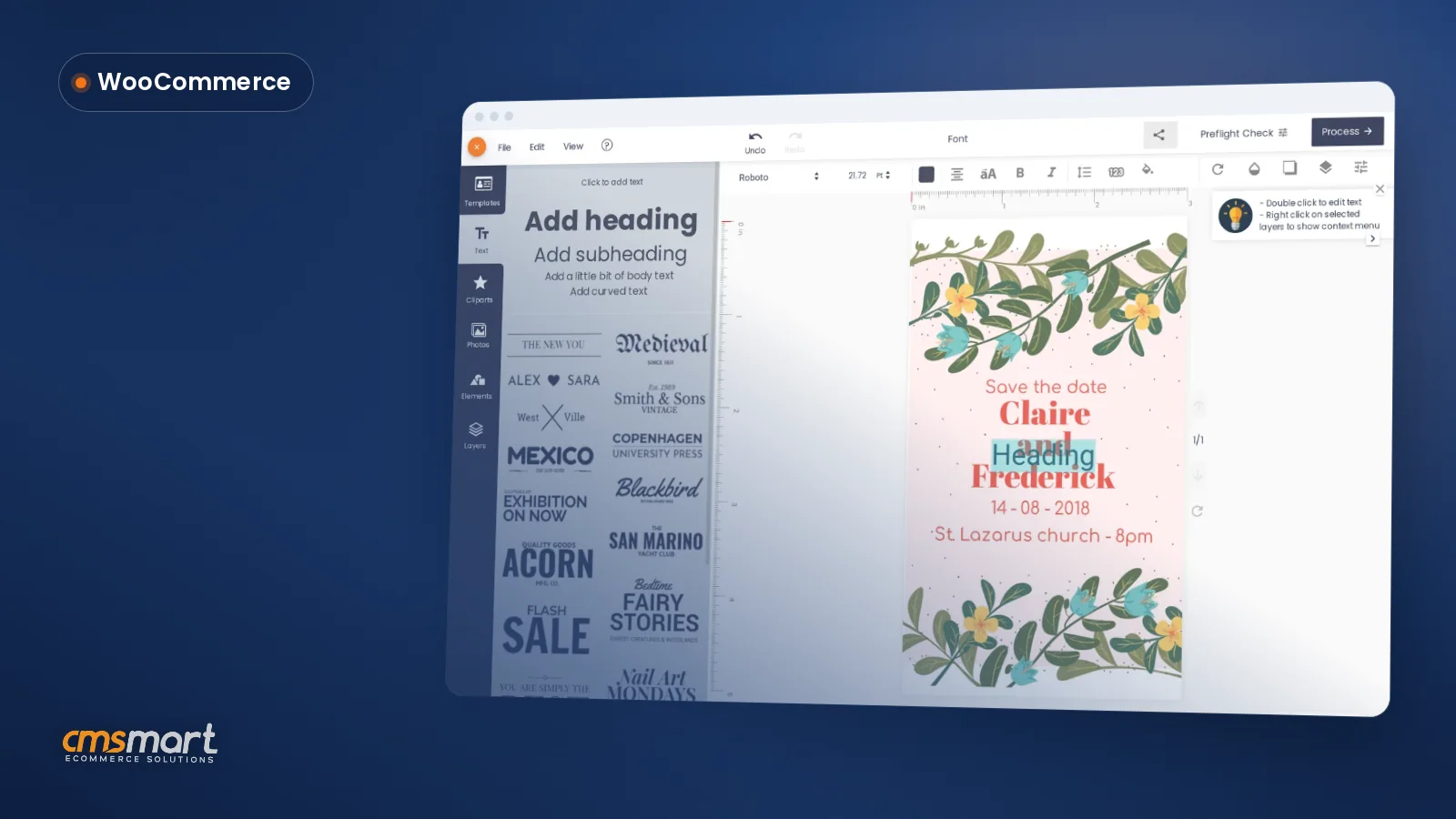
Stationery and invitation sellers lose orders when a font looks perfect on a buyer's screen and wrong on the printed card. Cmsmart's online designer gives your WooCommerce store custom font options for WooCommerce product designer buyers: curated pairings, a manual override in the canvas toolbar, and a print-ready PDF that locks in exactly what the shopper approved, order after order.
Was this tutorial helpful?
Written by
Cmsmart Product Designer Plugin Engineer
Builds and supports the Cmsmart Product Designer (NBDesigner) for WooCommerce.
The team behind it
 Account Manager
 Project Manager
 Business Analyst
 Developers & QA
Guide · Web-to-print
See how a product customization tool for WooCommerce lets shoppers edit designs live and ships a print-ready file. Get a quote today.
Guide · Web-to-print
Automate print-ready file export for every custom WooCommerce order: certified PDFs plus SVG, PNG and CMYK files your press can use today.
Guide · Web-to-print
See custom invitation design software for WooCommerce: live proofing, approval and automatic print-ready PDFs, built by Cmsmart.
Browse more guides, tutorials and case studies from the Cmsmart community.
Run a custom tote bag printing business with Cmsmart Product Designer: live pricing, real print specs and a print-ready PDF. See how to set it up.
Read MoreBuild a car wrap ecommerce store on WooCommerce: panel pricing, approval and print-ready PDFs before you print. Plan your wrap store today.
Read MoreDiscover how the home décor industry is transforming with the rise of personalized products and the challenges retailers face. Learn how CMSmart's Product Builder offers a solution, improving customer engagement, reducing return rates, and increasing sales through real-time 3D previews and automated processes.
Read More
Cmsmart Ecommerce provides custom ecommerce and WooCommerce development services for web-to-print, product personalization, plugin support and API integration.
Cmsmart Product Designer Plugin Engineer
Builds and supports the Cmsmart Product Designer (NBDesigner) for WooCommerce.
Meet the team →


In short
Why Does Font Chaos Cost Your Stationery Store Sales?
Cmsmart Product Designer removes the font guesswork that causes reprints and abandoned carts: buyers see the real typeface on the real layout before they pay, instead of a generic text box that only you can picture becoming a finished invitation.
Run a personalized stationery or card business long enough and the same five problems keep showing up:
What Would a Perfectly On-Brand Invitation Order Look Like?
Picture a buyer opening your Invitation product, picking a template, and seeing their own names set in the exact script and serif pairing your store curated — with Cmsmart Product Designer, that preview is also what prints, with nothing lost between the browser and the press.
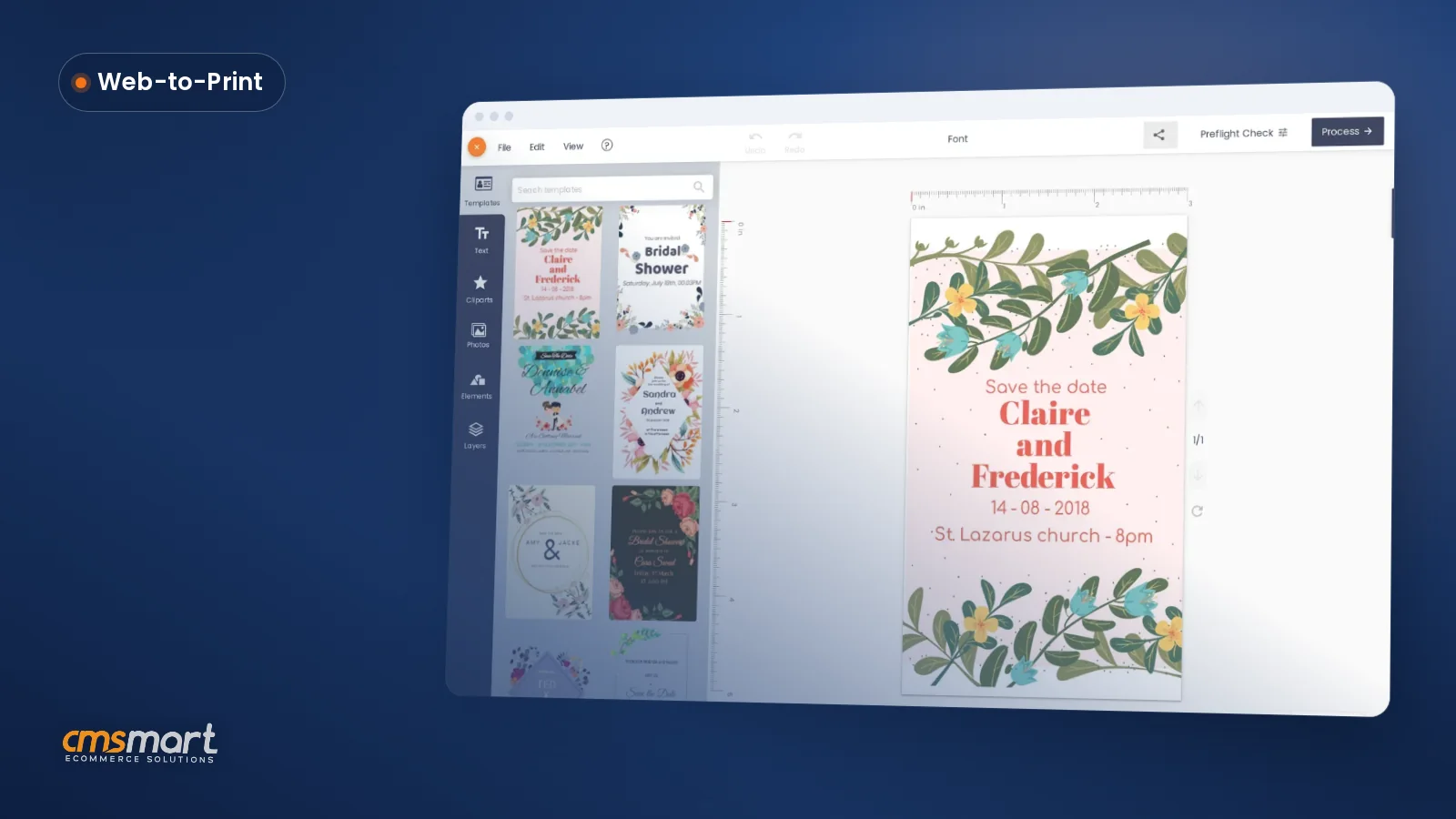
A couple opens your store at 10pm, two weeks before they need to mail their save-the-dates. They pick a floral template, and their names drop into the heading font your team paired with that design. They nudge the size, swap to a second curated typeface to see which reads better, and check out — no email proof, no late-night message asking for a bigger font. The design they approved on screen becomes a print-ready PDF for your production queue the next morning.
Example scenario. A boutique stationery shop sets up three curated template families — modern script, classic serif, minimalist sans — each pre-loaded with two on-brand fonts for heading and body text. A buyer only ever sees fonts that already work together, so every order that reaches production looks like it came from the same studio, even though hundreds of different buyers designed it.
How Does Cmsmart Deliver Custom Font Options for WooCommerce Product Designer Customers?
Cmsmart Product Designer combines a curated template-and-font library, a manual font toolbar for fine control, an approved-artwork lock, and Cmsmart Cloud rendering, so the typeface a buyer picks is the typeface that reaches the press — no separate design software required.
Four building blocks carry a font from a buyer's click to a finished print file, and it's worth being clear about which ones are in the plugin today and which are store-specific work Cmsmart builds on top:
Cmsmart insight: most font-related reprints we see in delivery work trace back to a script or display font that read fine at preview size but turned illegible once stroke width hit the page — check legibility at the printed point size, not the on-screen one, before you approve.
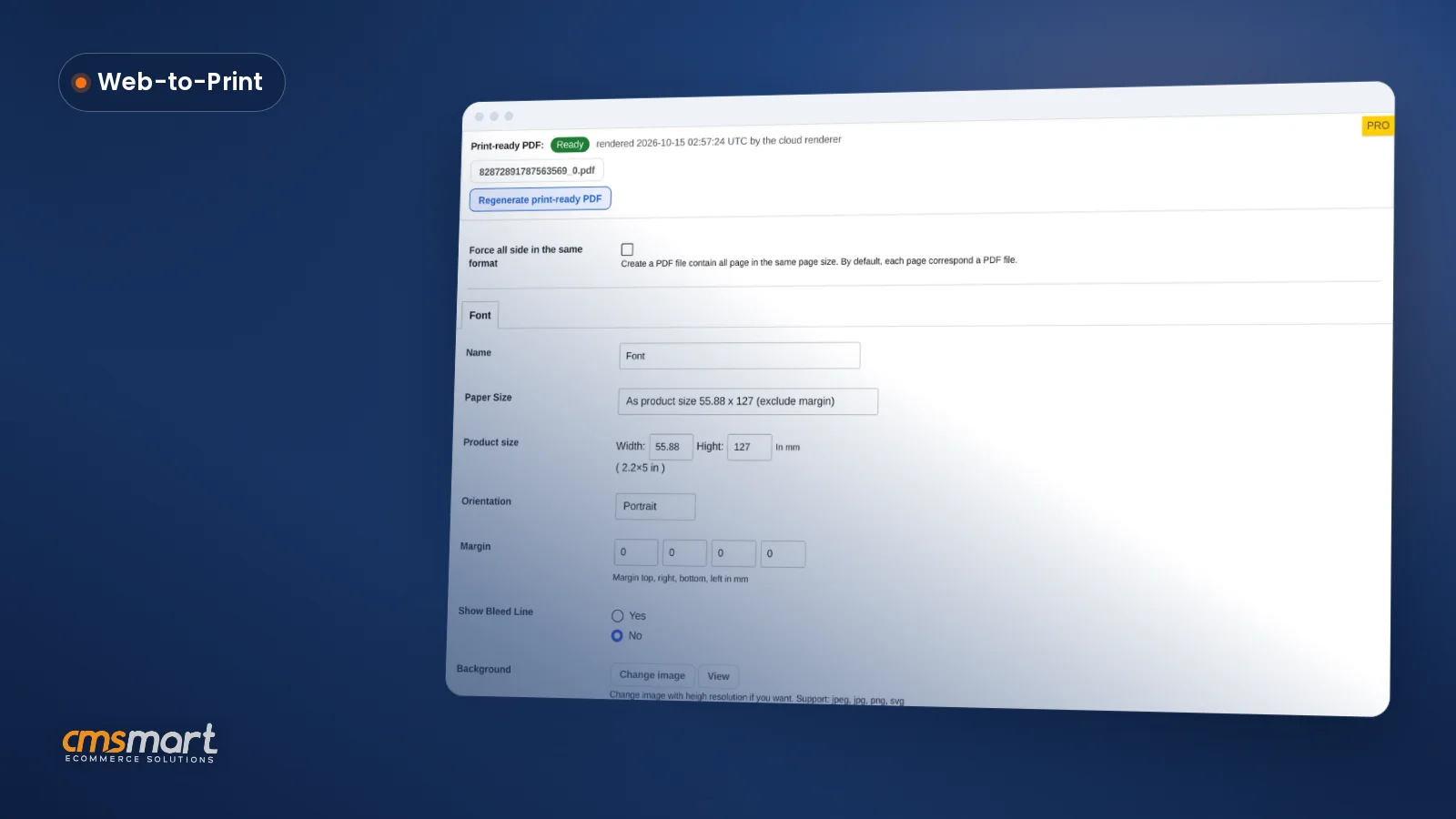
On the production side, the AI Preflight Quality Checker in Cmsmart Cloud scans every saved design for resolution, color mode, bleed and fonts, and flags anything that would cause a print problem; an admin reviews and resolves each flagged issue from the Cmsmart Cloud dashboard before the file goes to the press. Font embedding matters here because the PDF/X family of print standards requires every font to be embedded in a print-ready file, which is exactly what the Create PDF step produces.
What's the Business Value and ROI of Getting Fonts Right the First Time?
Cmsmart Product Designer turns font approval from a back-and-forth email thread into a one-time setup: fewer proof rounds, fewer reprints from substituted fonts, and a storefront that looks like one coherent brand instead of a hundred different ones.
Font-proofing ROI worksheet.
The underlying demand is real: personalized gifts are a market valued at USD 29.85 billion in 2024, and couples spend an average of $518 on their wedding paper suite (2025) — money that goes to whichever stationer gets the look right first. WooCommerce itself was tracked at 33.4% of ecommerce sites as of August 2025.
How Do You Set Up Custom Fonts in Your WooCommerce Product Designer?
Setting up curated fonts in Cmsmart Product Designer takes one afternoon: confirm your version, load fonts into the Media library, pair them with a template, and walk one test order through approval and print-ready PDF generation.
Here's how to configure and test it end to end on a stationery product:
What Custom Typography Tools Can Cmsmart Build for Your Store?
Beyond the curated, store-wide font library in Cmsmart Product Designer, Cmsmart builds store-specific typography tools as custom development — from per-product font locking to licensed webfont onboarding — so your stationery brand's rules are enforced automatically, not by hoping buyers pick well.
The Cmsmart Fonts library is store-wide by design, which is right for most shops. Businesses with stricter brand rules usually ask us for one of these next:
Projects like these run the same way as any other Cmsmart engagement: discovery call, solution design, build in sprints, QA against your real catalog, launch, and ongoing support — the same delivery model behind our published ecommerce projects and our product designer customization service.
Plan my on-brand font setup
Why Work With Cmsmart on Your Product Designer?
Cmsmart has built web-to-print and product-customization stores since 2012, backs the Cmsmart Product Designer (NBDesigner) plugin behind this tutorial, and keeps a published record of client work and reviews so you can check our track record before you commit.
Cmsmart has been building ecommerce and web-to-print solutions as a Netbase JSC division since 2012, across 6,300+ client projects, with a 4.2 rating from 404 Trustpilot reviews. One buyer of the designer, writing about using it for personalized cards, put it simply:
Cmsmart insight: "The tool has so many options. We are very happy with it... We would recommend the NB Designer tool for printing personalized cards." — M. Idema, Trustpilot review.
Browse related delivery work on cmsmart.net/projects, or see the plugin itself on the Cmsmart Product Designer page before you commit to any custom work.
Frequently Asked Questions About Fonts in Your WooCommerce Product Designer
Will my buyer's chosen font show correctly in the printed PDF?
Yes, for fonts in your Cmsmart font library: the online designer saves the exact font with the design, and the print-ready PDF that matches the order is rendered by Cmsmart Cloud from that same saved file, with the font embedded as PDF/X-style print standards require.
Can I let customers upload their own fonts?
The Cmsmart Fonts library is built for your team to curate, not for shopper uploads. When a brand wants that, Cmsmart builds the upload-and-validate flow as custom development, including a check that the font survives into the print-ready PDF.
Do I need design skill to curate a font library?
No. Media → Fonts is a straightforward admin screen, and most stores only need a handful of on-brand fonts paired into a few templates.
Can I restrict which fonts show on a specific product?
Out of the box, the Fonts library is store-wide. If a collection must stay locked to brand-approved typefaces only, Cmsmart builds that per-product font locking as custom development.
What happens if preflight finds a font problem?
The Preflight Quality Checker flags the saved design, and an admin resolves it from the Cmsmart Cloud dashboard before the print-ready PDF goes out, so the catch happens before the press run, not after.
How long does a custom typography project take?
It depends on scope, but most engagements follow the discovery, solution design, sprint build, QA and launch cycle described in our ecommerce projects delivery model; per-product font locking is usually one of the smaller asks on that scale.
Looking for the broader personalization story instead of the font details? See how Cmsmart approaches custom text generally in Sell Personalized Products with Custom Text, or learn how to build the templates these fonts attach to in How to Create a Template with Cmsmart Product Designer. For the wider web-to-print picture, start at the web-to-print hub.